
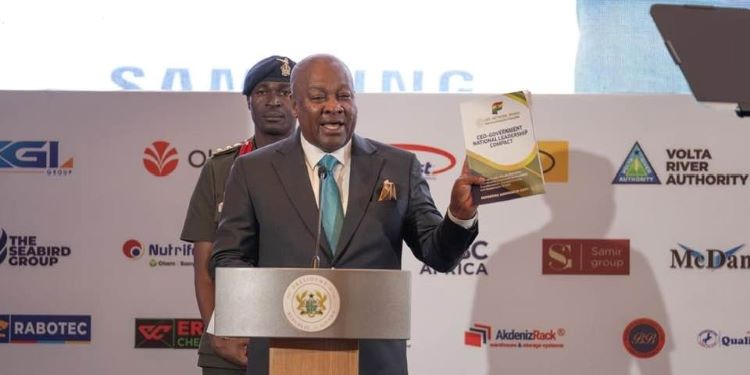
President John Dramani Mahama has officially launched the CEO Government Compact 2026 at the landmark 10th anniversary of the Ghana CEO Summit, formally handing the operational document over to the Minister of Trade, Agribusiness and Industry, Hon. Elizabeth Ofosu-Adjare.
The execution of this framework introduces a structured architecture to govern relations between the state and the private sector, moving beyond passive institutional dialogues to a binding high-level partnership agreement aimed at driving measurable outcomes in national productivity, industrial expansion, and market competitiveness over the next operational cycle.
According to President Mahama, the formalization of the compact marks a deliberate shift away from the legacy format of public-private engagements, frequently minimized to administrative speeches, annual conferences, and ceremonial events. The compact establishes an active tracking system for translating policy declarations into verifiable industrial metrics.
“At the ninth summit last year, I asked that engagement between government and business should move beyond annual conversations to a more structured framework for follow-up accountability and to be able to achieve measurable results.
“I’m therefore pleased that this recommendation has now evolved into the CEO Government Compact 2026. This is significant because the relationship between the government and the private sector must not be reduced to just speeches, conferences, and ceremonial engagements”
President John Dramani Mahama
The Ministry of Trade, Agribusiness and Industry (MoTAI) will act as the primary custodian of the document, coordinating cross-sectoral compliance frameworks to ensure that both regulatory organs and private enterprises adhere strictly to their respective operational pledges.

President Mahama noted that the evolution of that original administrative directive into the finalized 2026 compact provides the state with an instrument to stabilize the domestic business environment. Rather than allowing policy directions to fluctuate between economic quarters, the compact binds public and private leaders to an agreed roadmap.
This institutional arrangement is intended to secure long-term policy consistency, allowing corporate entities to deploy capital with greater regulatory predictability while giving the state a clear mechanism to monitor private-sector commitments.
He revealed that the inner architecture of the newly launched compact operates as a specialized bilateral framework configured to drive systemic economic transformation.
Structurally, the agreement requires that the ongoing relationship between the state apparatus and the business community remain grounded in four institutional values: “mutual trust, absolute policy consistency, shared national purpose, and reciprocal accountability.”
The compact requires that future summits avoid operating as isolated corporate events. Instead, every administrative interaction under this framework must link back to a clearly defined checklist of next steps, ensuring that general economic dialogue is consistently converted into targeted commitments.
“And so the compact we have received today is intended to serve as a high-level partnership framework between government and the business community, promoting accountability, innovation, competitiveness, and productivity. And so let today’s summit not end as another successful event without measurable follow-ups”
President John Dramani Mahama

Reforms and Metrics
To achieve these milestones, the compact divides operational obligations between the state and the private sector. For the government, the agreement mandates an immediate deepening of administrative and regulatory reforms designed to optimize the ease of doing business across the country’s manufacturing zones.
Public institutions are required to streamline the bureaucratic channels governing primary production, industrial processing, domestic trade logistics, and international export channels, thereby lowering overhead costs for formal local enterprises.
Conversely, the compact imposes strict performance requirements on the private sector. Corporate leaders and captains of industry are required to respond to state regulatory concessions by expanding direct capital investments into domestic processing hubs, upgrading technological innovation models, and increasing labor productivity.
Furthermore, businesses must commit to enforcing rigorous product standards across their supply chains and generating decent, sustainable employment opportunities within the local market.
“The next steps must be structured. It must move us from general dialogue to concrete commitments, and from those commitments to measurable outcomes reflected in investment, exports, industrial growth, and jobs”
President John Dramani Mahama
The launch of the compact during the 10th anniversary of the summit marks the beginning of a long-term economic planning cycle, as President Mahama noted that several corporate leaders have already begun scaling up their capital deployments within the domestic private sector, providing an initial baseline for the compact’s enforcement phase.
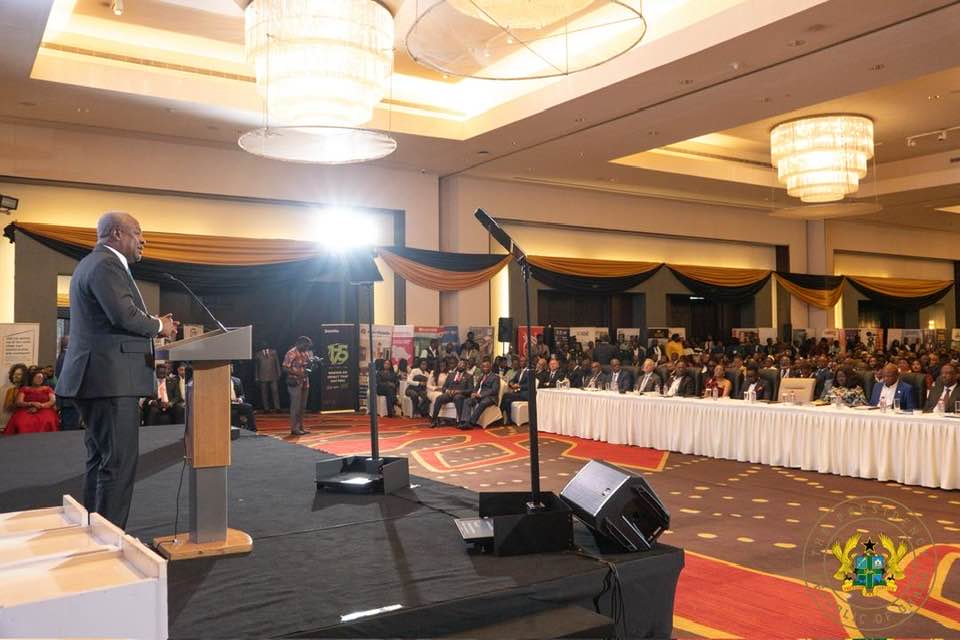
The next decade of public-private cooperation will be evaluated entirely on how effectively these combined investments translate into higher export volumes and sustained industrial output.
As MoTAI begins setting up the tracking frameworks required by the CEO Government Compact 2026, both state administrators and corporate executives face expanded structural responsibilities, with the success of the compact relying on the continuous execution of regulatory reforms and the transparent tracking of private sector production outputs.
READ MORE: US Judge Declines to Block Trump Mail-In Voting Order