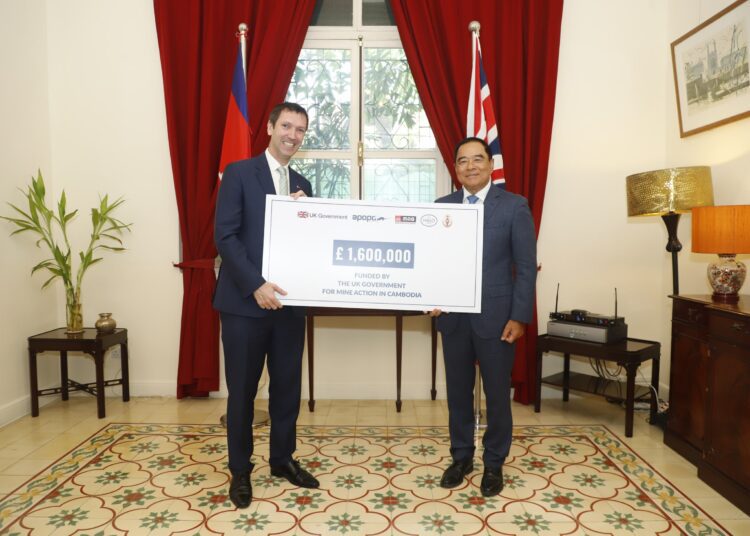
United Kingdom has renewed its long-standing commitment to mine action in Cambodia, extending decades of support aimed at clearing explosive remnants of war and restoring safe access to land for rural communities.
The latest funding package, worth £1.6 million, will support mine clearance operations and risk education programmes over the next year, as part of a broader partnership that has seen an estimated total UK contribution of £65 million over more than three decades.
According to the government, the continued investment is intended to strengthen community safety, improve livelihoods, and support long-term recovery in areas still affected by land contamination.
British Ambassador to Cambodia, Dominic Williams, stated, “UK and Cambodia share a strong and broad partnership, spanning security, development and shared prosperity.”
“As part of this, the UK has prioritised support for demining for over 30 years, in partnership with the Cambodian Mine Action Authority (CMAA), precisely because we believe no community should continue to live in fear of landmines.
“The scale of the challenge in Cambodia is significant, and continued investment in mine action remains essential to secure safe land, economic recovery and lasting confidence.”
Dominic Williams
Dominic Williams further indicated that, in renewing the funding,” we commend Cambodia’s sustained commitment and the brave work of Cambodian deminers in the field,” adding, “We hope our efforts will support the safe return of displaced people and strengthen protection for border communities at a time of heightened tension.”
The programme will be delivered through established humanitarian organisations, including HALO Trust, Mines Advisory Group, and APOPO, working alongside Cambodian partners and national authorities. The focus remains on clearing land contaminated by landmines, cluster munitions and other unexploded ordnance, enabling communities to safely return and resume agricultural activity.
Moreover, the UK-backed programme also includes structured livelihood support through local organisations Mlup Baitong and the Cambodian Institute for Research and Rural Development (CIRD), which will help families transition cleared land into productive use.
Between 2026 and 2027, HALO Trust and Mines Advisory Group are expected to clear more than 890,000 square metres of land across seven provinces, including Battambang, Siem Reap, Oddar Meanchey, Banteay Meanchey, Pailin, Pursat, and Koh Kong. The work is projected to directly benefit over 5,000 people while improving safety and enabling sustainable land use.
In addition, more than 4,000 explosive ordnance risk education sessions will be delivered across affected regions, reaching over 44,000 people, including thousands of women and girls. Authorities say awareness programmes remain essential in preventing accidents in areas where unexploded devices are still being discovered.
A major component of the initiative is the Minefields to Rice Fields project, implemented by APOPO in partnership with CIRD. The programme combines demining with regenerative agriculture, aiming to convert formerly dangerous land into productive farmland while supporting training, seed systems and rural livelihoods.
At least 500 farming households are expected to benefit directly, with additional indirect support reaching hundreds more through community-based agricultural initiatives.
UK Mine Action Support Helps Cambodia Near 2030 Landmine-Free Goal

Cambodia’s mine contamination stems from nearly three decades of armed conflict, beginning with the Cambodian Civil War in 1967 and continuing until 1998, leaving large areas of land still affected by explosive remnants of war.
According to the Mine Action Review, an estimated 524 square kilometres of territory remain contaminated by landmines and other explosive hazards.
The UK-backed initiative, however, is closely aligned with Cambodia’s national objective of meeting its Article 5 obligations under the Anti-Personnel Mine Ban Convention by 31 December 2030. The treaty, which the United Kingdom helped establish as one of its original signatories in 1997, requires states to clear all known mined areas and prevent further harm caused by explosive remnants of war.
Alongside clearance efforts, the programme is designed to support long-term recovery in affected regions by working with Cambodian non-governmental organisations to promote small business development and expand training in modern agricultural techniques. These initiatives are particularly focused on rural communities where former conflict zones are being gradually transformed into productive farmland.
H.E. Dr. Ly Thuch, Senior Minister and First Vice President of the Cambodian Mine Action Authority (CMAA) said, “Still going strong’ is more than a theme. It reflects four decades of unwavering partnership. The United Kingdom stood with Cambodia when we needed it most, and it continues to stand with us today.”
“For 33 years of cooperation have taken us beyond partnership. Today, Cambodia and the United Kingdom are true friends, united by a shared commitment to humanity and dignity.Behind every contribution are lives transformed, a child walking safely to school, a family returning home, a community restored. That is the true measure of mine action.”
H.E. Dr. Ly Thuch
He further indicated that, “Cambodia is now in the final chapter of its mine action journey,” adding, “Our commitment is clear: by 2030, no Cambodian community will live under the threat of explosive remnants of war.”
READ ALSO: Gas Expansion Agreement Shows Importance of Sustained Partnership for Energy Security – GNPC CEO