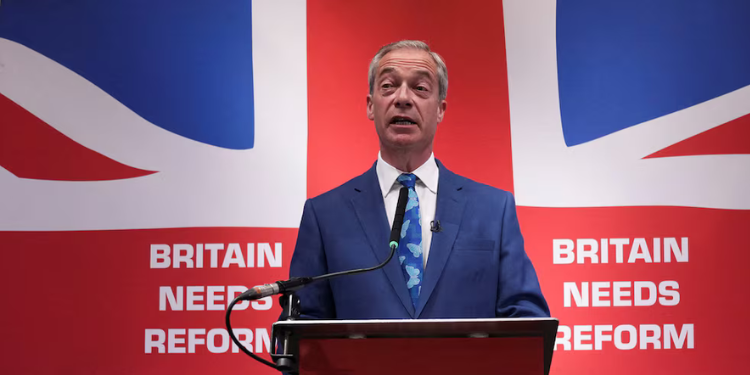
Reform UK has accused the British government of failing in its responsibility to protect senior political figures after revealing that party leader Nigel Farage rejected a government-funded security package he considered inadequate, reigniting concerns over the safety of elected representatives following the alleged murder of former Reform UK figure Ann Widdecombe.
The dispute has intensified political debate over how security is assessed for public officials in the United Kingdom, with Reform arguing that Farage’s taxpayer-funded protection was significantly reduced despite what it describes as increasing threats against prominent politicians.
The controversy comes at a time when counterterrorism police are investigating the circumstances surrounding Widdecombe’s death, prompting renewed scrutiny of whether current arrangements are sufficient to safeguard political leaders.
Following Home Secretary Shabana Mahmood’s promise to examine his security arrangements, Farage is now scheduled to meet with representatives from the Home Office. The discussion is viewed as a chance to assess the degree of security afforded to one of the most well-known and contentious political leaders in Britain, whose public profile has continued to rise since Reform UK’s electoral victories.
After Reform UK revealed that Farage had turned down an official security package last year, claiming that the protection supplied no longer adequately represented the degree of risk he faced, the topic received attention. Party officials have insisted that worries about the proposed arrangements’ insufficiency, rather than resistance to public support, were the basis for the decision.
Robert Jenrick, a Treasury spokesman for Reform UK, stated in an interview that Farage had turned down a security package that was much the same as what was presented to Conservative Party leader Kemi Badenoch.
He argued that authorities had made the wrong decision by reducing Farage’s publicly funded protection shortly after he entered Parliament, describing the move as both surprising and unjustified.
“Frankly I find it astonishing that, just a short period after he was elected to Parliament, the authorities, the government, chose to massively downgrade his security.”
Robert Jenrick
According to Reform UK chairman Zia Yusuf, parliamentary officials reduced Farage’s taxpayer-funded security by around 75% in September last year. The party private donors stepped in to finance additional protection after concluding that the official package no longer matched the risks facing the Reform leader.
Jenrick linked the issue directly to the broader debate about political violence in Britain, arguing that recent events demonstrated the need for authorities to reassess security provisions before tragedies occur rather than afterwards.
“It shouldn’t have taken the death of Ann Widdecombe for Nigel Farage to be given a meeting with the relevant Home Office committee that really is a dereliction of duty, and it’s ultimately the home secretary who makes that decision.”
Robert Jenrick
He also questioned whether political considerations may have influenced security decisions.
An increasingly delicate national dialogue about safeguarding politicians while maintaining free democratic participation has taken on a new dimension as a result of the accusations. Over the past ten years, there have been a number of high-profile attacks on elected officials in Britain, which has raised ongoing worries about striking a balance between personal protection and public accessibility.
The assassinations of Conservative MP Sir David Amess in 2021 and Labour MP Jo Cox in 2016 significantly changed how security risks to politicians are evaluated. Subsequent governments implemented increased security measures in the wake of the assaults, including a £31 million plan announced in 2024 to improve protection for constituency offices and Members of Parliament.
In light of this, Reform contends that lowering Farage’s protection went against the general trend of boosting security for public servants who face legitimate risks.
Questions Mount Over Security for Political Figures
The controversy has also prompted fresh calls for a comprehensive review of how security is allocated to MPs, former parliamentarians and other high-profile political figures.
Former Conservative justice secretary Sir Robert Buckland, who previously led a review into parliamentary security following the killing of Sir David Amess, revealed that he had already urged the government to revisit existing arrangements before the latest developments.
“Prior to Ann’s death I’ve been in correspondence with the home secretary and made it very clear I felt that a second limb of my review was necessary, namely a careful and close look at security arrangements of MPs.”
Robert Buckland
Buckland added that any review should extend beyond cabinet ministers and encompass parliamentarians across the political spectrum who may face elevated risks because of their public profile or political positions.
“Not just senior ministers who get round the clock protection, but MPs on all sides of the House – Nigel Farage, other Labour MPs under threat as well – all of that needs a very careful look.”
Robert Buckland
He warned that the current system appears inconsistent, suggesting some politicians experience different levels of protection despite facing comparable risks.
At the same time, Buckland cautioned that increasing security must not come at the expense of democratic accessibility, arguing that elected representatives should remain connected to the communities they serve.
“I think all of us would agree that if we end up in a default position where MPs and political figures are more remote from those who they serve, then representative democracy, democracy itself takes a blow.”
Robert Buckland
Security arrangements for serving MPs are generally determined by Parliament’s security authorities, while protection for high-profile political figures is considered separately by the Royal and VIP Executive Committee (RAVEC), an independent body comprising officials from the Home Office, Cabinet Office and the Foreign, Commonwealth and Development Office.
Home Secretary Shabana Mahmood has indicated she is prepared to review security guidance for former MPs and other public figures following recent events, although officials have traditionally avoided discussing the details of individual protection arrangements for operational reasons.
Reform UK, however, insists Farage’s case highlights broader shortcomings in the current system.
READ ALSO: Manchester United Announce The Signing of Karl Darlow