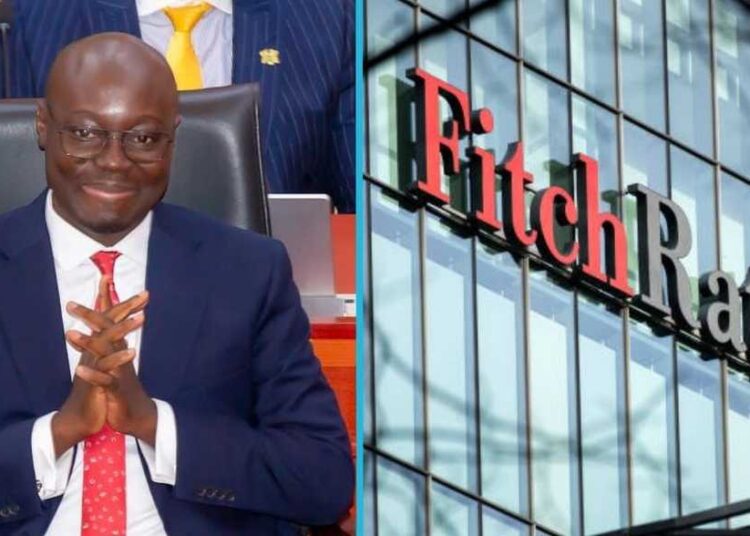
Ghana’s economic recovery story has received a significant vote of confidence after Fitch Ratings upgraded the country’s Long-Term Foreign-Currency Issuer Default Rating from ‘B-’ to ‘B’, while maintaining a Positive Outlook.
The latest rating action signals growing investor confidence in Ghana’s fiscal reforms, debt sustainability efforts, and improving macroeconomic fundamentals.
The upgrade comes at a time when Ghana is emerging from one of the most difficult economic periods in its recent history, marked by debt restructuring, inflationary pressures, and currency instability.
Fitch’s latest assessment suggests that the country has made notable progress in restoring economic stability, strengthening its public finances, and rebuilding confidence in both domestic and international financial markets.
Debt Reduction Strengthens Ghana’s Credit Profile
One of the strongest drivers behind the upgrade is Ghana’s remarkable reduction in public debt relative to Gross Domestic Product. According to Fitch, Ghana’s public debt is expected to decline further to 46 percent of GDP by 2027, placing it below the median forecast of 51 percent for countries in the ‘B’ rating category.
This projection follows a sharp 21 percentage-point decline in debt levels in 2025, supported by the appreciation of the cedi, tighter fiscal discipline, and strong economic growth. The reduction is particularly significant because it demonstrates that Ghana’s debt restructuring measures are beginning to yield measurable results.
Fitch believes the country’s continued ability to maintain primary budget surpluses, combined with lower real interest rates and a more stable macroeconomic environment, will sustain this downward debt trajectory over the medium term.
Rising International Reserves Improve External Stability
Another critical factor influencing Fitch’s decision is the sharp rise in Ghana’s international reserves. The ratings agency expects the country’s reserves to reach 4.8 months of current external payments by 2027, above the ‘B’ category median of 3.9 months.
This follows a strong increase of US$5.4 billion in unencumbered reserves in 2025, which lifted Ghana’s reserves to US$12.3 billion.
Fitch attributed this improvement to robust current account surpluses, foreign direct investment inflows, and steady disbursements from multilateral development partners.
The agency also highlighted Ghana’s efforts to formalise small-scale gold mining as a strategic initiative that could further enhance foreign exchange earnings and strengthen the country’s external buffers.
For a commodity-driven economy like Ghana, strong reserves remain essential in protecting the economy against global shocks, exchange rate volatility, and external financing pressures.
Record Current Account Surpluses Support Recovery
Ghana’s external position has also improved considerably. Fitch forecasts that the country’s current account surplus will remain strong in 2026 after recording a historic surplus of 8.2 percent of GDP in 2025.
This performance has largely been supported by elevated global gold prices, which have significantly boosted export earnings.
Although Fitch expects lower gold prices and rising import demand to narrow the current account surplus in 2027, Ghana is still projected to maintain a healthier balance than many peer economies in the same ratings category.
This development highlights the importance of the mining sector in Ghana’s economic recovery and its contribution to macroeconomic stability.
Fiscal Discipline Continues to Deliver Results
Fitch expects Ghana to maintain a fiscal primary surplus target of 1.5 percent of GDP in both 2026 and 2027 after posting a record 2.9 percent surplus in 2025.
This performance reflects improved public financial management and stronger expenditure controls.
According to Fitch, Ghana has significantly reduced the risk of short-term fiscal slippages by implementing tighter oversight mechanisms and improving budget execution.
The government’s recent decision to reduce taxes and levies on petroleum products to cushion consumers from rising global oil prices was also noted. Fitch estimates that the fiscal impact of the measure remains limited and manageable.
The agency’s positive outlook suggests confidence that Ghana’s policymakers will continue pursuing prudent fiscal management even as social and economic pressures persist.
Interest Costs Remain a Major Challenge
Despite these positive developments, Ghana still faces notable challenges, particularly in debt servicing costs.
Fitch projects that Ghana’s interest-to-revenue ratio will remain high at around 20 percent through 2027, significantly above the ‘B’ median of 14 percent.
This reflects the lingering impact of high borrowing costs and the legacy of debt restructuring.
However, Fitch acknowledged that declining Treasury bill yields and lower borrowing costs on restructured foreign currency debt are helping to reduce refinancing risks.
Ghana’s successful return to the domestic bond market in April 2026, with the issuance of a GHS3.8 billion seven-year bond, was viewed as an important milestone in restoring investor confidence.
Inflation Falls to Lowest Level in Decades
One of the most encouraging developments in Ghana’s economic recovery is the sharp decline in inflation.
Fitch noted that inflation fell to 3.2 percent year-on-year in March 2026, the lowest level recorded since 1999, before rising slightly to 3.4 percent in April.
The decline has largely been supported by the appreciation of the cedi and improved supply-side conditions.
Bank of Ghana has also played a central role in this recovery. The central bank cut its policy rate by a cumulative 1,400 basis points between July 2025 and March 2026, bringing the benchmark rate down to 14 percent.
Fitch expects the central bank to remain cautious going forward, pausing further easing to prevent inflationary risks from resurfacing.
Strong Growth Outlook Through 2027
Fitch expects Ghana’s real GDP growth to remain robust through 2027, averaging around 5 percent.
The growth outlook is supported by strong gold production, rising consumer confidence, lower inflation, and improving credit conditions.
A less restrictive fiscal environment is also expected to support domestic demand and investment.
This suggests that Ghana’s recovery is not solely driven by temporary external factors, but increasingly supported by structural economic improvements and stronger domestic fundamentals.
Governance Remains an Important Strength
Fitch also recognised Ghana’s governance performance as a supporting factor in its credit profile.
Using governance indicators from the World Bank, the agency noted Ghana’s relatively strong institutional framework, peaceful democratic transitions, moderate political participation, and established rule of law.
These governance strengths continue to differentiate Ghana from many countries in the same credit category and reinforce investor confidence in the country’s long-term economic prospects.
A New Chapter for Ghana’s Economy
The upgrade from Fitch Ratings marks another milestone in Ghana’s economic recovery journey.
After years of debt distress, inflation shocks, and currency instability, the country is gradually rebuilding its financial credibility on the global stage.
While challenges remain, particularly in debt servicing and commodity price exposure, the positive outlook suggests that if current reforms are sustained, Ghana could secure further upgrades in the coming years.
For investors, businesses, and development partners, Fitch’s latest decision sends a strong signal that Ghana’s economic turnaround is becoming increasingly credible.
READ ALSO: Ecobank Unveils Multi-Million Debt Strategy