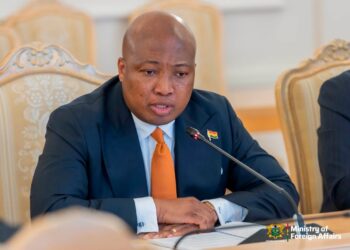

The Chief Executive Officer of Goldbod and National Communications Officer of the governing National Democratic Congress, Sammy Gyamfi, has defended the 2025 financial statements of the Bank of Ghana, rejecting claims by members of the Minority that the central bank recorded a GHS34 billion operating loss.
Speaking during a media interview, Sammy Gyamfi accused opposition lawmakers of deliberately misrepresenting the bank’s audited financial statements to create public panic and discredit the central bank.
According to him, the audited accounts prepared by KPMG clearly indicated that the Bank of Ghana recorded an operating loss of GHS15.6 billion in 2025 and not the GHS34 billion figure being circulated by some members of the opposition.
“KPMG says Bank of Ghana made an operating loss in the year 2025 of 15.6 billion cedis. And then you have Kojo Oppong Nkrumah saying no, it is not so, it is 34 billion”.
Chief Executive Officer of Goldbod and National Communications Officer of the governing National Democratic Congress, Sammy Gyamfi
Sammy Gyamfi questioned the credibility of attempts to challenge the conclusions of KPMG, insisting that the audit firm’s findings should be respected unless proven otherwise with factual evidence. “Unless you can use facts to impugn the integrity of the work that KPMG has done, you do not have a case,” he said.
Dispute Over Accounting Interpretation
The disagreement centers largely on how losses recorded under “Other Comprehensive Income” should be treated in the Bank of Ghana’s financial statements.

According to Sammy Gyamfi, the Minority incorrectly added unrealized revaluation losses recorded under Other Comprehensive Income to the actual operating loss captured in the Profit and Loss statement. He described the approach as inconsistent with accounting principles and contrary to the Bank of Ghana Act.
“What he is doing is what is called voodoo mathematics. It is a sacrilege in accounting to add profit or loss from other comprehensive income statements to the real P and L statement.”
Chief Executive Officer of Goldbod and National Communications Officer of the governing National Democratic Congress, Sammy Gyamfi
He explained that realized losses recorded in the Profit and Loss statement reflect actual operational gains or losses incurred by the institution, while figures captured under Other Comprehensive Income involve unrealized revaluation adjustments.
According to him, unrealized exchange rate differences and valuation changes should not be classified as operational losses. “When you go to the other comprehensive income, you are talking about profits or losses that arise from revaluation gains or losses or exchange differences that are unrealized,” he explained.
Bank of Ghana Act Referenced
To support his argument, Sammy Gyamfi cited Section 7 of the Bank of Ghana Act, Act 612, which provides guidance on the treatment of revaluation gains and losses in the central bank’s accounts.
According to him, the law specifically excludes gains or losses arising from the revaluation of foreign assets, gold reserves, or exchange rate movements from the computation of annual operating profits or losses.
Sammy Gyamfi argued that KPMG’s accounting treatment was therefore fully consistent with Ghanaian law and accepted accounting standards. “To say that the auditor should have done that means KPMG should have violated the law passed by Parliament,” he stated.

He further criticized opposition lawmakers, including Kojo Oppong Nkrumah, Mohammed Amin Adam, and Gideon Boako, arguing that as parliamentarians, they should understand the provisions of the law they passed.
Currency Stabilization and Revaluation Losses
Sammy Gyamfi also sought to explain how the recent appreciation of the Ghana cedi contributed to the revaluation losses recorded by the Bank of Ghana. According to him, the central bank holds foreign reserves largely denominated in dollars and other foreign currencies.
When preparing financial statements in cedis, those foreign assets must be converted using prevailing exchange rates. He explained that when the cedi appreciates against the dollar, the cedi value of foreign investments declines, resulting in book losses even if the actual dollar investments remain intact.
Using a simplified example, he said a one billion dollar investment valued at an exchange rate of 14.75 cedis to the dollar in 2024 would record a lower cedi value if the exchange rate appreciated to 10.45 cedis to the dollar in 2025.
“So that is a revaluation loss; it is the exchange rate differential that has led to a revaluation loss on that investment,” he stated. According to him, such losses are a consequence of currency stabilization and prudent monetary management rather than operational failure.
He stressed that unrealized revaluation losses should not be interpreted as actual financial losses until the underlying investments mature or are liquidated.
Bank of Ghana Remains Policy Solvent
Sammy Gyamfi further rejected suggestions that the Bank of Ghana had become policy insolvent. He explained that policy solvency refers to whether the central bank generates enough income to finance its core monetary operations, including open market operations and sterilization activities.

According to him, the Bank of Ghana generated operating income of approximately GHS22 billion in 2025 while sterilization costs stood at about GHS16 billion. “The bank is policy solvent by over 5.5 billion cedis,” he stated.
He contrasted this with 2024, when the bank reportedly recorded policy solvency of about GHS700 million. According to Sammy Gyamfi, the figures demonstrate improved operational strength rather than financial deterioration.
Gold Reserve Profits Defended
Another point of contention concerns profits generated from the sale of portions of Ghana’s gold reserves. The Minority reportedly argued that profits from gold reserve sales should not have been included in the Bank of Ghana’s operating income.
Sammy Gyamfi strongly disagreed, insisting that reserve management activities including gold purchases and sales form part of the central bank’s lawful operations under the Domestic Gold Purchase Programme.
“The Bank of Ghana, as part of reserve management, can buy gold and sell gold,” he explained. According to him, if losses from gold transactions are recognized within the Profit and Loss statement, gains from similar transactions must also be included.
He accused the Minority of applying inconsistent standards for political convenience. “What our brothers in the NPP are doing is very disingenuous,” Sammy Gyamfi stated.
READ ALSO: Fitch Ratings Upgrades Ghana to ‘B’ as Economic Recovery Gains Momentum