

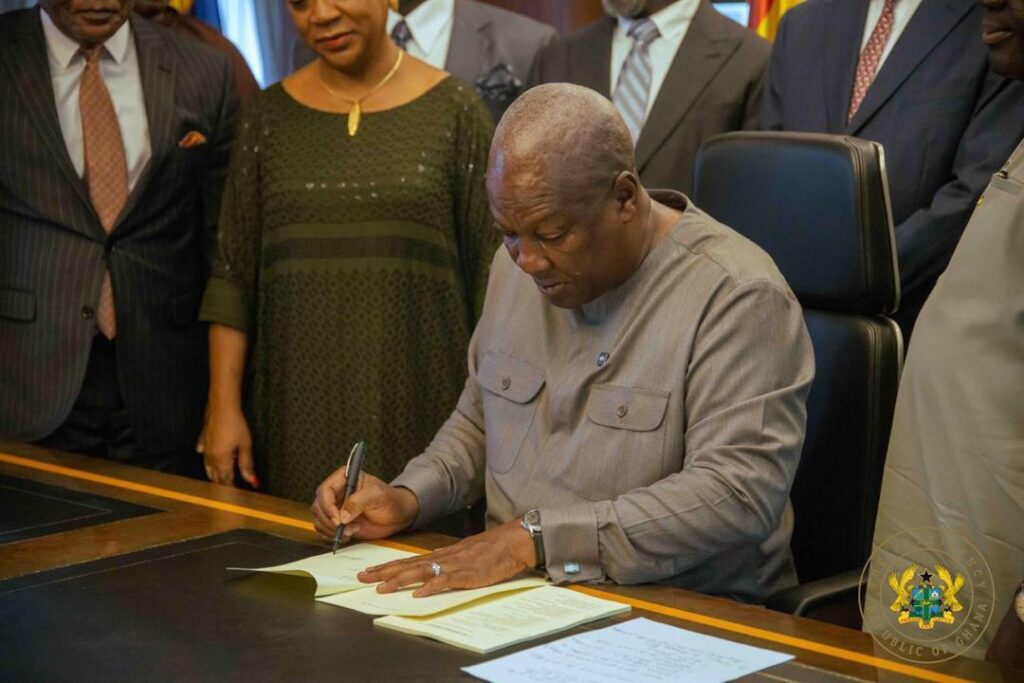
President John Dramani Mahama has assented to the Legal Education Act, 2026, marking what supporters of the reform describe as a historic turning point in Ghana’s legal education system and effectively ending the long-standing centralized professional legal training model that had existed for decades.
The signing ceremony took place on Monday, May 11, with senior government officials and key actors in the reform process in attendance. Among those present was Rockson-Nelson Dafeamekpor, Member of Parliament for South Dayi and Majority Whip, who has been one of the strongest advocates for reforms within Ghana’s legal education sector.
Confirming the development shortly after the President’s assent, Hon. Dafeamekpor described the moment as the successful conclusion of an eight-year struggle aimed at widening access to professional legal education in the country.
“It gives me the greatest pleasure to inform you that, just now, I joined the Clerk, the AG, the Chief of Staff, the Finance Minister, Dr. Valerie Sawyerr, Hon. Marietta Brew to witness His Excellency John Dramani Mahama give his assent to the new Legal Education Act, 2026.”
Rockson-Nelson Dafeamekpor, Member of Parliament for South Dayi and Majority Whip
He added that the legislation represents a watershed moment for thousands of law students in Ghana and abroad who have long called for reforms in the country’s legal training system.
Expanding Access to Professional Legal Training
For years, access to professional legal education in Ghana has remained one of the most debated issues within the country’s academic and legal circles, attracting protests from student groups.
Admission bottlenecks, limited infrastructure, and concerns over restricted opportunities had generated sustained public debate, particularly among law graduates seeking admission into professional training.
According to Dafeamekpor, the new law directly addresses these longstanding concerns by opening the system to more institutions while maintaining rigorous standards.
“This watershed legislation widens the opportunity for many to have access to professional legal education in Ghana unlike before. What is critical to note is that standards have been tightened under this new law, ensuring that quality is not sacrificed.”
Rockson-Nelson Dafeamekpor, Member of Parliament for South Dayi and Majority Whip
The Majority Whip also disclosed that, according to the Attorney General, implementation measures are already being developed to ensure a smooth rollout of the new system.
Describing the development as deeply personal and symbolic, he concluded, “What a momentous day this is for all law students home and abroad. Eight years of a tough fight has eventually been won.”
Major Structural Changes Introduced
The Legal Education Act, 2026 introduces sweeping reforms to Ghana’s professional legal training framework and significantly restructures how aspiring lawyers will be trained and licensed.
One of the most significant changes under the new law is the establishment of the Council for Legal Education and Training, a new regulatory body that replaces the role previously performed by the General Legal Council in supervising professional legal education.

The new council will be responsible for curriculum development, quality assurance, accreditation, and oversight of institutions authorized to deliver professional legal training.
Another major reform is the decentralization of professional legal training. Rather than all students being required to pass through the Ghana School of Law, accredited universities across the country will now be permitted to offer the Law Practice Training Course, significantly broadening access to legal training.
The legislation also replaces the existing entrance examination model with a standardized National Bar Examination, which students will write at the completion of their professional training before being called to the Bar.
Reports surrounding the implementation framework suggest that the duration of professional training may be streamlined to one year, with stronger emphasis placed on clinical legal education, practical work experience, and modern competencies including information technology and artificial intelligence literacy.
The law also introduces measures aimed at improving access for underrepresented groups, including persons living with disabilities, in line with broader national goals of inclusion and equal opportunity.
Journey from Parliament to Presidential Assent
The legislative journey of the bill began on October 24, 2025, when it was formally introduced to Parliament by Dr Dominic Ayine, Ghana’s Attorney General and Minister for Justice.
Following months of parliamentary debate, stakeholder consultations, and committee reviews, the bill was passed by Parliament on March 26, 2026. Its final passage into law came on May 11, 2026, when President Mahama formally appended his signature, turning one of the National Democratic Congress’s key campaign promises into national policy.
The reform had been championed by the ruling party as part of efforts to resolve persistent admission backlogs and create what party officials described as a more equitable, fair, and accessible legal education system.

A New Chapter for Legal Education
With the signing of the Legal Education Act, 2026, Ghana’s legal education landscape enters a new phase that many believe could reshape the future of legal practice in the country.
For thousands of current and aspiring law students, the reform represents not only expanded opportunity but also the promise of a more modern and inclusive training system.
As accreditation processes begin and implementation frameworks are rolled out, attention will now shift from legislative victory to practical execution.
For reform advocates such as Hon. Dafeamekpor, however, Monday’s signing was more than a policy milestone. It was the culmination of years of advocacy, persistence, and belief that legal education in Ghana could be opened to more people without compromising excellence.
READ ALSO: Black Princesses Return Home After Sealing Eighth Consecutive WC Qualification