
Ghana’s political establishment may be heading into its most generationally driven election cycle yet, with new polling data suggesting that the country’s rapidly expanding youth population is beginning to reshape the political calculations of both major parties ahead of the 2028 general elections.
Fresh analysis from Mussa Dankwa based on the March 2026 national tracking poll indicates that younger voters, particularly those within the Gen Z and younger millennial brackets, are emerging as the most decisive bloc in Ghana’s electoral landscape, with clear signs that many are gravitating toward younger political figures over older party heavyweights.
According to Mussa Dankwa, the demographic profile of the poll alone sends a powerful political message. He explained that voters aged between 18 and 34 accounted for 42 percent of respondents, while those between 35 and 44 made up another 36 percent.
Together, these two categories represent 78 percent of the electorate sampled. For political strategists, the implication is difficult to ignore. “Any candidate dreaming of winning elections in Ghana must appeal to these young voters,” Mussa Dankwa observed as he presented his analysis of the latest tracking poll.
Political analysts say the numbers suggest that Ghana’s 2028 election may be less about traditional party loyalties and more about generational identity, economic aspirations, and perceptions of performance.
Haruna Iddrisu and Ato Forson Dominate Among Young Voters
One of the clearest trends emerging from the poll is the strong performance of younger NDC hopefuls against Mahamudu Bawumia among younger age groups.

In a hypothetical contest involving Haruna Iddrisu, the poll shows Haruna commanding a strong lead among voters aged 18 to 34, polling 58 percent against Bawumia’s 34 percent, a commanding 24 point advantage.
Among voters aged 35 to 44, Haruna maintains a double-digit lead, polling 53 percent compared to Bawumia’s 40 percent. However, the picture changes among older demographics.
Among voters aged 45 to 54, Bawumia edges ahead by 47 percent to 45 percent. In the 55 to 64 category, his lead widens slightly to 49 percent against Haruna’s 44 percent. Interestingly, Haruna regains momentum among voters aged 65 and above, polling 49 percent compared to Bawumia’s 42 percent.
An equally impressive showing was recorded by Dr Cassiel Ato Forson. In his matchup against Dr Bawumia, Ato Forson also secures 58 percent support among voters aged 18 to 34, matching Haruna’s 24-point advantage.
Among voters aged 35 to 44, he performs even better, polling 54 percent to Bawumia’s 39 percent. Among older age groups, however, Bawumia recovers modest leads.
Analysts say the numbers indicate that younger government appointees who are currently visible in national governance may be enjoying a significant credibility advantage among younger voters who prioritize performance and relevance.
Older Political Figures Face Growing Generational Pressure
The March poll also tested the electoral strength of older NDC figures, and the results suggest a slightly more difficult path among younger voters. In a head to head race involving Johnson Asiedu Nketia, the veteran politician still leads Bawumia among younger voters, but by narrower margins.
Among voters aged 18 to 34, Asiedu Nketia polls 55 percent against Bawumia’s 35 percent, giving him a 20 point lead, four points lower than both Haruna and Ato Forson.
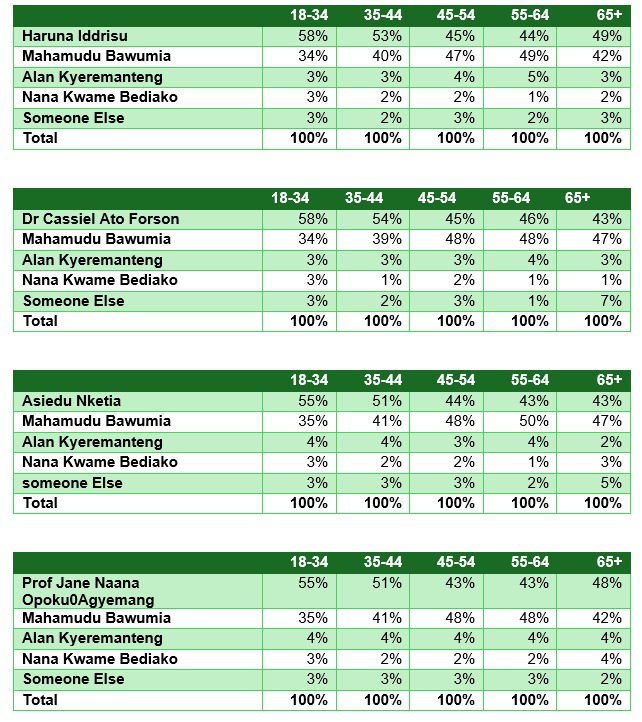
Among voters aged 35 to 44, his lead drops further to 51 percent against 41 percent. Among older voters, Bawumia performs better, widening his margins across multiple age brackets.
The figures suggest that while party loyalty remains important, younger voters may increasingly associate leadership appeal with generational alignment.
Vice President Holds Her Ground
The poll also tested a potential race involving Vice President Jane Naana Opoku-Agyemang and former Vice President Dr Bawumia. Among voters aged 18 to 34, Professor Opoku Agyemang receives 55 percent support, compared with Bawumia’s 35 percent.
She maintains similar numbers among voters aged 35 to 44 and remains competitive across older demographics. Among voters aged 65 and above, she actually outperforms some of the other contenders, polling 48 percent compared to Bawumia’s 42 percent.
Mussa Dankwa says her numbers indicate that voter decisions may not be based solely on age, but also on trust, national visibility, and leadership perception.
Internal Party Structures Could Complicate Youth Momentum
Despite the apparent popularity of younger candidates among the general electorate, Mussa Dankwa warned that party delegate structures may present a major obstacle.
He pointed out that while 42 percent of Ghana’s national electorate is aged 34 or below, only 18 percent of NDC delegates fall within that same age category.
Among voters aged 45 to 54, the national average stands at 16 percent, yet within the delegate system, that figure rises sharply to 27 percent. The gap becomes even more pronounced among older demographics.
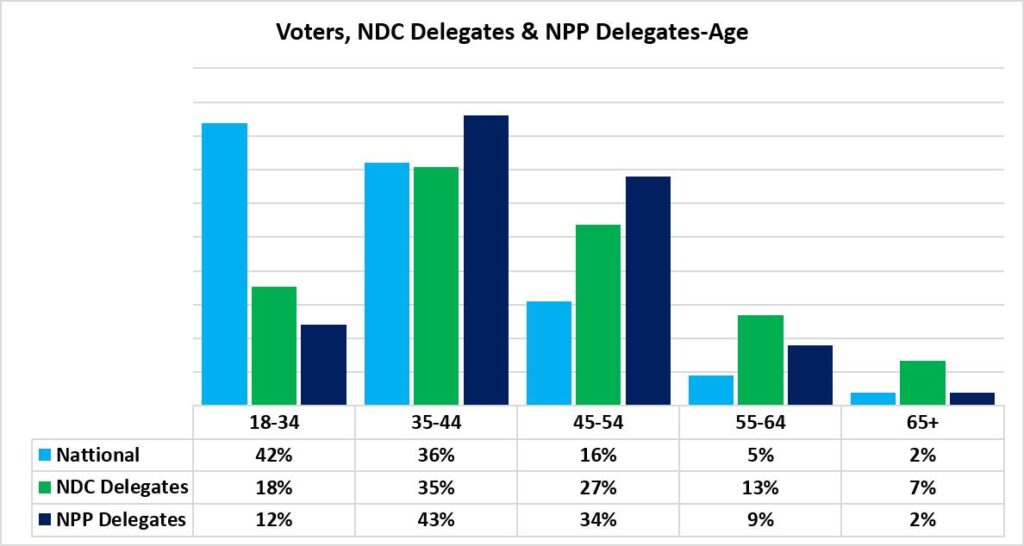
While only 5 percent of national voters fall between ages 55 and 64, delegates within that category account for 13 percent. Among voters aged 65 and above, the national figure is just 2 percent, but among delegates, it rises to 7 percent.
Mussa Dankwa suggested that this imbalance could make it harder for younger aspirants to translate public popularity into internal party victories. He linked the trend partly to the historical cadre structure within the NDC, where members of earlier political formations continue to maintain influence at the grassroots level.
Call for Political Renewal
Reflecting on the broader implications of the data, the analyst said Ghana’s political parties may soon face difficult choices about internal reform. As the electorate grows younger, more urban, and increasingly issue-driven, parties whose internal structures remain dominated by older delegates risk becoming disconnected from the voters they seek to represent.
Mussa Dankwa issued a blunt warning. “The political parties must look to reform, or they will die a slow but painful death when it comes to their membership.”
As Ghana moves closer to the 2028 presidential race, one message from the March tracking poll appears unmistakable. The Gen Z generation is no longer waiting quietly on the political sidelines.
It is increasingly shaping the conversation, influencing the numbers, and sending what analysts describe as a clear warning to Ghana’s political old guard.
READ ALSO: Ghana Government Secures GH¢6bn in T-Bill Windfall As Fitch Magic Ignites Investor Stampede