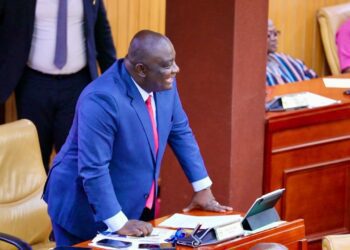
Chief Executive Officer of the Ghana Gold Board (GoldBod), Sammy Gyamfi, Esq., has announced a strategic pivot in the nation’s mineral trade that positions the Ghana Accelerated National Reserve Accumulation Programme (GANRAP) as the primary shield for the economy against global volatility.
This initiative is designed to fundamentally restructure how the state interacts with the gold sector, moving beyond mere revenue collection to a proactive model of reserve building that targets a massive influx of liquidity and stability.
By centralizing the acquisition process under GoldBod, the government expects to secure a consistent flow of bullion that will serve as a domestic buffer, ensuring that the country’s financial foundations remain unshaken by the unpredictable shifts of the international commodities market.
The program is underpinned by an ambitious operational target to purchase three tonnes of gold every week, a volume projected to generate over $400 million in weekly economic value through 2028.



“We want to accumulate about 15 months of import cover so that when there is any external shock like COVID-19 or the Russia-Ukraine war, Ghana’s economy can stand the test of time. This is about building a resilient economy at a lower cost while ensuring that Ghana derives maximum benefit from its gold resources.”
Sammy Gyamfi, Esq

This procurement strategy is bifurcated to capture the full spectrum of Ghana’s production, with 2.45 tonnes sourced weekly from the artisanal and small-scale mining (ASM) sector and the remaining 0.55 tonnes provided by large-scale mining entities.
By integrating these two streams, the Mahama administration intends to consolidate the nation’s foreign reserves and provide the necessary ammunition for the Bank of Ghana to stabilize the cedi.
This transition from the previous Domestic Gold Purchase Programme to the fully sanctioned GANRAP framework represents a move toward institutional efficiency, aimed at decoupling national economic security from the whims of external lending and short-term debt.
Driving Efficiency Through Institutional Reform
The transition to GANRAP signifies a departure from the costly legacy systems that previously governed gold reserve accumulation.
Since the establishment of GoldBod in April 2025, the institution has focused on overhauling the Bank of Ghana’s initial domestic purchase model, which was hampered by high operational overheads.

According to Mr. Gyamfi, the cost of accumulating reserves has been slashed from 16 percent under the old regime to a current 7.25 percent, with aggressive targets to bring this down to 3 percent in the coming years.
This “cost-reduction crusade” is supported by a policy shift where GoldBod now purchases gold at the interbank exchange rate rather than forex bureau rates, effectively eliminating the exchange rate gaps that previously bled the system of potential gains.
Fortifying the Cedi with a Domestic Gold Buffer
A central pillar of this repositioning is the use of physical gold to anchor the local currency against the “unprecedented pressures” of the global financial market.
By mopping up ASM gold which has historically been prone to smuggling and channelling it into official reserves, GANRAP creates a steady supply of foreign exchange that does not depend on the issuance of Eurobonds or bilateral loans.

This “economic war chest” allows the government to intervene in the currency market with greater autonomy.
Tightening the systems to minimize purity losses and reducing discount arrangements on exports further ensures that every ounce of gold mined on Ghanaian soil contributes directly to the national balance sheet, providing a “non-inflationary” path to expanding the monetary base.
Strategic Resilience Against Global Volatility
The long-term objective of GANRAP is to build a “resilient fortress” that protects Ghana from the “contagion effects” of geopolitical tensions and global health crises.

With a target of 15 months of import cover, the country is seeking to reach a level of liquidity that far exceeds the standard benchmarks of peer economies.
This move is intended to ensure that, in the event of another global supply chain disruption or a sudden spike in oil prices, the state has the internal resources to fund essential imports without triggering a balance-of-payments crisis.
By leveraging the state’s pre-emption rights to 20 percent of large-scale production and formalizing the ASM sector, Ghana is effectively domesticating its wealth, turning its status as a top-tier gold producer into a tangible defense mechanism for its citizens.
READ ALSO: Fisheries Commission Directors Ordered To Finalize Inland Strategy