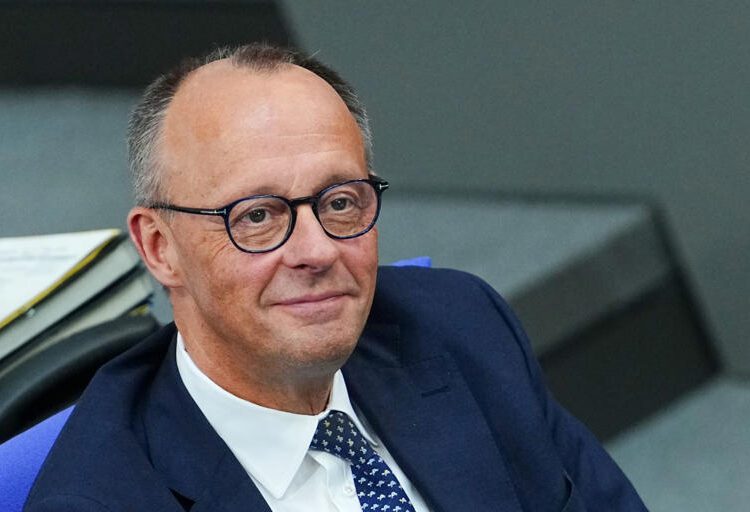
German Chancellor Friedrich Merz has called for Ukraine to gain “associate membership” of the EU to aid the process of fully joining the bloc and bolster peace talks.
In a letter to EU leaders, Merz said that associate membership; essentially participation and representation in EU institutions, but without voting rights, would be “a decisive step on Ukraine’s path to full membership.”
He also called for the EU “without delay” to open all six membership negotiating topics with Ukraine, known as clusters. Under the German plan, Ukraine would attend EU summits and ministerial meetings, be represented in the European Commission, European Parliament and European court of justice, but unable to cast a vote.
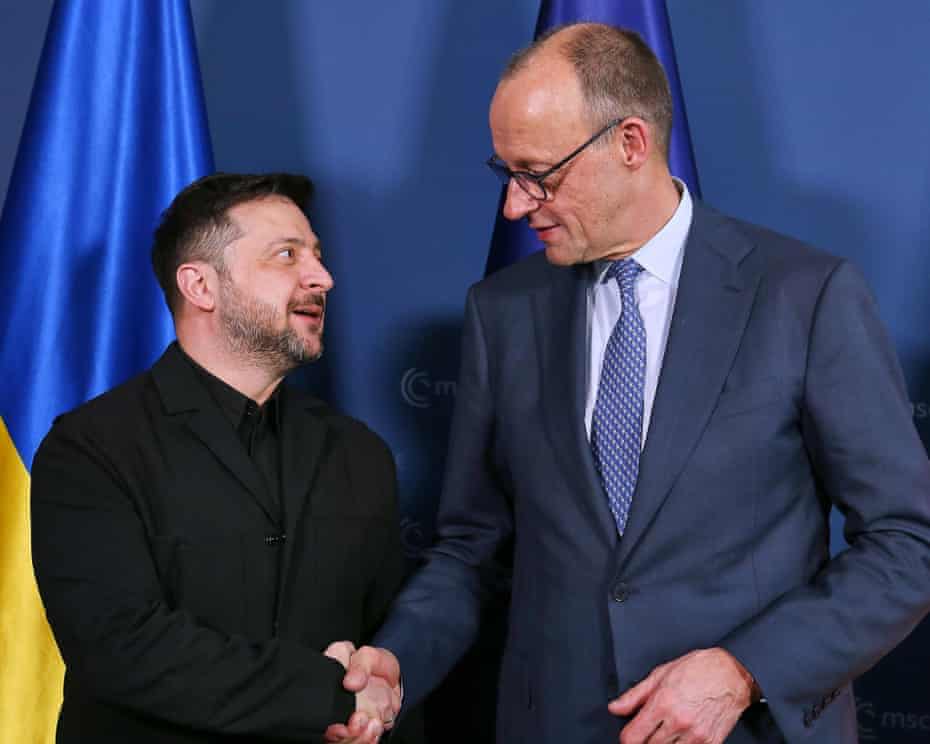
Under the proposals, Ukraine would not immediately receive funds from the EU budget, but would gain access to programmes on a “step-by-step basis.” Kyiv would align with EU foreign policy and be covered by the EU’s mutual assistance clause, article 42.7, to create a security guarantee. In case of backsliding on rule of law or EU values, Ukraine would face a snapback mechanism restricting its rights.
“It is obvious that we will not be able to complete the accession process [for Ukraine] shortly, given the countless hurdles as well as the political complexities of ratification processes in various member states.
“However, with a view to the peace process, we do not have time for further delays…My proposal reflects Ukraine’s particular situation, a country at war. It will help facilitate the ongoing peace talks as part of a negotiated peace solution. This is essential not only for Ukraine’s but for the entire continent’s security.”
Friedrich Merz
Merz wants EU leaders to discuss his ideas at an upcoming EU summit. The next one, in June, will be the first attended by Hungary’s new Prime Minister, Péter Magyar, who has already signalled a new approach to Ukraine. His predecessor, Viktor Orbán, blocked the opening of accession talks with Ukraine.
Hungary, notably, has blocked the opening of negotiations, but with a new government now in place in Budapest this month that stance could change. Still, Merz’s plan is unlikely to please those European officials who argue that EU membership must be a merits-based process that concludes only once all the benchmarks have been met.
However, the German leader did say that his approach should be extended to other countries waiting in line to join, notably those in the Western Balkans, where E.U. leaders are due to gather for a summit next month. On the war, Merz wrote that his proposal “will help facilitate the ongoing peace talks as part of a negotiated peace solution. This is essential not only for Ukraine’s but for the entire continent’s security.”
Ukraine sees E.U. membership as one “security guarantee” for a stable future once the war ends. Its best guarantee would be NATO membership, but the Trump administration insists that cannot happen, and others are wary of it joining while fighting continues.
As U.S-led mediation efforts have stalled, EU countries have begun to debate whether to launch a parallel negotiating track and who might mediate on their behalf in the unlikely event that Putin might agree to talk to them.
Earlier this month, Costa said that “we need, in the right moment, to have talks with Russia to address our common issues on security.” He said this should not “disturb” U.S.-led talks, but that it’s important for Europe to address its own security concerns.
Since then, speculation has swirled in European media about possible EU negotiators, including former German Chancellor Angela Merkel, a Russian speaker who knows Putin well, and former European Central Bank Chief Mario Draghi. Putin has suggested that he might talk to Gerhard Schröder, another past German chancellor but officials have poured cold water on that idea.
Merz Deems EU Enlargement Deemed Necessity
In his letter, Merz described EU enlargement as a “geopolitical necessity” but said the process takes too long and causes frustration for candidates and existing members. Six western Balkan countries were told their future was in the EU back in 2003, but the process towards joining has been slow.
Merz wrote there should also be “innovative solutions” to accelerate EU enlargement with countries in the western Balkans, suggesting “privileged access” to the internal market and granting them observer status in the EU institutions.
EU enlargement lost momentum after the big bang expansion of 2004 and no country has joined since Croatia in 2013. However, the process gained new urgency following Russia’s full-scale invasion of Ukraine in 2022, which triggered applications from Ukraine, Moldova and Georgia.
READ ALSO: Global Backlash Over Ben-Gvir’s Flotilla Activists’ Abuse Video Grows