Author: Kay Codjoe, Market Research Consultant and Volunteer Associate at the IMANI Centre for Policy and Education
On 29 October 2025, I published an op-ed titled A Cyber Coup d’État? warning that Ghana was quietly constructing one of the most fragmented and over-centralised digital governance architectures in its democratic history.
Not a coup of tanks and bayonets, but one of legal clauses, overlapping mandates, sprawling digital authority, and fragmented technocratic power disguised as modernisation.
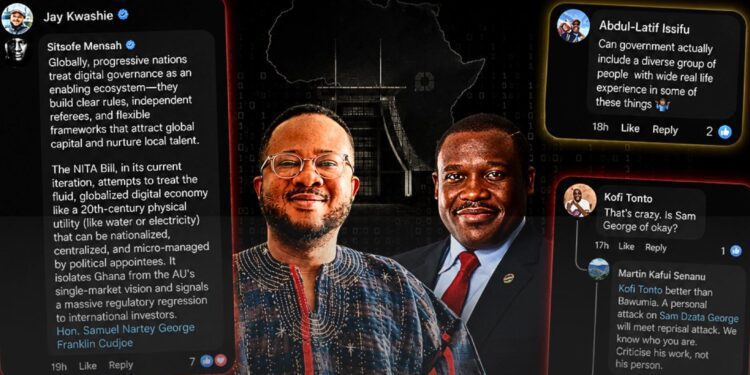
Hon. Samuel Nartey George’s response to growing scrutiny around the proposed NITA Bill has unintentionally reinforced the central warning: Ghana’s digital governance framework is becoming increasingly dependent on overlapping authority, ministerial assurances, and future harmonisation instead of clear legislative precision and institutional coherence.



That warning was later amplified through the detailed civic interrogation by Canadian-based Ghanaian tech professional Jay Kwashie, not because technology reform is unnecessary, but because the scale and overlap of the proposed legislative ecosystem demand serious scrutiny, not emotional defensiveness.
Initially, citizens were given barely one week to review and comment on these extraordinarily technical Bills before the consultation window was later extended to 14 November 2025. Even then, there were no major nationwide civic engagement forums online or offline to help ordinary Ghanaians understand what was being proposed in their name.
Yet these reforms are massive. New laws proposed include the Data Harmonisation Bill, the Digital Economy and Innovation Development Fund Bill, the MDHI Bill, the Emerging Technologies Bill, the Ghana Innovation and Startup Bill, and several others.
Existing laws governing the NCA, Cybersecurity, Data Protection, Electronic Transactions, and NITA itself are also being amended simultaneously. That is not minor legislative housekeeping. That is a full reconstruction of Ghana’s digital state.
Hon. Samuel Nartey George’s response to public criticism of the proposed NITA Bill was politically energetic, rhetorically combative, and institutionally revealing. Unfortunately, beneath the confidence sat a troubling pattern: the repeated substitution of legal certainty with ministerial assurances.
Throughout his response, the Minister defended key weaknesses in the Bill not by pointing to precise statutory safeguards within the text itself, but by appealing to future Bills, existing frameworks elsewhere, administrative intentions, and implied harmonisation.
In legislative drafting, that is a red flag. The OECD’s Best Practice Principles for Regulatory Policy stress “role clarity,” “preventing undue influence,” and clear institutional boundaries as essential for modern regulators.
Yet the emerging Ghanaian digital architecture does the exact opposite: overlapping mandates, fragmented authority, and blurred regulatory lines across NITA, the CSA, the DPC, the NCA, and the proposed Emerging Technologies framework.
The Minister’s response unintentionally confirmed this fragmentation. When citizens questioned the absence of AI governance safeguards within the NITA Bill, the Minister replied that another Emerging Technologies Bill would handle AI governance.
That is precisely the concern. Who controls AI? Three different Bills appear to answer: “We do.” Who governs national data? Multiple institutions simultaneously claim authority. Who regulates digital infrastructure, cybersecurity, interoperability, innovation standards, and licensing? An expanding maze of agencies now step forward together.
A coherent digital governance framework does not require citizens, investors, startups, lawyers, and courts to conduct archaeological excavations across multiple future statutes to understand the legal environment governing AI deployment. Good drafting cross-references clearly. Good governance harmonises explicitly. Good regulators avoid jurisdictional ambiguity. The same contradiction appeared on data sovereignty.
Citizens pointed out that the NITA Bill lacks explicit provisions governing localisation and sovereign control of critical national data. The Minister replied that the existing Data Protection regime already addresses these concerns. Again, that answer validates the criticism rather than defeating it. If data sovereignty obligations are foundational to national ICT governance, why is there no explicit statutory cross-reference inside the very Bill governing national ICT infrastructure and systems?
Legislation is not interpreted through ministerial interviews. It is interpreted through text. Courts do not enforce Facebook explanations. They enforce statutes. The Minister’s response on institutional independence was even weaker.
Section 16 reportedly invokes the “independence” of the Authority while Section 15 simultaneously subjects the Authority to ministerial policy directives. Instead of engaging the constitutional tension honestly, the Minister simply declared: “There is no ambiguity here except in your imagination.” That is not a legal argument.
The OECD defines regulatory independence as protection against “undue influence” over regulatory outcomes. While ministerial policy direction alone does not destroy independence, concerns become legitimate when appointments, removals, operations, funding, and directives all converge within the same executive ecosystem.
Those concerns deserve rebuttal through doctrine and drafting, not insults. Then came perhaps the most intellectually catastrophic part of the Minister’s response: the plumber analogy.
Citizens questioned the wisdom of requiring mandatory government certification for ICT professionals across the private sector, including software developers, cloud engineers, cybersecurity analysts, AI practitioners, and startup technical staff.
The Minister responded by comparing them to licensed plumbers. This comparison fundamentally misunderstands the structure of modern digital economies.The concern being raised was not anti-regulation. It was concerned about overregulation and centralised gatekeeping. That concern is globally recognised.
The World Economic Forum and OECD consistently warn that regulatory uncertainty and duplicative compliance structures disproportionately harm startups and smaller firms that lack the legal and financial capacity to navigate overlapping administrative systems.
That is precisely the risk Ghana is now sleepwalking toward. Perhaps the most revealing line in the Minister’s response was his dismissal of citizen criticism as “plain-faced ignorance” and “misleading illusions.” That posture misunderstands democracy entirely.
A citizen downloaded a draft Bill, studied it carefully, identified ambiguities, compared international standards, questioned institutional structures, triggered civic debate, and forced a Cabinet Minister into an extensive public defense of his Ministry’s legislative architecture.
That is not ignorance. That is constitutional citizenship operating at full intelligence. And the fatal irony is extraordinary: In attempting to silence civic scrutiny, the Minister ended up proving exactly why that scrutiny was necessary in the first place.
READ ALSO: GNPC Promotes Ghana’s Upstream Oil Investment Potential At OTC 2026