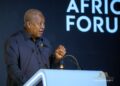
Edudzi Kudzo Tameklo, the National Petroleum Authority (NPA) Chief Executive Officer, has sounded an alarm over escalating legal and administrative frictions within West Africa’s downstream sector, pointing to severe risks that could destabilize structural operational frameworks.
The escalating dispute centers on legal altercations initiated by Dangote Petroleum Refinery against state regulatory frameworks, a development that the NPA boss signals as a potential catalyst for critical economic vulnerability.
This escalating corporate showdown, documented in recent judicial filings at the Federal High Court in Lagos, underscores a fragile geopolitical balancing act between protecting domestic industrial capacity and maintaining a transparent, open-market environment for multiple operational entities.
“Nigeria’s state oil firm NNPC has accused Dangote Petroleum Refinery of trying to restrict competition and risk creating monopoly control of the fuel market, according to court documents cited by Reuters. The case comes ahead of Dangote’s planned refinery IPO in September, adding uncertainty over market rules and investor expectations.”
Edudzi Kudzo Tameklo, the National Petroleum Authority (NPA) Chief Executive Officer
The administrative friction intensifies as the Nigerian National Petroleum Company Limited (NNPC) openly counters the legal challenge brought forward by Africa’s largest refining hub.

NNPC argues that limiting import credentials strictly to protect local private infrastructure directly compromises statutory supply mechanisms, presenting an immediate threat of product scarcity and localized inflationary spirals.
The state corporation maintains that the landmark Petroleum Industry Act explicitly safeguards competitive multiplicity, noting that the private refinery has yet to submit definitive empirical proof of its unilateral capacity to guarantee unceasing domestic volume fulfillment.
Furthermore, independent marketing syndicates have collectively voiced stiff resistance against structural foreclosure, asserting that judicial mandates enforcing exclusivity would inevitably paralyze the competitive landscape, spike pricing indexes, and decimate logistical resiliency across the distribution chain.
Downstream Monopoly Risks and Market Polarization
The petition brought forth by Dangote Refinery in April targeted the statutory validity of import licenses extended to competing entities, alleging that sustained fuel importations actively cannibalize domestic refining investments.

By demanding a judicial restriction on third-party import permits, the massive industrial facility seeks to consolidate its position as the primary supplier within the territory, an objective that state actors view as a perilous path toward economic cartelization.
Critics point out that transitioning from an import-dependent framework directly to a single-source domestic reliance creates an institutional single point of failure.
If the mega-refinery suffers unforeseen technical breakdowns, industrial actions, or feedstock shortfalls, the absence of active parallel import channels would leave the populace exposed to immediate fuel depletions.
Consequently, the state oil firm’s vehement defense of regulatory open-access serves as an institutional buffer designed to avert total market captive dependency.
Financial Stakes and the Looming Public Floatation
Compounding the immediate operational friction is the strategic timing of this litigation, which unfolds right on the eve of Dangote’s highly anticipated Initial Public Offering (IPO) scheduled for September.

Financial analysts observe that launching an aggressive legal campaign to alter established statutory market mechanisms injects significant systemic volatility into the investment landscape, clouding investor predictability regarding regulatory compliance and future cash flows.
The push to secure legally mandated market dominance via the courts can be interpreted as a strategic maneuver to maximize valuation metrics ahead of the public listing, assuring prospective shareholders of long-term revenue insulation.
However, this high-stakes legal strategy introduces a double-edged sword; while it highlights the sheer scale of the refinery’s regional ambitions, it simultaneously exposes potential international investors to a highly litigious and unstable regulatory environment, complicating the capital formation process.
Structural Implications for Regional Energy Resiliency
From a broader macro-structural perspective, this domestic standoff carries profound implications for the wider Sub-Saharan energy market, which closely relies on Nigeria’s downstream equilibrium for pricing stability.

Should the court rule in favor of restricting import permissions, the resulting domestic consolidation will fundamentally alter historic trans-border product flows, potentially driving up procurement costs for neighboring nations.
A monopolized domestic marketplace weakens the competitive price-discovery mechanism, leaving retail consumers entirely vulnerable to the corporate governance decisions of a singular boardroom.
The ongoing confrontation highlights a deep systemic challenge facing emerging economies: the difficult task of nurturing transformative local mega-projects without inadvertently dismantling the competitive market structures necessary to guarantee long-term national security and macroeconomic resilience.
READ ALSO: Ghanaian Businesses Urged To Expand Via Mauritius Route