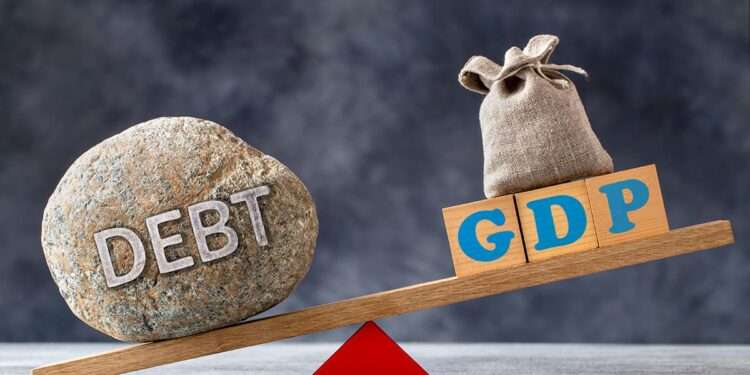
Ghana has made notable progress in stabilizing its economy following a period of severe fiscal challenges.
Public debt levels have declined significantly due to restructuring efforts, a stronger cedi, and fiscal discipline under the IMF-supported program. Yet high debt servicing obligations continue to constrain the government’s ability to fund critical development priorities. This situation raises concerns about long-term growth and public service delivery.
Ghana’s public debt peaked in the early 2020s amid the COVID-19 pandemic, global shocks, and domestic imbalances. Debt-to-GDP reached highs above 90 percent in some estimates around 2022 before declining. By late 2025, total public debt had fallen to around GH¢630 billion, equivalent to approximately 45 percent of GDP, reflecting successful domestic debt exchange, external restructuring under the G20 Common Framework, and currency appreciation.
Despite the improved stock position, flow challenges persist. Debt service, including interest and amortization, has absorbed a large share of government revenues in recent years. Historical data showed debt service-to-revenue ratios exceeding 100 percent at peaks, with projections indicating sustained pressure into the mid-2020s. In the 2026 budget, interest payments alone are projected at GH¢57.7 billion, representing a notable portion of total expenditure estimated around GH¢302.5 billion.
Domestic debt constitutes a growing share, with short-term instruments like treasury bills featuring prominently. While borrowing costs have eased substantially, with treasury bill rates dropping by over 1,600 basis points in some periods, the legacy of high-interest obligations from earlier years lingers. External debt restructuring has provided relief through extended maturities and reduced coupons on Eurobonds, but full normalization with remaining commercial creditors remains ongoing.
Crowding Out Effect on Public Spending
High debt servicing directly limits fiscal space for other expenditures. When a substantial portion of revenue services past borrowing, fewer resources remain for capital investment, social programs, and operations.
In Ghana’s case, interest payments have historically competed with allocations for education, health, and infrastructure.The 2025 and 2026 budgets illustrate this tension. Significant funds go toward interest and legacy obligations, including energy sector debts. Capital expenditure, while prioritized in the 2026 “Big Push Infrastructure Programme” with GH¢30 billion for roads, still faces constraints relative to overall needs. Primary expenditure (excluding interest) is targeted carefully to maintain a primary surplus, reflecting the need for prudence.
This dynamic creates a crowding-out phenomenon. Resources diverted to debt reduce funding for human capital development. Education and health sectors, vital for long-term productivity, receive allocations that may not fully address infrastructure gaps or quality improvements. Infrastructure projects essential for growth, such as roads, power, and digital connectivity, compete for the remaining fiscal room. Analysts note that sustained high servicing costs can slow progress toward Sustainable Development Goals by limiting investments in these areas.
Economically, the effect extends beyond the budget. High government borrowing can elevate domestic interest rates, potentially crowding out private investment. Although recent rate declines have eased this pressure, structural vulnerabilities remain. A weaker fiscal position also signals higher risk to markets, which can raise future borrowing costs and perpetuate the cycle.
Macroeconomic Context and Policy Responses
Ghana’s challenges stem from a combination of external shocks and domestic policy choices. The pandemic increased spending while revenues fell. High fiscal deficits, financed through expensive domestic markets when external access was limited, compounded the debt stock. Currency depreciation inflated the local-currency value of external obligations.
The government’s response under the IMF Extended Credit Facility has emphasized fiscal consolidation, revenue mobilization, and debt restructuring. Inflation has fallen dramatically to single digits, the cedi has strengthened, and reserves have improved. These gains have lowered financing costs and supported debt reduction. The 2026 budget targets GDP growth of around 4.8 percent, inflation at 8 percent, and a contained fiscal deficit.
Debt management strategy focuses on lengthening maturities, diversifying creditors, and reviving the domestic bond market with benchmark issuances. Liability management operations aim to reduce interest burdens over time. Tax reforms, including VAT simplifications and efforts to broaden the base, seek to boost revenues and reduce reliance on borrowing.
Risks and Long-Term Implications
Despite progress, risks persist. Debt service-to-revenue ratios remain elevated in projections, vulnerable to growth slowdowns, commodity price shocks (given reliance on cocoa, gold, and oil), or currency volatility. Global interest rate environments and geopolitical tensions could affect external financing conditions.
If unaddressed, persistent high servicing costs threaten to undermine social stability. Citizens expect improvements in services, jobs, and infrastructure. When budgets prioritize debt over delivery, public frustration can rise. Moreover, limited investment in productive sectors hampers potential growth, making debt sustainability harder to achieve in the long run.
Positive developments offer hope. Lower borrowing costs, structural reforms, and a shift toward growth-oriented spending could gradually expand fiscal space. Successful completion of remaining debt treatments and sustained revenue growth are critical.
Pathways to Greater Fiscal Freedom
To mitigate threats to spending power, Ghana must pursue a multi-pronged approach. Enhancing domestic revenue mobilization through improved tax administration and compliance is essential. Efficiency in public spending, including rationalizing subsidies and reducing waste, can free resources. Investing borrowed or available funds in high-return projects that boost growth and revenues creates a virtuous cycle.
Strengthening institutions for transparent debt management and fiscal responsibility builds market confidence, potentially lowering risk premiums. Deepening private sector participation through public-private partnerships can supplement public investment in infrastructure without adding directly to debt.
All in all, while Ghana has navigated a difficult period with commendable results in debt reduction and stabilization, servicing costs continue to challenge spending priorities. Balancing debt obligations with investments in people and productivity remains the central economic task. With disciplined execution of current reforms and focus on inclusive growth, the country can ease these constraints and unlock greater development potential.
READ ALSO: Standard Chartered Exit Fuels Nduom’s Bold Ownership Demand