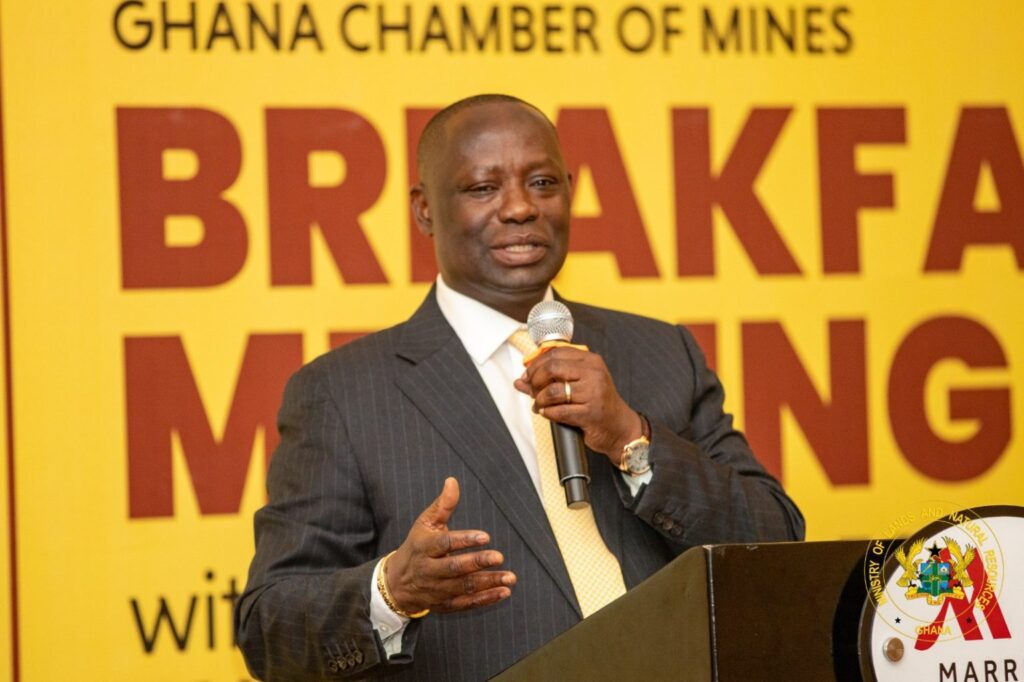
Ing. Kenneth Ashigbey, CEO of the Ghana Chamber of Mines has thrown his full support for the calls for the enactment of a dedicated Mining Revenue Management Act to ensure that mineral wealth translates into tangible development for host communities.
Mirroring the structure and oversight provided by the Petroleum Revenue Management Act, this proposed legislation aims to institutionalize the channelling of mining proceeds directly into local infrastructure, education, and healthcare projects.
“Just as we have the Petroleum Revenue Management Act, we should also have the Mining Revenue Management Act, that is really important, so that we are able to direct where resources go. I just want to reiterate that in 2025, Goldfields, Anglo Gold, Eduaprim, and then Ghana Manganese, paid 5.1 billion cedis to GRE in form of taxes.”
Ing. Kenneth Ashigbey, CEO of the Ghana Chamber of Mines
The current fiscal landscape often leaves mining-affected areas struggling with underdevelopment despite the billions of cedis generated annually by large-scale operators. In 2025 alone, industry giants like Goldfields, AngloGold, and Ghana Manganese contributed 5.1 billion cedis in taxes, yet a significant portion of this revenue remains inaccessible for local community investment.

By establishing a formal management framework, the government could move away from centralized spending and toward a model that guarantees a larger, ring-fenced share of royalty’s proposals suggest up to 30 percent dedicated specifically to the needs of the communities where these minerals are extracted.
“We need to make sure that we structure, and I agree completely with Dr. Pupulampo when he talks about the fact that we need to structure the way we’re spending our money so that part of that money goes into these communities to be able to then develop the community, be able to bring infrastructure into the community, be able to bring some work, you know.”
Ing. Kenneth Ashigbey, CEO of the Ghana Chamber of Mines
Bridging the Gap for Host Communities
The proposed Act is designed to cure the chronic issue of “fragmented” royalty distribution that currently sees only a small fraction of funds reaching local assemblies.
Under the current system, royalty payments are often absorbed into broader government expenditure, leaving communities with little to show for the environmental and social impacts of mining.
Ing. Ashigbey emphasizes that a legislative fix would force a “laser” focus on strategic regional development. Instead of funds dissipating, they would be anchored in industrialization projects, medical infrastructure, and educational advancements.
This ensures that when a mine eventually ceases operations, the community is not left with only “holes and all of that,” but rather a sustainable economic base.

Formalizing Small-Scale Mining and Restoration
Beyond large-scale operations, the Act would play a critical role in formalizing the artisanal and small-scale mining sector.
By bringing these miners into a structured system, the government can ensure that they, too, contribute to community development funds.
This transition is essential for environmental stewardship; currently, the burden of land restoration often falls on the Minister for Lands and Natural Resources to fund through scarce state revenue.
If small-scale operators are brought into the formal fold, their contributions could fund proactive land reclamation, ensuring that local ecosystems are protected rather than abandoned after extraction.
Creating Lasting Economic Legacies
The push for a new Act is also about creating a blueprint for “the second coming” of mining towns a reference to communities that have survived past mining cycles and must now reinvent themselves.
Ing. Ashigbey highlights the transformative potential of using mine expenditure to foster local capacity.

He points to examples where mining companies have successfully mentored local service providers such as those once focused on rudimentary chainsaw services and transformed them into national-level contractors capable of competing for major road and infrastructure projects.
This strategy of local procurement and skill-building, backed by a robust legislative framework for revenue management, could finally ensure that Ghana’s mineral wealth secures a prosperous future for the people in its mining heartlands.
READ ALSO: Deloitte Predicts Tougher Days for Ghanaians As Rising Energy Costs Threaten Economic Recovery