The Democratic Republic of Congo (DRC) has reported a sharp rise in Ebola infections, with confirmed cases approaching 600 as health authorities intensify efforts to contain one of the largest Ebola outbreaks in recent years.
In its latest update, the Congolese government announced that confirmed cases of the deadly Bundibugyo strain of Ebola had increased to 598, including 115 deaths. Authorities also reported that 22 patients had recovered from the disease and noted that no new health zones had recorded infections.
The outbreak is believed to have been spreading undetected for several weeks before health officials identified the virus, complicating containment efforts and allowing the disease to gain a foothold across multiple provinces.
The epidemic is concentrated in the conflict-affected provinces of Ituri, North Kivu and South Kivu, regions that have long struggled with insecurity, displacement and weak healthcare infrastructure.
According to government figures, cases have now been recorded in 17 health zones in Ituri Province, seven health zones in North Kivu and one health zone in South Kivu.
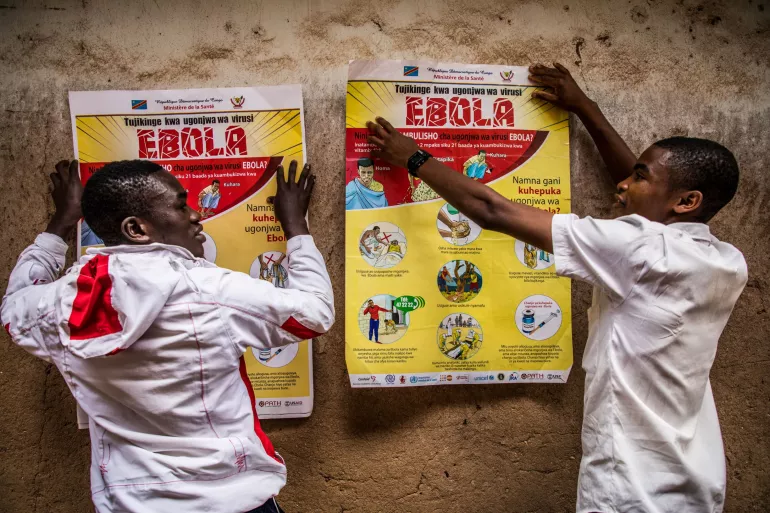
Authorities have launched an extensive awareness campaign urging residents to report symptoms early and cooperate with health workers. “If you have a fever, vomiting, diarrhea, or severe weakness, you should go to the nearest health center immediately,” the government stated in a public advisory, while also urging communities not to attack healthcare personnel responding to the outbreak.
Mistrust of health authorities remains a major challenge. Reports of attacks on treatment centres and burial teams have hindered response efforts, while aid agencies warn that shortages of essential protective equipment continue to expose frontline workers to significant risk.
The International Rescue Committee has called for increased international funding to strengthen containment measures in Ituri Province and prevent the disease from spreading further across the region.
Moreover, World Health Organization (WHO) has also highlighted the scale of the challenge. WHO’s Director of Health Emergency Alert and Response Operations, Dr Abdirahman Mahamud, recently confirmed that neighbouring Uganda had reported 19 confirmed cases, including two deaths and one probable fatality.
Encouragingly, WHO noted that, there is currently no evidence of community transmission in Uganda.
Dr Mahamud further indicated that Ituri Province accounts for approximately 94 per cent of all confirmed cases and explained that the recent increase in infections is partly due to expanded testing capacity.
More decentralised laboratories have been established across affected areas, including a fully operational facility in Mongbwalu. Additional field laboratories have also been deployed to accelerate testing and reduce delays in diagnosis.
According to WHO’s Director of Health Emergency Alert and Response Operations, health workers had identified more than 5,000 contacts across the three affected provinces, with 62 per cent currently under follow-up. Officials hope to increase that figure to between 90 and 95 per cent in the coming weeks.
Despite progress, logistical challenges remain significant. “Ituri, North and South Kivus combined are as big as France,” Dr Mahamud stated, noting that some samples still take up to 24 hours to reach testing facilities because of poor transport and communication networks.
To strengthen the response, WHO and its partners have deployed more than 100 personnel, delivered 40 tonnes of medical supplies and equipment, and established treatment centres to support government-led containment efforts as the fight against the outbreak intensifies.
Nigeria Establishes Ebola Task Force, Releases N10bn for Emergency Preparedness
Meanwhile, Nigeria has intensified measures to prevent the spread of Ebola into the country, with President Bola Tinubu approving the establishment of a Presidential Task Force on Ebola Virus Disease Preparedness and the immediate release of N10 billion in emergency intervention funding.
The move comes as the Ebola outbreak in the Democratic Republic of Congo and neighbouring Uganda continues to expand, prompting the World Health Organization (WHO) to declare the crisis a Public Health Emergency of International Concern.
According to a statement issued by the President’s Special Adviser on Information and Strategy, Bayo Onanuga, the N10 billion emergency fund is expected to strengthen the operational readiness of the Nigeria Centre for Disease Control and Prevention (NCDC) and support critical public health response activities nationwide.
As part of the preventive measures, President Tinubu directed authorities to intensify passenger screening at all international airports through enhanced temperature checks, crowd-control protocols and closer monitoring of travellers arriving on routes considered high-risk.
Airlines identified for additional scrutiny include Air Uganda, RwandAir, Air Tanzania, Air Angola, Kenya Airways and Ethiopian Airlines, all of which operate direct or connecting services from affected regions.
The President also ordered the immediate activation of referral and isolation centres at the international airports in Lagos and Abuja, with similar facilities to be established at other airports across the country.
Tinubu further instructed authorities to disinfect airport facilities, including departure halls, baggage sections and cargo areas, while also considering the designation of specific terminals for high-risk flights to facilitate controlled screening and isolation procedures.
States hosting international airports and border corridors have also been directed to submit preparedness plans and funding requirements to ensure a coordinated national response should the outbreak spread beyond Central Africa.
READ ALSO: GSE Investors Trade Over GH¢20 Million in One Day