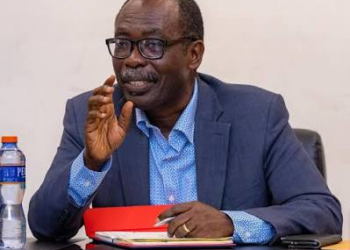
The Board Chairman of the National Development Planning Commission (NDPC), Dr Nii Moi Thompson, has argued that many of the flood disasters experienced across the country could have been prevented through the implementation of long standing national planning documents.
He explained that Ghana has already developed detailed infrastructure frameworks that address drainage systems, flood control measures and coastal protection strategies. The NDPC Chairman noted that the plans contained specific recommendations for Accra and other urban centres many years ago.
According to him, the proposals cover drainage master plans, flood forecasting systems and institutional arrangements aimed at reducing the impact of floods. He added that strategies have also been developed for the northern savanna zone, urban settlements and vulnerable coastal communities.
Dr Thompson indicated that the plans were documented as part of a broader infrastructure framework completed during his earlier tenure at the commission. He stressed that the documents were intended to guide decision makers and support long term development.

“Everything we are going through should not have happened. If the plans had been implemented, the impact on lives and property would have been far less and much more manageable. Everything was split up here. It’s about drainage, flood control, and coastal protection.”
Dr Nii Moi Thompson
The NDPC Chairman also disclosed that the infrastructure plan was designed to work alongside the National Spatial Development Framework. He explained that development planning requires a close connection between infrastructure investments and land use management.
He noted that the National Spatial Development Framework contributed to the establishment of the Land Use and Spatial Planning Authority in 2016. The framework also required every district assembly to develop its own spatial planning scheme.
Dr Thompson revealed that only a small number of district assemblies have completed the required planning frameworks despite more than a decade having passed. He argued that weak enforcement mechanisms have slowed compliance with the law.
In addition, he criticised the misplaced priorities among some public officials. The NDPC Chairman suggested that greater attention should be devoted to addressing development challenges instead of pursuing activities that offer little value to national progress.
He said the situation is both frustrating and emotionally difficult because many of the current challenges have already been anticipated. The development planner stressed that effective implementation of policy recommendations would have significantly reduced the country’s vulnerability to flooding and environmental degradation.
Long Term Planning Key To National Development
Dr Nii Moi Thompsonalso highlighted the importance of institutional continuity and long term planning in shaping Ghana’s future development agenda. He explained that the NDPC is structured to balance political leadership with permanent technical expertise.
The NDPC Chairman said the commission functions as a working institution whose members actively participate in policy reviews and planning exercises. He disclosed that commissioners are currently reviewing the 2025 Annual Progress Report while contributing to the preparation of a consolidated National Development Plan.
According to him, every President requires a mechanism through which national development priorities can be advanced. He noted that the Constitution already provides safeguards to ensure that national interests remain paramount.
Dr Thompson stated that the commission currently consists of 37 commissioners who operate through specialised subcommittees. He added that external experts are regularly invited to contribute technical knowledge and strengthen decision making.

“Nobody takes you seriously without a long term plan. The moment you speak about the future with clarity, serious partners become interested.”
Dr Nii Moi Thompson
He pointed to China as an example of a country that values long term development frameworks. The NDPC Chairman recalled that discussions about long term planning generated significant interest among Chinese partners and investors.
Furthermore, he said Ghana has previously developed comprehensive plans that failed to achieve sustained implementation. The consequence, he argued, was the loss of opportunities that could have accelerated economic transformation.
Dr Thompson stressed that development planning should not be viewed as a partisan exercise. He explained that permanent civil servants ensure continuity while political leadership provides strategic guidance aligned with constitutional principles.
He therefore called for stronger public appreciation of planning institutions and their role in national progress. The NDPC Chairman argued that long term planning offers governments a clear path to achieving measurable development outcomes while maintaining continuity across political transitions.
Strong Institutions To Turn Plans Into Results
Dr Thompson has urged greater attention to institution building, warning that weak implementation structures continue to undermine national development efforts despite the existence of comprehensive plans and policy frameworks.
He explained that Ghana’s long term development strategy includes sector specific infrastructure frameworks covering energy, transport, water resources and flood management.
The NDPC Chairman disclosed that infrastructure plans proposed major projects including light rail systems for Accra, Kumasi, Tamale and Sekondi Takoradi. He said investors showed interest when they became aware of the country’s commitment to long term planning.
According to him, the principal challenge has never been the absence of ideas. He argued that weak institutions have prevented many proposals from moving beyond the planning stage.
Dr Thompson cited challenges relating to performance monitoring and infrastructure management. He referred to data indicating that losses within the water sector had increased despite targets aimed at reducing inefficiencies.
“We always talk about budget deficits and trade deficits, but the mother of all deficits is the institutional deficit. We have very weak institutions and, in many instances, they do not even exist.”
Dr Nii Moi Thompson

He stated that effective institutions provide the foundation upon which private sector growth and public sector performance depend. Without capable institutions, he argued, economic ambitions become difficult to achieve.
The NDPC Chairman recalled that the country’s 40 year development plan was completed in 2017 and supported by several sectoral frameworks. He noted that implementation began through initiatives such as the Land Use and Spatial Planning Authority before momentum gradually weakened.
He also revealed ongoing efforts to secure parliamentary backing for future long term plans. Discussions with lawmakers and other stakeholders are intended to make national development strategies more durable and less vulnerable to political changes.
Dr Thompson explained that long term plans establish broad national objectives while political parties retain the flexibility to pursue their own manifestos. Once elected, governments can align campaign promises with national development targets through coordinated planning processes.
He also highlighted the importance of measurable indicators in assessing progress. He cited electricity consumption per capita as a more reliable indicator of development than access rates alone.
While access to electricity remains relatively high, he said actual levels of consumption reveal significant gaps compared with countries such as Germany, Malaysia and South Korea. He argued that stronger implementation of existing recommendations would have helped Ghana close those gaps more rapidly.
READ ALSO: Alvaro Arbeloa Leaves Real Madrid