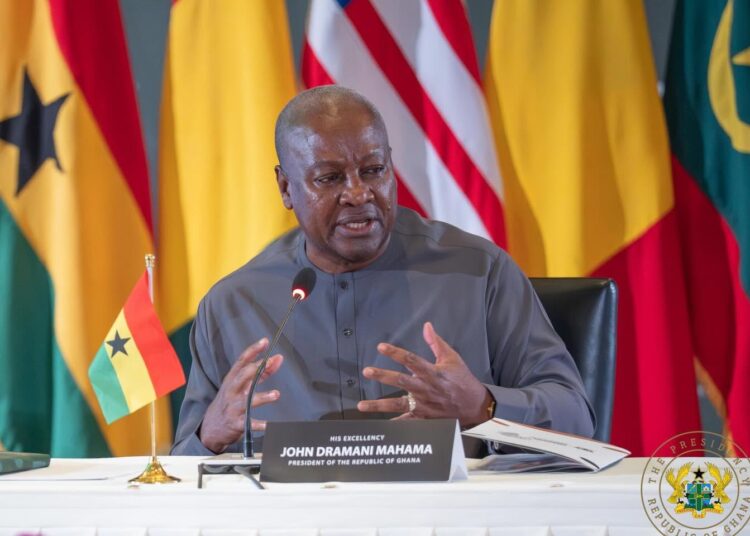
President John Dramani Mahama has pledged that his administration will take firm and difficult decisions to address Accra’s perennial flooding, stressing that the recurring disaster can no longer be treated as a seasonal inconvenience but as a national emergency requiring collective responsibility and decisive action.
Speaking on his arrival from bilateral visits to the United Kingdom and Belarus, the President said the recent floods and the collapse of buildings that resulted in fatalities should compel the nation to reflect deeply on the underlying causes of such tragedies.
“Let me first thank the Vice President for visiting a lot of the places that were affected by the floods and also the recent collapse of structures and buildings that led to deaths. This is an issue that we need to really, as a nation, do some hard searching”.
President John Dramani Mahama
He also commended Vice President Professor Jane Naana Opoku Agyemang for drawing attention to the issue of indiscipline, which he described as one of the major factors contributing to the flooding crisis.

Indiscipline and Poor Waste Disposal
President Mahama expressed concern about what he described as the erosion of societal values, particularly with regard to environmental sanitation and waste management practices.
“Our values are eroded. We don’t care anymore. When it’s raining is the time for us to pour our garbage in the drain and we think that we’ve disposed of it.”
President John Dramani Mahama
According to him, the widespread practice of dumping refuse into drains ultimately worsens the flooding situation as the waste accumulates and obstructs the free flow of water.
“Yes, you’ve disposed of it from your house, but it won’t go far. It will go and get choked with the garbage from all the other houses, and when the rains come, it will back up into your house”.
President John Dramani Mahama
The President noted that even underground drainage systems, often proposed as solutions to flooding, are rendered ineffective because they become clogged with plastic waste, food packaging materials, and Styrofoam containers discarded by residents.

Urbanisation and Encroachment
Beyond waste disposal, President Mahama identified unregulated development and the destruction of natural drainage systems as significant contributors to flooding in the capital.
He lamented the disappearance of green spaces that traditionally absorbed excess rainwater, describing Accra as a city increasingly overwhelmed by concrete structures. “There’s a concrete jungle. In many places, in many countries, there are green places that soak up the water. In Accra, there’s nowhere,” he remarked.
The President specifically highlighted the encroachment on wetlands and waterways, explaining that these areas play a vital role in managing stormwater before it flows into the Atlantic Ocean.
“The wetlands that absorb the water before releasing it into the Atlantic Ocean are being constricted because people are filling and building and then reducing the volume of water it can contain”.
President John Dramani Mahama
He warned that when these natural buffers lose their capacity to contain water, flooding becomes inevitable. “If it can’t contain that volume of water, then it backs up, and it floods everybody’s house,” he added.
Shared Responsibility for the Crisis
President Mahama argued that addressing the flooding problem requires accountability from all stakeholders, including landowners, local assemblies and officials responsible for issuing development permits.
Referring to ongoing demolition exercises targeting structures built in wetlands, he acknowledged public criticism but maintained that such actions were necessary.
“When the Greater Accra Regional Minister and her team go and they are demolishing houses built in the wetlands, people say the government is inhumane,” he stated. However, he questioned how some of the affected structures received official approval in the first place.

“Those lands are not supposed to be sold, and partly the fault of our assemblies and the officers who grant the permits. Some of the houses have building permits. How did they get them?”
President John Dramani Mahama
The President said the nation must engage in honest reflection and ensure that institutions entrusted with enforcing planning regulations carry out their responsibilities effectively.
Government Signals Tough Action
President Mahama disclosed that he had directed the National Disaster Management Organisation and other relevant agencies to identify all restricted waterways across the country.
He indicated that the government would act decisively once the exercise is completed. “We’re going to identify all the restricted waterways, and when they have done that, I’m giving the directive that they should go ahead and do what they have to do,” he said.
The President expressed hope that citizens would understand that such measures are intended to protect lives and property. “I hope that when we do that, all Ghanaians will understand that it is the government’s business to protect the safety of all of us,” he noted.
Learning from the Past
Using a traditional analogy, President Mahama cautioned against delaying action until disaster strikes again. “We shouldn’t be like the vulture who says he will repair his roof when the rain stops. When the rain stops, it forgets about it,” he remarked.
He stressed that Ghana must avoid repeating the cycle of responding to floods only after lives and property have been lost. “This time if we repair the roof, we have to really work on it,” he added.
The President also observed that rainfall this year had been unusually intense, beginning in May and continuing into June, thereby worsening the extent of flooding experienced in several communities.

He further directed government communication institutions to intensify public education campaigns aimed at changing behaviours that contribute to environmental degradation and flooding.
“We should be able to do small skits that show our people what not to do in respect of the kinds of things that we do that create problems for us”.
President John Dramani Mahama
As the country grapples with the devastating effects of recurrent flooding, President Mahama’s remarks signal a renewed commitment to implementing measures that prioritise public safety, environmental responsibility and long term urban resilience.
READ ALSO: NPA Marks World LPG Day, Advances Clean Cooking Agenda