The Member of Parliament for Damongo and Ranking Member of the Foreign Affairs Committee, Honourable Samuel Abdulai Jinapor has argued that the size of a government should not be measured solely by the number of ministers and deputy ministers. He indicated that an assessment of appointments across government institutions offers a more accurate picture of the actual scale of an administration.
Speaking on the ongoing debate over the structure of government, Honourable Jinapor stated that public attention has focused heavily on ministerial appointments. He suggested that such an approach leaves out several categories of appointees whose positions also carry significant financial implications.
The Damongo MP observed that the current administration has repeatedly presented itself as the leanest government in the history of the Fourth Republic. He, however, contended that expenditure associated with government operations points to a different reality.
To support his position, the Ranking Member referred to appointments within the Office of Government Machinery. He explained that compensation for presidential appointees is determined through an established grading framework linked to public office rankings.
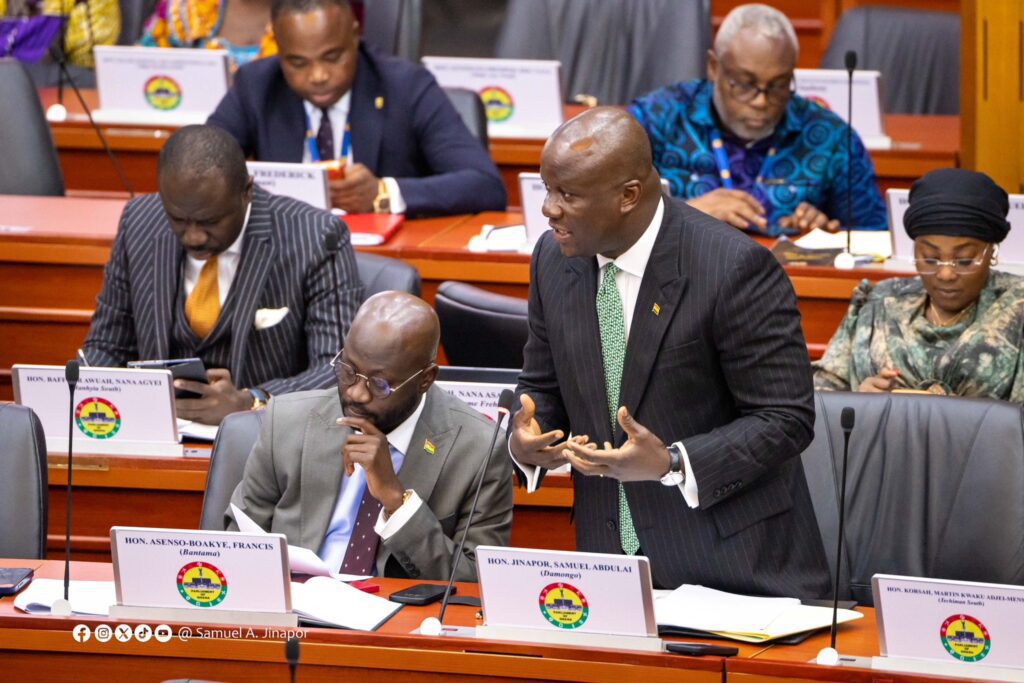
Honourable Jinapor noted that the Chief of Staff is ranked above a Member of Parliament serving as a Cabinet Minister and below the Speaker of Parliament. He added that Senior Presidential Advisors, Presidential Advisors and Presidential Aides are similarly assigned grades comparable to ministers and deputy ministers.
Furthermore, Honourable Jinapor pointed to the appointment of regional party organisers as presidential staffers attached to Regional Coordinating Councils. He argued that such appointments carry financial obligations comparable to those of ministers of state.
“Once these appointments are examined in terms of compensation and benefits, the picture changes significantly. The discussion must go beyond ministers and deputy ministers if we want a true assessment of government size.”
Honourable Samuel Abdulai Jinapor
The Ranking Member also cited presidential staffers who have been assigned to ministries, departments and agencies as Corporate Affairs Directors and Special Assistants. He stated that these positions contribute to the overall cost of governance.
Discussing the budgetary figures, the Damongo MP referenced compensation estimates contained in recent national budgets. He noted that the 2026 estimate for compensation under the Office of Government Machinery stood at GH¢550 million compared with GH¢326 million in 2024.
He remarked that the difference between the two allocations raises legitimate questions about the cost of administration. In his view, those figures warrant a wider examination of appointments beyond cabinet and deputy ministerial positions.
The Ranking Member also compared the number of deputy ambassadors serving in Ghana’s diplomatic missions. He stated that former President Nana Addo Dankwa Akufo Addo had six deputy ambassadors while President John Dramani Mahama currently has eighteen.
He added that a meaningful analysis of government size requires consideration of every category of political appointment. The Damongo MP stressed that limiting the discussion to ministers alone does not present the full picture of public expenditure.
Government Size Debate Requires Honest National Assessment
The Ranking Member for the Foreign Affairs Committee, Honourable Jinapor called for a transparent examination of staffing arrangements across government institutions. He argued that public discussions on the issue should be guided by facts and detailed analysis.
His remarks followed explanations by Presidential Spokesperson Honourable Felix Kwakye Ofosu regarding the movement of some civil servants to the Presidency after the restructuring of ministries. The government spokesperson suggested that such administrative changes contribute to higher personnel figures within the Office of Government Machinery.

In response, Honourable Jinapor observed that previous administrations also operated several major programmes from the Presidency. He cited the Free Senior High School programme under former President Akufo Addo as one example of a national initiative managed from the seat of government.
The Damongo MP clarified that his intervention is not directed at criticising the size of the current administration. Instead, he said the national conversation should focus on presenting a complete account of government staffing and expenditure.
Additionally, the Ranking Member urged independent institutions and media organisations to undertake detailed studies of appointments across ministries, departments and agencies. He suggested that such research would provide a clearer understanding of how government structures function in practice.
“Let us be candid, transparent and honourable about this discussion. A proper analysis of appointments across government institutions will give the public a clearer understanding of the facts.”
Honourable Samuel Abdulai Jinapor
He also referred to appointments in Ghana’s diplomatic missions abroad. The Member of Parliament stated that a comprehensive review of staffing arrangements at foreign missions would contribute meaningfully to the debate.

Beyond diplomatic postings, Honourable Jinapor highlighted the presence of special assistants, communication directors and corporate affairs officials within various public institutions. He said these appointments should form part of any objective assessment of government size.
The Ranking Member argued that the emphasis on the number of ministers has overshadowed other categories of appointments. Consequently, he emphasised that the overall structure of government can only be understood when all positions are taken into account.
He acknowledged that the Constitution grants the President authority to establish a government capable of implementing its policy agenda. The Damongo MP added that every administration is entitled to organise its affairs in a manner it considers effective.
“I am saying that the conclusion or assertion that we have a lean government simply because we have 58 ministers is totally misleading.”
Honourable Samuel Abdulai Jinapor
He reiterated that a balanced national conversation requires openness and evidence based analysis. In his assessment, a fuller examination of appointments and compensation would provide citizens with a more accurate understanding of the cost and structure of government.
READ ALSO: Climate Crisis Puts Almost Every Child at Risk, UNICEF Warns