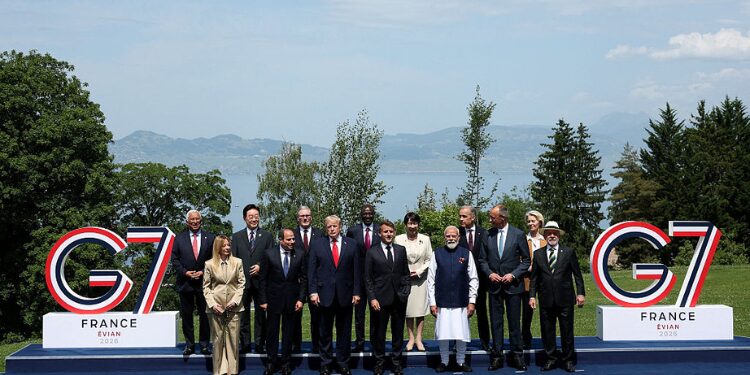
G7 leaders have called for an “immediate robust ceasefire” in Lebanon and pledged to accelerate efforts to diversify global energy supply routes away from the Strait of Hormuz as they endorsed an interim agreement aimed at ending the war between the United States and Iran.
The agreement, which is expected to be formally unveiled later this week, is designed to pave the way toward a permanent settlement after months of conflict that has reportedly killed more than 7,000 people across Iran and Lebanon.
In a joint statement, the G7 leaders emphasised their shared position on preventing nuclear escalation in the region while signalling cautious support for the diplomatic breakthrough. “We underline the need for the negotiation to address the threats posed by Iran in the region and beyond and ensure that they never obtain a nuclear weapon,” the statement stated.
Although the leaders broadly align with Washington’s long-standing concerns over Iran’s nuclear ambitions, several members reportedly expressed unease about the broader consequences of the war and the extent to which Tehran has retained its regional influence despite sustained military pressure.
The emerging deal, according to officials extends an earlier ceasefire arrangement by 60 days to allow negotiations on a final settlement. It also outlines potential economic incentives, including a proposed $300 billion reconstruction fund supported by Gulf states, contingent on Iran’s compliance with agreed conditions.
However, key issues remain unresolved. Iran’s missile programme and its continued support for allied militias such as Hezbollah are not currently included in the formal negotiation agenda, a gap that analysts highlights could complicate long-term stability.
The G7 statement also placed significant emphasis on Lebanon, where fighting between Israel and Hezbollah has intensified in parallel with the wider regional conflict. Leaders called for an immediate ceasefire and the disarmament of Hezbollah, warning that continued violence risks further destabilising the region.
The situation in Lebanon remains highly volatile. Israeli forces continue to occupy parts of southern Lebanon, while large-scale displacement has left more than a million people unable to return to their homes. Hezbollah, meanwhile, maintains that it remains operational and has linked any long-term truce to the withdrawal of Israeli forces.
A spokesperson for Hezbollah noted that the group does not believe Iran will agree to a permanent ceasefire unless Israeli forces withdraw from occupied territory, underscoring the fragility of the emerging diplomatic framework.
The dispute has also exposed growing tensions between Washington and Tel Aviv. President Trump publicly criticised Israel’s military conduct in Lebanon and suggested that its actions risk undermining broader peace efforts.
The US President went further, warning that continued Israeli operations could complicate the diplomatic process with Iran, which he has made a central foreign policy objective.
“Without us, without the United States, there would be no Israel. Without me, there would be no Israel, because no other president was willing to do what I did.”
Donald Trump
Energy Security Fears Drive G7 Push to Reduce Reliance on Strait of Hormuz

Beyond the immediate political and security implications of the ceasefire negotiations, the G7 summit was also shaped by growing concern over global energy markets and the vulnerability of key supply routes.
The Strait of Hormuz, a critical chokepoint for global oil and liquefied natural gas shipments, has emerged as one of the most strategically sensitive areas in the world during the conflict. Disruptions to shipping in the region have already contributed to volatility in global energy prices and raised fears of prolonged instability in international markets.
In response, G7 leaders announced a coordinated plan to reduce reliance on the Strait by diversifying global energy supply routes and increasing strategic reserves.
The statement committed member states to “accelerate the diversification of energy supply routes in order to reduce global vulnerability to the Strait of Hormuz and to increase our energy stocks.”
Officials highlighted that a coalition led by Britain and France would play a key role in securing maritime shipping lanes once the Strait is expected to reopen later this week under the terms of the ceasefire agreement.
Oil markets reacted quickly to the diplomatic developments, with Brent crude futures falling below $80 per barrel, marking their lowest level since the initial escalation of the conflict.
However, it is still unclear how quickly production and shipping operations will return to normal. Industry analysts warn that even if the Strait reopens as planned, supply systems in the Middle East may take months to fully recover.
While this action is expected to relieve pressure on global energy prices, it will also face political scrutiny in the United States, where critics warn that concessions to Tehran risk undermining long-term influence over Iran’s nuclear and military ambitions.
Despite these reservations, G7 leaders expressed willingness to support the agreement’s execution, casting it as a crucial step toward resolving a crisis that has already transformed regional alliances and global oil security calculations.
READ ALSO: Gold Holds Gains Amid Interim US-Iran Peace Agreement