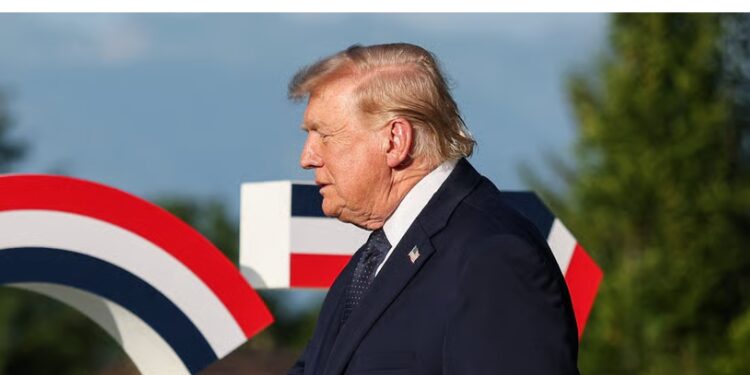
US President Donald Trump has issued one of his strongest warnings yet to Iran, declaring that “all hell will rain down” on the Islamic Republic if it attempts to acquire a nuclear weapon, as negotiators move closer to a framework agreement aimed at ending months of conflict and easing tensions across the Middle East.
Speaking to reporters during the G7 summit in Évian-les-Bains, France, Trump sought to reassure allies that any emerging agreement with Tehran would contain strict safeguards preventing Iran from advancing a nuclear weapons programme.
At the same time, Trump delivered unusually sharp criticism of Israel’s military campaign in Lebanon, warning that continued strikes against Hezbollah risk undermining a fragile diplomatic process that he has championed.
“They’re not going to acquire a nuclear weapon. If they do, all hell will rain down on them.”
Donald Trump
He added that the preliminary agreement “says it loud and clear: they’re not going to develop it and if they do, they suffer unbelievable consequences.”
For years, Iran’s nuclear programme has remained one of the most contentious issues in Middle Eastern geopolitics, drawing concern from Western powers, Israel and regional Arab states.
Successive American administrations have sought to prevent Tehran from developing nuclear weapons capabilities, while Iranian leaders have consistently maintained that their nuclear activities are intended for peaceful purposes.
The latest diplomatic initiative comes amid broader efforts to de-escalate several interconnected conflicts that have destabilised the region. Central among these is the ongoing confrontation involving Hezbollah in Lebanon, a powerful Iran-backed movement that has been engaged in hostilities with Israel.
It was on this issue that Trump directed some of his strongest criticism toward one of Washington’s closest allies.
“Israel is fighting Hezbollah too long and too many people are being killed. And you don’t have to knock down an apartment house every time you’re looking for somebody.
“Because there are a lot of people in those apartment houses. And they’re not all Hezbollah, I can tell you.”
Donald Trump
Trump indicated that he had personally communicated his concerns to Israeli Prime Minister Benjamin Netanyahu, despite describing their relationship as positive but added that the Israeli leader “has to be more responsible with respect to Lebanon.”
His remarks came after reports that Israeli strikes on Beirut over the weekend had put more strain on negotiations and prompted fears of a larger regional escalation.
While Trump continues to portray Iran as the primary threat to regional security, his administration appears increasingly anxious that ongoing instability in Lebanon would jeopardise diplomatic gains from a possible agreement with Tehran.
Netanyahu Faces Growing Pressure as Washington and Tehran Pursue Diplomatic Breakthrough
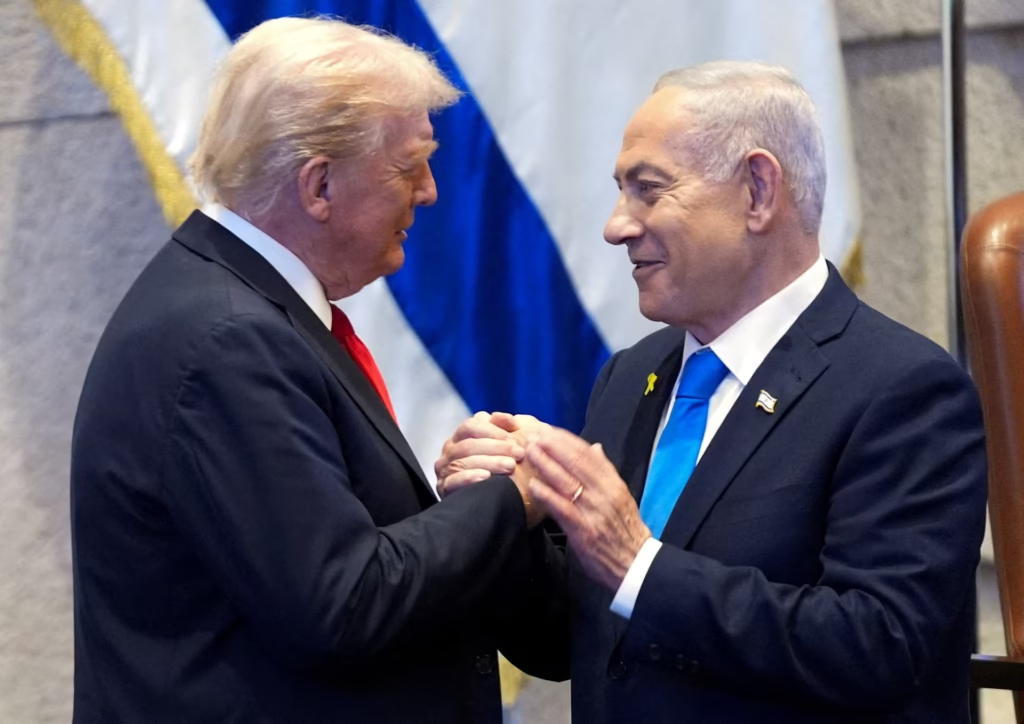
Trump’s latest intervention has placed Israeli Prime Minister Benjamin Netanyahu in an increasingly difficult political position, as he navigates mounting domestic pressure while managing differences with his country’s most important ally.
For decades, Netanyahu has built much of his political identity around security issues, particularly his opposition to Iran and his close relationship with successive American administrations. However, the prospect of a US-Iran framework agreement has complicated that political narrative.
The emerging deal threatens to challenge several pillars of Netanyahu’s long-standing approach to regional security.
Critics within Israel have questioned whether the prime minister has retained meaningful influence in Washington after finding himself publicly criticised by Trump on multiple occasions during the negotiations.
The US president intensified that pressure during remarks at the G7 summit noting, “I didn’t like that he did an attack that was too much,” referring to recent Israeli military operations.
He added that, “without the US, there would be no Israel because no other president was willing to do what I did.”
Trump also suggested that Syria could play a greater role in containing Hezbollah, arguing that Damascus might be better positioned to address the challenge without causing widespread civilian harm. “I suggested to Israel to let Syria take care of Hezbollah. Because to be honest with you, I think they’d do a better job of doing it,” he noted.
Moreover, US President, Donald Trump praised Syrian leader Ahmed al-Sharaa, stating that he had “protected everything that I’ve asked for,” adding that “if Israel can’t do the job without killing everyone else, he’ll do the job. Syria will do the job.”
Nevertheless, observers warn that developments on the ground could still influence negotiations. Iran has consistently viewed Hezbollah as a key strategic ally, and any escalation in Lebanon could affect Tehran’s willingness to engage constructively in diplomatic talks.
For Netanyahu, the challenge is increasingly political as well as strategic. With elections approaching and security remaining central to public debate, he faces the difficult task of convincing Israeli voters that his approach continues to safeguard national interests while maintaining vital ties with Washington.
As G7 leaders continue discussions in France, attention is now focused on whether negotiators can transform the proposed framework into a lasting agreement. Success would represent one of the most significant diplomatic developments in the Middle East in recent years.
Failure, however, could reignite tensions across a region already burdened by overlapping conflicts, fragile ceasefires and competing geopolitical ambitions.
READ ALSO: Grids Gas Define Africa Energy Future Debate