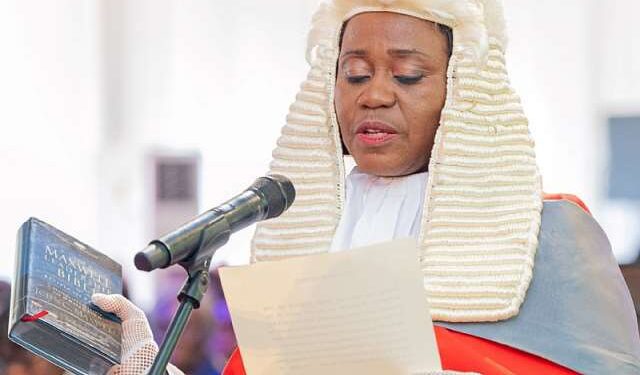
Former Chief Justice Justice Gertrude Araba Esaaba Sackey Torkornoo has filed an application at the Supreme Court seeking a review of the court’s earlier decision that dismissed her challenge against her removal from office.
The application, filed under Article 133 of the 1992 Constitution and pursuant to Rules 54, 55, and 56 of the Supreme Court Rules, asks the apex court to overturn its ruling delivered on May 28, 2026. Justice Torkornoo argues that the decision resulted in a miscarriage of justice and denied her the constitutional right to be heard.
The latest legal move marks another significant development in the ongoing legal battle surrounding her removal from office and the constitutional questions that have emerged in its aftermath.
Fair Hearing Concerns Raised
At the heart of Justice Torkornoo’s application is the claim that she was denied a fair hearing during proceedings leading to the dismissal of her case. According to the application, the Supreme Court acknowledged during case management proceedings that she did not have active legal representation.
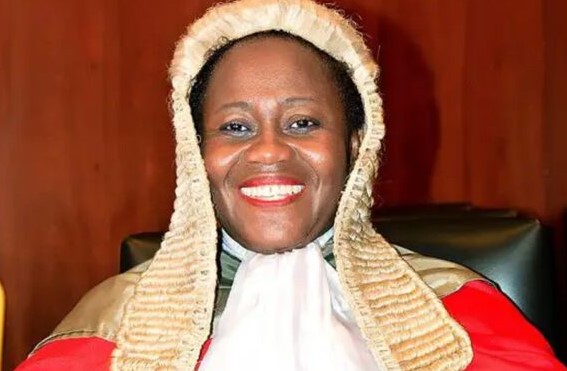
This followed the withdrawal of her lawyer, Godfred Yeboah Dame, who formally filed a notice terminating his representation in the matter. Justice Torkornoo contends that the circumstances surrounding the proceedings prevented her from fully presenting her case before the court reached its decision.
Her affidavit further notes that the Attorney General, who was the defendant in the consolidated suits, was also absent during those proceedings. She argues that these circumstances contributed to a process that failed to satisfy constitutional standards of fairness.
The former Chief Justice is therefore asking the Supreme Court to revisit its earlier ruling and set aside the decision that dismissed her challenge.
Continuing Legal Battle
The review application comes amid a series of legal proceedings arising from her removal from office. Justice Torkornoo has consistently challenged aspects of the process that led to her removal and has pursued legal remedies in both domestic and regional courts.
Her latest application follows developments at the ECOWAS Community Court of Justice, which recently dismissed her application for interim measures. The regional court held that she had not demonstrated the urgency necessary to justify intervention aimed at halting the removal process.
The ECOWAS ruling represented a setback in her efforts to secure immediate relief while broader legal questions surrounding her removal remain under consideration. Despite that outcome, Justice Torkornoo continues to pursue multiple legal avenues in Ghana’s judicial system.
High Court Challenge Remains Active
Alongside the Supreme Court review application, the former Chief Justice is pursuing a judicial review action before the High Court. That case challenges the legality of President John Dramani Mahama’s removal warrant issued in September 2025.
Justice Torkornoo argues that her removal as a Justice of the Supreme Court did not comply with constitutional procedures prescribed under Article 146 of the Constitution.

According to her position, the processes required for the removal of a Justice of the Superior Courts were not fully observed. The High Court case is expected to examine those constitutional questions separately from the issues raised before the Supreme Court.
Together, the proceedings form part of a wider legal dispute that has attracted significant public and professional interest because of its implications for judicial independence, constitutional governance, and due process.
Mixed Reactions Emerge
The latest application has generated varying reactions within legal circles. Private legal practitioner Timothy Selikem Korku Donkor criticized the move, describing it as an abuse of the court process.
In comments shared publicly, he argued that repeated legal actions over the matter place additional pressure on an already burdened judicial system. “This is an abuse of the court process,” he stated.
He further expressed concern about the impact of multiple court actions in a justice system where cases often face delays and judges continue to grapple with heavy workloads.
However, supporters of Justice Torkornoo’s position maintain that every litigant is entitled to exhaust available legal remedies, particularly where constitutional rights and questions of due process are concerned.
The Supreme Court is expected to determine whether the grounds advanced by the former Chief Justice justify reopening the matter and reviewing its earlier decision.

The review application now places the matter once again before Ghana’s highest court. Its determination could shape the next phase of a legal dispute that has generated national debate and raised important constitutional questions about judicial accountability, removal procedures, and the right to a fair hearing.
For now, attention turns to the Supreme Court as it considers whether its May 28 ruling should stand or whether the former Chief Justice’s arguments warrant a fresh examination of the case.
READ ALSO: Oil Prices Return to Pre-War Levels as Hormuz Traffic Rebounds