The European Union has issued two measures to protect its steel industry and limit e-commerce small parcels, as the 27-nation bloc struggles with its trade imbalance with China.
Under the plans disclosed, there will be a new 3 euro ($3.42) customs duty on small packages. From Wednesday, the EU will remove an customs duty exemption called “de minimis” for parcels valued at under 150 euros. Chinese firms like the e-commerce giants Temu and Shien control about 90% of this type of trade, according to the Commission. The US made a similar move last year.
The European Commission said that 5.9 billion small packages were imported into the EU in 2025, compared with about 1.4 billion in 2022. At roughly 16 million a day, that’s 97% of the traffic, but represents just 2% of import value. A majority of the packages were said to have failed safety tests and triggered environmental concerns on overuse of plastic.
The new rules also set tariff-free quotas at 18.3 million metric tons annually and imposes an out-of-quota duty of 50% on 26 types of steel imports. It also requires more transparency from importers to trace where the so-called “melt and pour” stage of production takes place to ensure countries like China will not circumvent protections by shipping products to the EU via third countries.
The EU had put in new steel tariffs in October to protect the bloc from a flood of steel imports diverted by new U.S. trade policy under President Donald Trump. According to the European Steel Association, Europe’s steel industry is in crisis, with crude steel output falling to a “historic low” in 2026.
The trade group’s Director-General Axel Eggert said in March that Europe’s steel production is “shrinking while imports as a share of the EU market are rising,” adding, “EU policymakers must therefore agree the new steel trade measure quickly without it being weakened otherwise Europe risks losing more industrial capacity.”
While China produces more than half of the world’s steel, the EU imports mostly from trade partners like the UK, Ukraine, India, Taiwan, Turkey, Japan and South Korea. The new tariffs could trigger penalties in free trade agreements with nations like Japan but some exemptions have been granted to Ukraine.
The European Commission said that new rules on steel imports are designed to protect EU plants and jobs from “the damaging impacts of global overcapacity” on “a strategically crucial European industry.” China’s subsidies for steel production have led critics in Brussels and beyond to charge that policy undercuts steel industries from Germany’s Ruhr valley to Kyushu Island in Japan.
The EU’s trade deficit with China widened in 2025 to around 360 billion euros ($410 billion) — or roughly 1 billion euros a day — and is rising in 2026. China’s annual global trade surplus reached a near-record $1.2 trillion last year even after higher tariffs introduced by the Trump administration, and despite China’s dependency on Persian Gulf energy, the war in Iran has not destabilized China’s export-led economy with sales of high-tech goods and vehicles abroad having jumped.
Meanwhile, China’s Minister of Commerce Wang Wentao met with the EU’s trade representative Maroš Šefčovič in Brussels on Monday. “The EU remains open for business but we need to defend our industrial base and keep pushing for a level playing field globally, so our industries get a fair shot at competing,” Šefčovič said after the talks.

He said, “That is why today’s talks – and the ones to follow – matter,” adding, “The status quo is not an option.” He has set an October deadline for meaningful results in rebalancing trade during a visit to Beijing.
European Commission President Hails New Measures
European Commission President, Ursula von der Leyen said in an online post praising a new 3 euro ($3.42) customs duty on small packages, “Today’s change is about restoring fairness for European businesses and better protecting our consumers.”
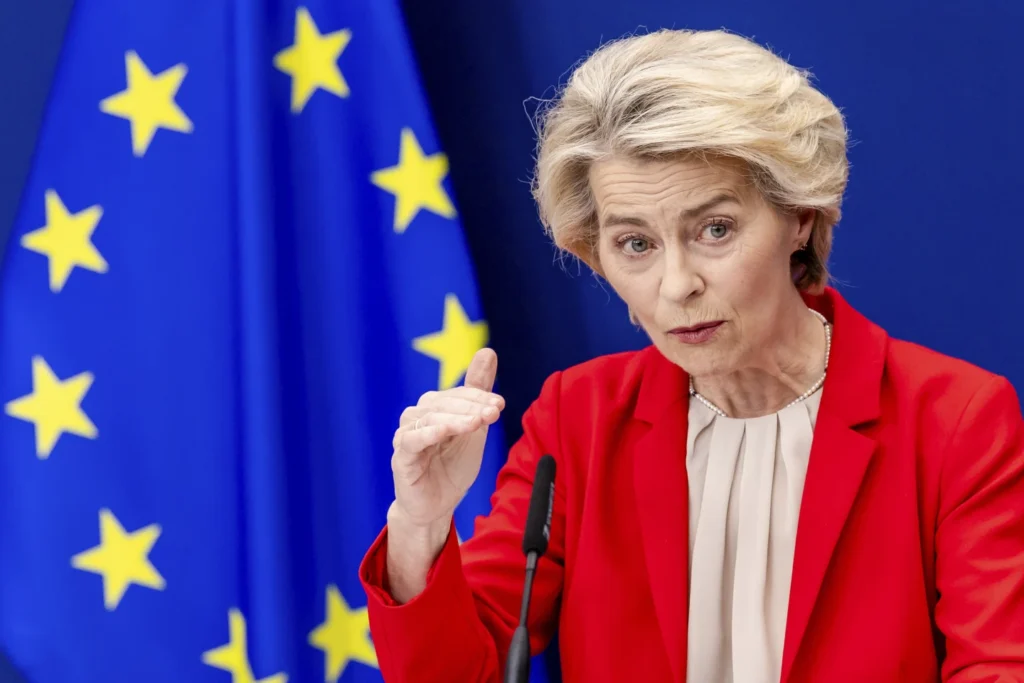
“The surge in low-value online imports has put our retailers at an unfair disadvantage. Too many of these products also fail to meet EU safety standards, putting consumers at risk.”
Ursula von der Leyen
Also, Bernd Lange, the Head of the European Parliament’s trade committee stated in a post online, “Europe finally shows teeth against flood of cheap package deals.”
However, Gary Ng, a research fellow at the Central European Institute of Asian Studies opined that the 3 euro tax might “not affect the big picture” as it’s minimal compared to the price gap between Europe and China for goods like e-commerce. While it may be effective in reducing small orders and impulse purchases, Ng said that customers and e-commerce platforms can still make group orders.
China’s Ministry of Commerce in May warned the EU against new steel import regulations and said China would firmly respond to “discriminatory measures” against its companies and products.