Years after the Public Interest and Accountability Committee (PIAC) began issuing recommendations on how Ghana should better manage petroleum revenues, the country’s independent oil revenue watchdog says too many of those proposals continue to go unimplemented, raising fresh concerns about accountability and value for money in the sector.
The Committee is now calling for stronger enforcement mechanisms to ensure that recommendations contained in its statutory reports translate into action rather than becoming recurring observations with little practical impact.
According to discussions during PIAC’s #TimeWithPIAC Facebook Live Session as reported by Energy News Africa, PIAC officials argued that repeated failures to act on identified governance gaps risk undermining the country’s petroleum revenue management framework at a time when prudent use of oil revenues remains critical to Ghana’s economic development.
Ghanaians want to know why key recommendations designed to protect our oil resources are repeatedly left on the table.
PIAC’s Senior Communications Manager, Jessica Acheampong
Her remarks reflect a concern that has featured consistently in several of PIAC’s annual and semi-annual reports, where the Committee has identified implementation gaps across institutions responsible for managing petroleum revenues.
From oversight to implementation
Since its establishment under the Petroleum Revenue Management Act, PIAC has served as an independent oversight body tasked with monitoring how Ghana collects, allocates and spends petroleum revenues.
Over the years, its reports have highlighted issues ranging from delayed projects and maintenance deficiencies to concerns about the fragmentation of petroleum-funded investments across numerous small projects.
While successive governments have acknowledged many of these observations, PIAC believes implementation has not kept pace with the recommendations being made.

According to Mark Ofori Adu Agyemang, Head of PIAC’s Technical Department, the value of independent oversight depends not only on identifying problems but also on ensuring that institutions respond to them.
Without coordinated action by implementing institutions, monitoring alone risks becoming a mere academic exercise rather than a tool for improving governance, he observed during the discussion.
Why implementation matters
The Committee argues that the consequences of weak implementation are already visible.
Samuel Boakye, Chairman of PIAC’s Technical Subcommittee, linked recurring challenges such as delayed projects, abandoned infrastructure and expenditure inefficiencies to failures by implementing agencies to adequately act on recommendations contained in PIAC’s reports.

Those concerns echo findings that have appeared repeatedly in the Committee’s published assessments of petroleum revenue utilisation, where questions have been raised about whether oil revenues are consistently delivering long-term development outcomes.
For a country with finite petroleum resources, governance experts have long argued that how revenues are invested is just as important as how much revenue is generated.
Projects left incomplete, inadequate maintenance planning and the spreading of limited petroleum resources across numerous projects can reduce the long-term developmental impact of oil revenues.
Calls for stronger accountability
Rather than relying solely on moral persuasion, PIAC believes additional measures may now be necessary to improve compliance.
Officials participating in the discussion called for legal and institutional reforms that would strengthen the implementation of recommendations, while also encouraging greater scrutiny from Parliament, the media and civil society organisations.
The Committee also sees public engagement as an important part of that accountability process.

By taking discussions directly to citizens through digital platforms, PIAC hopes to encourage broader public interest in petroleum revenue governance and increase pressure on public institutions to respond more consistently to oversight findings.
The approach reflects a growing recognition that transparency alone may not be sufficient unless it is accompanied by sustained public demand for implementation.
A broader governance question
The discussion comes as Ghana continues to face increasing pressure to maximise the developmental impact of petroleum revenues amid broader fiscal constraints.
Recent debates around petroleum revenue utilisation have focused not only on how much money enters the Petroleum Holding Fund but also on whether allocations produce measurable economic value through well-executed projects and stronger institutional performance.
For many governance analysts, the challenge is gradually shifting from transparency towards implementation.
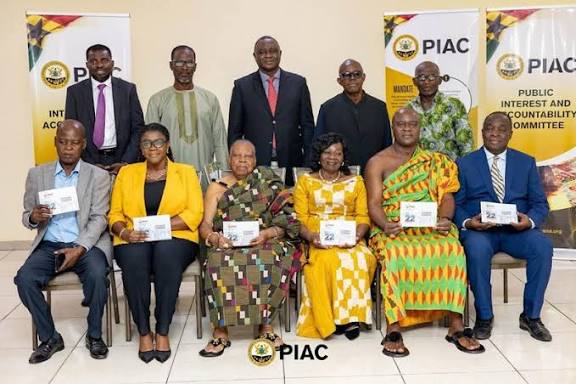
Ghana’s petroleum governance framework is often regarded as one of the more comprehensive in Africa, with institutions such as PIAC, the Ministry of Finance, the Bank of Ghana and Parliament all playing oversight roles.
The more difficult task, however, lies in ensuring that recommendations emerging from those oversight processes consistently influence public policy and project execution.
As Ghana prepares for future investments in its petroleum sector while balancing competing development priorities, PIAC maintains that stronger implementation of existing recommendations could improve value for money, strengthen public confidence and help ensure that petroleum revenues deliver lasting national benefits.
READ ALSO: Belgium Stage Stunning Comeback to Eliminate Senegal in Extra Time