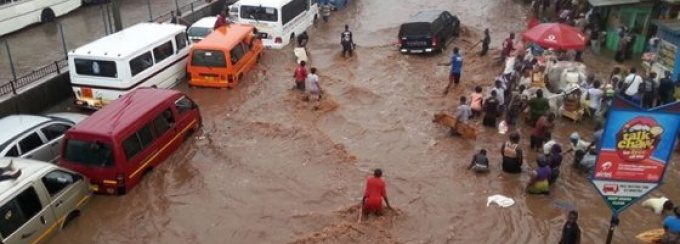
Associate Professor in Housing and Urban Development at the Department of Estate Management, Kumasi Technical University, Professor Lewis Abedi Asante has attributed Accra’s recurring flood crisis to severe urban congestion, rising infrastructure pressure and persistent political interference in planning enforcement.
Prof Asante indicated that rapid population growth has placed enormous strain on essential services across the capital. As a result, housing, roads, education and healthcare systems are facing demand levels far beyond the city’s existing capacity.
In further elaboration, the Associate Professor explained that congestion emerges when service delivery fails to match population growth. The imbalance between supply and demand, he noted, continues to deepen pressure across urban communities.
Additionally, Prof Asante pointed to Ghana’s widening housing deficit as a critical sign of structural weakness within urban planning. He stated that the national housing shortfall is nearing two million units, with Accra accounting for a significant portion of that burden.

Moreover, he explained that annual housing delivery remains far below what is required to ease the deficit. That shortfall, he said, continues to intensify overcrowding and unplanned expansion across the city.
“Congestion is felt when the city cannot provide what its growing population needs, and that pressure eventually overwhelms every major public service.”
Professor Lewis Abedi Asante
Focusing on land use practices, particularly the continuous destruction of wetlands and waterways, Prof Asante observed that these natural drainage systems once served as buffers that absorbed excess rainwater during heavy storms.
He also identified the Sakumono Wetland as one of the notable examples of wetland encroachment in Accra. The Associate Professor argued that the loss of such ecological assets has significantly weakened the city’s resilience against flooding.
Prof Asante criticised political interference in planning enforcement. He noted that even after planners identify illegal structures in vulnerable zones, influential individuals often intervene to shield offenders from sanctions.
The Associate Professor also acknowledged interventions such as the Greater Accra Resilient and Integrated Development Project, commonly known as GARID. While the initiative expanded drains and supported desilting works around the Odaw basin, he said the expected long term impact remains limited.
Furthermore, he stressed that repeated flooding despite years of intervention raises difficult questions about implementation effectiveness. The focus, he argued, must now shift toward stronger enforcement and accountability.
“Political pressure, building in waterways and weak enforcement continue to undermine every intervention aimed at solving Accra’s flood problem.”
Professor Lewis Abedi Asante
Prof Asante therefore urged city authorities to act decisively against illegal developments in flood prone areas. He added that sustainable planning remains essential if Accra is to withstand future extreme rainfall events.
Urban Planning Failures Expose Long Term Environmental Risks
Beyond congestion and weak enforcement, Accra’s flood challenge is increasingly being shaped by wetland encroachment and poor waste management, both of which continue to undermine the city’s natural drainage systems.
Prof Lewis Abedi Asante introduced the concept of wetland gentrification to explain the growing pressure on protected green spaces. In this context, he said wetlands often become prime targets for development once surrounding communities become densely built up.
Subsequently, areas originally reserved to retain stormwater begin attracting commercial and residential developers. These locations, due to their strategic value, gradually lose their ecological function.

Prof Asante widened the discussion beyond politicians alone. He stated that chiefs and family heads also play a major role by releasing protected wetland lands for private development.
In many cases, he explained, these transactions involve influential individuals with the financial capacity to construct on unstable terrain. Churches, wealthy developers and private property owners, he noted, frequently invest heavily in engineering works to support such construction.
Meanwhile, the consequences of these developments are felt across every social class. Floodwaters, the Associate Professor observed, affect both low income communities and affluent neighbourhoods alike.
Places such as Teshie-Nungua Estates, Spintex Road and Madina were cited as examples of heavily affected locations during recent flooding. Their vulnerability, he argued, demonstrates that flood risk has become a citywide issue.
“If we fail to protect wetlands, we will keep returning to the same conversation five or ten years from now while floods continue to destroy lives and property.”
Professor Lewis Abedi Asante
Another aspect, he added, lies in the way Ghana treats waste. Prof Asante observed that floodwaters carried massive volumes of plastic waste during the recent disaster, revealing a neglected environmental challenge.
In a striking comparison, he referenced Germany, where plastic bottles carry refundable value through deposit return systems. Such systems, he explained, encourage recycling and reduce indiscriminate disposal.
He argued that assigning economic value to waste could transform public behaviour in Ghana. Plastic collection would become an opportunity for income generation while simultaneously reducing drainage blockages.
READ ALSO: Belgium Stage Stunning Comeback to Eliminate Senegal in Extra Time