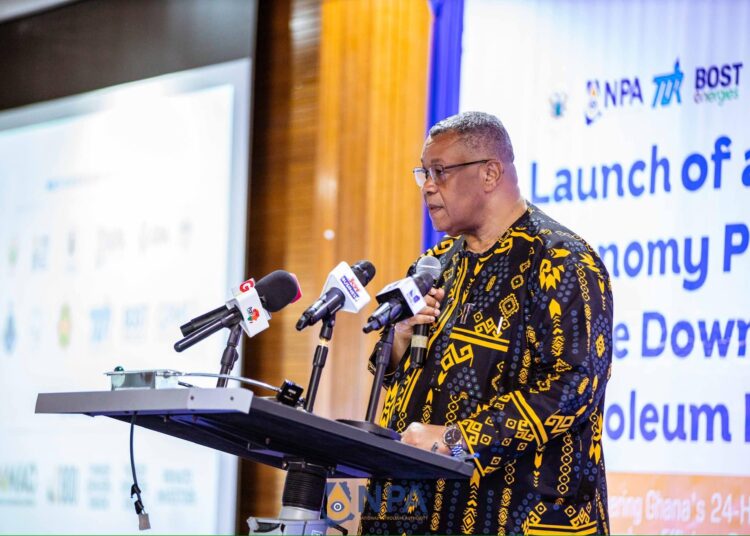
Senior Presidential Advisor on the 24-Hour Economy, Augustus “Goosie” Tanoh, has urged African nations to leverage their vast critical mineral reserves for domestic industrial development rather than remaining passive exporters of raw materials.
Speaking at the opening of the High-Level Conference on Governance, Critical Minerals and Conflict in Africa in Accra, Tanoh emphasized that the global green energy transition presents the continent with an extraordinary opportunity to transform its economic baseline.
He asserted that African governments must implement deliberate industrial strategies to capture substantial value from their mineral wealth, warning that failing to act would leave the continent behind in the expanding global green economy.
“The overwhelming central emerging task before us is clear: the world definitely will use Africa’s minerals. The question is whether Africa will use them to build its own industries, create decent jobs and strengthen peace, or be a collaborator and bystander.”
Senior Presidential Advisor on the 24-Hour Economy, Augustus “Goosie” Tanoh

Mr. Tanoh highlighted the stark contradiction of Africa possessing vital transition minerals such as lithium, cobalt, graphite, and manganese while relying on foreign imports for finished manufactured goods.
He advocated for using the framework of the African Continental Free Trade Area (AfCFTA) to construct robust regional value chains that enable local processing, high-tech manufacturing, and expanded intra-continental commerce.
Additionally, he explained that Ghana’s 24-Hour Economy initiative is specifically tailored to reinforce this agenda by connecting raw resource development with reliable energy, technological innovation, streamlined transport networks, and workforce skills training to build a self-sustaining industrial base.
Breaking the Historical Cycle of Raw Extraction
Mr. Tanoh pointed out that previous resource booms across the continent yielded surging export revenue while factories, technical infrastructure, and high-value jobs were developed overseas to enrich foreign nations.
Reflecting on these historical shortcomings, he maintained that “this time, the measure of success must be different,” calling for an end to economic models that prioritize primary extraction over local capacity building.
To avoid repeating past structural errors, African policymakers must actively incentivize local mineral processing and value addition.

Historically, exporting raw bauxite, iron ore, and crude oil exposed African states to international commodity volatility while exporting lucrative manufacturing jobs.
By establishing domestic refineries, smelters, and processing plants near mining sites, the continent can retain significantly higher economic returns and protect its domestic currencies from trade deficits.
Strategic Rationale for Africa’s Mineral-Led Industrialisation
Beyond immediate revenue expansion, critical minerals constitute the fundamental foundation of 21st-century industrialization and technological power.
The global shift away from fossil fuels depends heavily on critical raw inputs like lithium, cobalt, nickel, graphite, and rare earth elements resources held in immense quantities across African nations.
For instance, the Democratic Republic of Congo supplies over 70 percent of global cobalt, while countries like Ghana, Zimbabwe, and Mali hold strategic reserves of lithium vital for electric vehicle (EV) energy storage systems.
Relying on these minerals for industrial development offers Africa a strategic path toward technological sovereignty and long-term economic stability.
By developing domestic battery cell production, renewable energy manufacturing, and EV assembly plants, African economies can transition from peripheral raw material suppliers into core drivers of global supply chains.
Furthermore, leveraging the AfCFTA enables African states to pool raw resources, harmonize mining frameworks, and build integrated supply ecosystems capable of serving a unified market of 1.3 billion people.
Sustainable Governance, Transparency, and Inclusive Growth
Industrial ambition, however, must be matched by strong governance and ethical stewardship to prevent local displacement and environmental destruction.
Mr. Tanoh underscored that “industrialisation must go hand in hand with transparency, environmental protection and community participation,” insisting that mineral exploitation should uplift citizen livelihoods rather than incite armed conflict or worsen socio-economic disparities.
Organized by the Open Society Foundations from July 27 to 29 in Accra, the high-level summit brought together key government officials, civil society organizations, researchers, development partners, and mining communities to address these crucial governance challenges.
Integrating targeted national initiatives, such as Ghana’s 24-Hour Economy policy, provides an operational blueprint for sustained, continuous manufacturing operations across the extractive sector.
By pairing mineral refining with round-the-clock power, modern transport infrastructure, and workforce development, African nations can guarantee that critical mineral wealth yields lasting prosperity, decent employment, and regional stability.
Ultimately, shifting from raw material exports to industrial value addition ensures that Africa secures its rightfully active position in shaping the global economic future.
READ ALSO: Cyberattacks Threaten Progress in Global HIV Fight, UNAIDS Warns