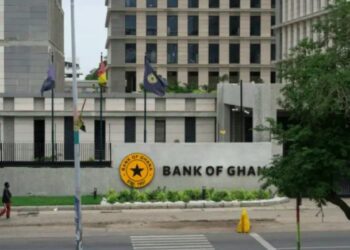
Ghana’s rapidly expanding digital financial ecosystem is facing a growing fraud challenge, prompting the Bank of Ghana (BoG) to call for a major shift in how financial institutions protect customers and transactions.
The Head of Fintech and Innovation at the Bank of Ghana, Elhanan Owureku Asare, has warned that isolated fraud prevention systems operated by individual banks, fintech companies, mobile money operators and non-bank financial institutions are no longer sufficient in an era where financial transactions seamlessly move across multiple platforms.
His comments come at a time when the country’s latest fraud statistics reveal an alarming rise in both the number of fraud cases and the amount of money exposed to financial crime.
BoG Pushes for Unified Defence Against Fraud
Speaking on the growing threat of digital financial crime, Mr. Asare stressed that the interconnected nature of Ghana’s financial ecosystem demands an equally connected approach to fraud prevention.
According to him, institutions cannot continue operating independent fraud detection systems while criminals exploit the gaps between different platforms.
“I know our recommendation is to make sure that we have an industry-wide solution to prevent fraud. So, a solution that will deal with the banks, a solution that will deal with the fintechs, a solution that will deal with non-bank financial institutions. I think we need to have a 360-degree solution, not one that is siloed. All these are connected. So, when you have a solution that is siloed, then it becomes a problem.”
Elhanan Owureku Asare
His remarks highlight a growing concern within the central bank that financial criminals are increasingly taking advantage of disconnected monitoring systems to move funds through several institutions before suspicious activity can be detected.
Digital Finance Creates New Opportunities and New Risks
Ghana has witnessed remarkable growth in digital payments over the past few years, driven by mobile money, fintech innovation and increasing adoption of electronic banking services.
Millions of customers now transfer money, pay bills, receive salaries and conduct business digitally every day. While this transformation has improved financial inclusion and convenience, it has also created new opportunities for cybercriminals and fraud syndicates.
As transactions move almost instantly between banks, payment service providers and fintech platforms, weaknesses in one institution can expose the broader financial ecosystem to fraud.
This growing complexity is what the Bank of Ghana believes requires a coordinated industry response rather than isolated institutional efforts.
Fraud Cases Continue to Climb
Fresh data from the Bank of Ghana’s 2024 fraud report underscore the urgency of the situation.
Banks, specialised deposit-taking institutions and payment service providers recorded a combined 16,733 fraud cases in 2024, representing an increase from 15,865 cases recorded in 2023.
The figures point to a steady rise in fraudulent activities despite continued investments in cybersecurity and fraud detection technologies across the financial sector.
Even more concerning is the increase in the financial value exposed to fraud.
According to the report, the total value at risk climbed by 13 per cent, rising from GH¢88 million in 2023 to approximately GH¢99 million in 2024.
The rising financial exposure demonstrates that fraud schemes are becoming increasingly sophisticated and potentially more costly for institutions and customers alike.
Payment Service Providers Face Biggest Threat
The latest figures show that payment service providers continue to bear the greatest burden of electronic fraud in Ghana’s financial sector.
The sector recorded 15,673 electronic fraud cases in 2024, compared with 14,655 incidents the previous year.
This means payment service providers accounted for the overwhelming majority of all reported fraud cases across the financial ecosystem.
The financial impact also intensified.
The value at risk within the payment service provider sector increased by 18 per cent, rising from GH¢16 million in 2023 to GH¢19 million in 2024.
The figures reflect the growing popularity of mobile money services and digital payment platforms, which have become essential tools for millions of Ghanaians but are also increasingly targeted by fraudsters seeking to exploit unsuspecting users and system vulnerabilities.
Why Collaboration Matters
Industry experts have long argued that fraud prevention can no longer be treated as an individual institutional responsibility.
Modern fraud schemes often involve multiple accounts, different payment channels and several financial institutions within a matter of minutes.
Without real time information sharing and coordinated monitoring, suspicious transactions may pass through different platforms without triggering sufficient alerts.
The Bank of Ghana’s proposed industry-wide solution seeks to bridge these gaps by enabling a comprehensive approach that brings together banks, fintech firms, mobile money operators and non-bank financial institutions under a common fraud prevention framework.
Such collaboration could improve early detection, strengthen intelligence sharing and reduce opportunities for criminals to exploit disconnected systems.
Protecting Confidence in Ghana’s Digital Economy
As Ghana continues its journey toward a fully digital financial ecosystem, maintaining public trust will remain critical.
Consumers increasingly rely on digital channels for everyday financial transactions, making security one of the most important foundations of financial inclusion and innovation.
The Bank of Ghana’s call for an integrated fraud prevention strategy signals a recognition that safeguarding the future of digital finance will require cooperation across the entire financial industry.
With fraud cases continuing to rise and financial losses becoming more significant, the central bank’s push for a unified defence may prove to be one of the most important steps in protecting Ghana’s evolving digital economy.
READ ALSO: SLTF Announces July 15 Deadline, After GHS 187.7 Million Loan Disbursement