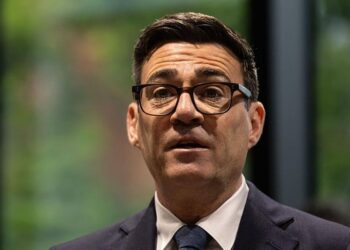
Andy Burnham has taken a decisive step towards becoming the United Kingdom’s next prime minister after securing the backing of an overwhelming majority of Labour Members of Parliament, leaving him on the verge of an uncontested victory in the race to succeed Keir Starmer as party leader.
The former Greater Manchester Mayor received nominations from 322 Labour MPs on the opening day of the leadership contest, placing him just one nomination short of the point at which it would become mathematically impossible for another candidate to mount a successful challenge.
With no rival expected to enter the race before nominations close next week, Burnham is widely anticipated to be confirmed as Labour leader on 17 July before formally taking office as Prime Minister on 20 July.
Burnham, who only returned to Westminster a few weeks ago after winning a parliamentary by-election in Makerfield, has made an incredible political comeback with the swift consolidation of support. The seasoned politician, who had previously lost Labour leadership elections in 2010 and 2015, now seems poised to fulfil his lifelong dream of heading both the party and the British government.
His ascent follows Keir Starmer’s resignation after mounting pressure from Labour MPs in the wake of disappointing local election results and growing concerns over the party’s electoral direction. Burnham’s return to Parliament immediately transformed the political landscape, with senior Labour figures increasingly viewing him as the leader capable of rebuilding public confidence and reconnecting the party with voters across Britain.
In a statement thanking colleagues for their support, Burnham described the endorsements as a sign that Labour was ready to embrace a different style of leadership focused on decentralising political power and tackling regional inequalities.
“I am deeply grateful” to Labour MPs who nominated him, he stated, adding that the backing reflected a “shared belief that Britain needs a new approach to politics. That is the circuit breaker I am offering: power out of Westminster, an economy rewired for ordinary people, and good growth in every postcode.”
The scale of support has surprised even seasoned Westminster observers. Under Labour’s rules, leadership hopefuls require nominations from 81 MPs to enter the contest. Burnham’s 322 endorsements around four-fifths of Labour’s parliamentary part leave virtually no room for a challenger to emerge, especially after former defence minister Al Carns announced he would not stand and instead endorsed Burnham’s leadership bid.
Despite the overwhelming show of unity, some Labour MPs have expressed concern that the absence of a contested leadership election could limit scrutiny of Burnham’s programme before he assumes office. Others argue that avoiding a lengthy internal contest will allow the governing party to focus on economic challenges, public services and international affairs instead of months of political infighting.
Burnham Promises New Political Direction

Burnham has started laying out the general tenets that would guide his administration if he is elected prime minister later this month, even though he has not yet released a comprehensive government blueprint.
His plan to create a new No. 10 unit in Manchester, which would enhance regional administration and give local authorities more responsibility over housing, transport and economic growth, is at the heart of his vision. Burnham’s long-held conviction that towns outside of London ought to have more sway over national policy is reflected in the idea.
He has also pledged to deliver “greater public control” over the water and energy sectors, although further details of how such reforms would be implemented are still expected.
In recent comments on foreign and security policy, Burnham has signalled continuity in Britain’s support for NATO, Ukraine and the country’s nuclear deterrent while arguing that UK must strengthen its defence industrial base in response to an increasingly unstable international environment.
The Labour leader-in-waiting has also sought to distinguish himself from the outgoing leadership on the Middle East. In a video message released on social media, Burnham apologised for Labour’s initial response to Israel’s military campaign in Gaza, indicating that the party “didn’t get it right” and must do better under his leadership.
At the same time, he indicated that he intends to retain Jonathan Powell as National Security Adviser, signalling a measure of continuity in Britain’s national security apparatus despite the impending political transition.
Meanwhile, outgoing Prime Minister, Keir Starmer has also endorsed Burnham’s leadership credentials, telling reporters that he believed his long-time colleague would make a good Prime Minister. Having worked closely with Burnham since his early years in Parliament, Starmer praised his experience and ability to lead Labour into its next chapter.
If no challenger emerges before nominations close, Burnham will become Labour leader without a ballot of party members or affiliated trade union supporters, bringing one of the fastest leadership transitions in the party’s modern history.
READ ALSO: France Soar Past Morocco to Secure Semi Final Berth