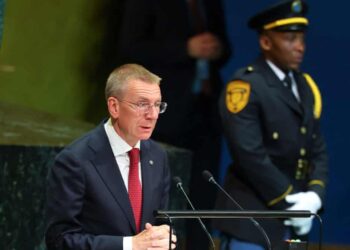
Lithuania’s parliament voted in favour of a government manifesto presented by Social Democrat Mindaugas Sinkevičius today, clearing the way for him to become Prime Minister and for his proposed cabinet to take office.
He replaces fellow Social Democrat Inga Ruginienė, Prime Minister since last year, who is moving aside for the party leader to take over amid recent turmoil in her coalition government.
The resolution was supported by 72 members of parliament, with 29 voting against and 4 abstaining. A swearing-in ceremony for the new Government members was scheduled for the same Parliament sitting.
The new centre-left coalition comprises the Social Democrats, For Lithuania and the Farmers and Green Union, giving the government a narrow parliamentary majority
The populist Nemunas Dawn party, whose leader is facing charges of incitement to hatred against Jews and belittling the Holocaust, is no longer part of the governing coalition.
The Government programme is the political document that sets the Cabinet’s agenda for the coming years. It lists 14 main priorities, including protection from external threats, economic growth, family policy, prices and incomes, education, health, transport infrastructure, energy, public order, agriculture, environmental protection, culture and civic identity, regional policy, local self-government and foreign policy.

Sinkevičius told that parliament that the new Government would aim to take decisions responsibly, listen to different groups in society and remain open to proposals regardless of parliamentary faction or political party.The programme’s most direct household pledges concern purchasing power. The Prime Minister described rising prices as one of the biggest challenges and said the Government would seek to raise incomes, strengthen fair competition and reduce income inequality.
In social protection, the programme emphasises reducing poverty among older people, increasing pensions, and expanding social and long-term care services. These commitments would affect pensioners, families caring for relatives, and municipalities that provide or coordinate many local services.
In health care, Sinkevičius pledged to reduce waiting times in medical institutions, strengthen services outside major cities and improve working conditions for medical staff. The programme says quality health, education, social and cultural services should be available in every municipality. In practice, the Government’s progress will be judged not only by national indicators but also by whether services improve in smaller towns and rural areas.
The Cabinet also promises to encourage investment and better-paid jobs across Lithuania’s regions. In family policy, it pledges better conditions for raising children, increased support for families, nursery places, expanded non-formal education and help for parents combining work with childcare.
Lithuanian Government To Keep Defence Spending Above 5% GDP
Nato and European Union member Lithuania, which borders both Russia and Belarus, is the top defence spender in Nato as a share of the country’s economy, devoting an estimated 5.33% of its gross domestic product (GDP) to the military this year.
Sinkevicius’ government manifesto pledged to keep the spending above 5% of GDP and to seek a continued US troops presence in the Baltic nation as a key deterrent against Russia, while continuing to support Ukraine.
On defence, Sinkevičius referred to lessons from the war in Ukraine. He said that future military effectiveness would depend not only on the amount of modern weaponry but on how quickly a state can integrate new technologies into force structures, command systems, troop training and combat operations. “It would be a mistake to believe that Russian military threat is subsiding due to the large losses it is now taking,” Sinkevicius told parliament, referring to Russia’s ongoing war in Ukraine.
The Government links its economic model to investment in people, knowledge and innovation. Sinkevičius said this should raise productivity, create higher added value, increase incomes and strengthen the state’s financial capacity.
The programme presents social investment not only as a matter of fairness but also as part of a long-term economic growth strategy. That makes implementation important for businesses, the public sector, schools, universities and the labour market
The next election in Lithuania is scheduled for October 2028.
READ ALSO: CalBank Profit Soars 25% to GHS353.6 Million in Strong First Half Performance