Minister for Lands and Natural Resources, Hon. Emmanuel Armah-Kofi Buah, announced that the Mineral Development Fund (MDF) is aggressively rolling out targeted socio-economic interventions to ensure mining-affected areas achieve real, long-term development.
The state agency has completed strategic planning and secured the necessary commitment authorizations to execute critical infrastructure projects across several mining enclaves this year.
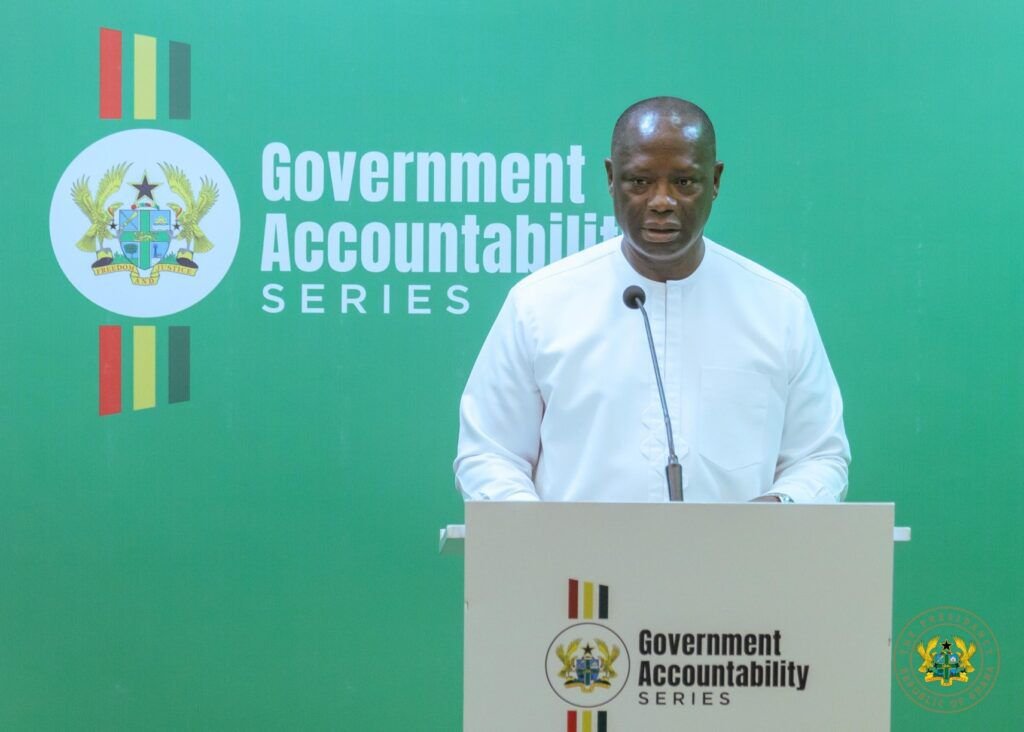
Speaking at the Government Accountability Series, the sector minister emphasized that these strategic updates reflect an institutional blueprint designed to systematically uplift rural populations and bring visible modernization to communities whose terrains yield the nation’s wealth.
“The Mineral Development Fund continue to advance this mandate of ensuring that mining communities derive tangible and sustainable benefit from the country’s mineral resources through targeted interventions in environmental restoration, community development, research, and economic diversification. The Fund continue to strengthen evidence-based decision-making within the mining sector. During the period two research papers reach the peer review stage and are awaiting publications.”
Minister for Lands and Natural Resources, Hon. Emmanuel Armah-Kofi Buah
To operationalize this agenda, the sector ministry has finalized a cross-sector project portfolio aimed at improving the daily lives of residents.
This comprehensive infrastructural push includes the immediate construction of three specialized small-town water supply systems and 16 solar-powered boreholes, directly targeting chronic water scarcity across multiple mining districts.
Simultaneously, the MDF is tackling regional disparities in basic social services by establishing newly built school infrastructure projects in six districts, putting up ultra-modern health centers in four districts to optimize primary clinical care, and constructing vibrant market facilities in six distinct mining zones to boost local commercial networks.
The Socio-Economic Imperative for Community-Led Mineral Benefits
Resource-rich enclaves frequently suffer from a structural imbalance known as the “resource curse” or “paradox of plenty,” where localized extraction results in environmental degradation without corresponding economic growth.
Historically, resource-bearing populations face severe disruptions, including the loss of arable agricultural lands, topsoil erosion, and the pollution of major aquatic ecosystems.

Consequently, structural interventions through designated mineral funds are essential to rebalance this dynamic, transforming depleting subsurface wealth into permanent human capital and resilient civic infrastructure.
By building markets and clinical structures, the state successfully cushions these communities against the eventual economic shocks of mine closures and asset depletion.
Furthermore, modern resource governance frameworks dictate that local populations must hold a tangible equity stake in the extractive value chain to maintain social stability and legal compliance.
Many Experts note that providing reliable public utilities, such as solar-powered water facilities and modern educational centers, directly mitigates community agitations, protects corporate mining investments, and curbs the proliferation of unregulated, illegal mining operations.
By institutionalizing these development programs, the state transforms mining from an isolated extractive activity into a catalytic engine for regional industrialization and comprehensive economic diversification.
Scientific Advancements and Strategic Project Tracking
Hon. Emmanuel Armah-Kofi Buah stated that the fund’s current operations rely heavily on data-backed strategies to ensure optimal capital allocation.
According to the sector minister, “the Fund has also secured commitment authorisation” to ensure the simultaneous execution of these multiphase infrastructural projects without fiscal delays.

This approach ensures that funding translates rapidly into actual brick-and-mortar facilities, optimizing public service delivery.
Beyond the immediate physical construction, the MDF is augmenting its operational efficiency by bridging the gap between scientific inquiry and practical public policy.
Ministry records indicate that two major scientific research papers have successfully reached the rigorous peer-review stage and are currently awaiting formal publication.
These academic assessments will provide the mining industry with localized data to refine environmental reclamation practices, maximize resource conservation, and optimize the socioeconomic impact of future mineral revenues across the country.
READ ALSO: Government Reclaims 1,335 Acres of Degraded Lands, Targets 1,500 More in 2026