IndexBox, a leading international market research firm, projects that the global power battery lithium recycling market could achieve a robust compound annual growth rate (CAGR) of 12.0% between 2026 and 2035.
This expansion underscores an accelerating shift toward closed-loop critical mineral supply chains as the global energy system transitions away from fossil fuels.
Driven by rising end-of-life battery volumes from electric vehicles (EVs) and utility-scale energy storage systems, the power battery recycling industry is evolving from a niche waste management activity into an essential strategic sector that secures key manufacturing feedstocks such as lithium, cobalt, nickel, and manganese.
“In the baseline scenario, IndexBox estimates a 12.0% compound annual growth rate for the global power lithium battery recycling market over 2026-2035, bringing the market index to roughly 420 by 2035 (2025=100). Meanwhile, the Middle East & Africa region faces significant challenges including limited EV adoption, weak regulatory frameworks, and informal waste management systems. However, growing interest in renewable energy and battery storage, particularly in Saudi Arabia and the UAE, is creating future feedstock potential.”
latest IndexBox report
Expanding on this secular upward trajectory, the firm’s quantitative baseline model forecasts that the overall market index will surge to roughly 420 by 2035, using 2025 as the base benchmark index of 100.
While mature markets across Asia-Pacific, North America, and Europe are poised to capture the lion’s share of early recycling capacity, developing regions reflect a far more heterogeneous development path.
For instance, the Middle East & Africa (MEA) region currently accounts for an estimated share of 3% of the global market, with localized processing activity concentrated predominantly in South Africa and the United Arab Emirates.
The region faces substantial operational and institutional hurdles, including limited EV adoption rates, weak regulatory frameworks, and predominantly informal waste management systems that inhibit systematic feedstock collection.
Nevertheless, mounting regional momentum in renewable power installation and grid-scale battery storage most notably in Saudi Arabia and the UAE is steadily building significant future feedstock potential, even as current investment in formal recycling infrastructure remains minimal and the market’s current direction is characterized as nascent.
Navigating Regional Bottlenecks and Emerging Feedstock Frontiers
The contrast between rapid global scaling and regional inertia highlights the nuanced structural barriers present in developing economic corridors.
In emerging regions, the current state of infrastructure acts as a primary bottleneck; as market analysis indicates, the regional landscape is defined by “informal waste management systems” and “minimal investment in formal recycling infrastructure.”

Without clear legislative mandates such as extended producer responsibility (EPR) regulations or standardized battery collection protocols valuable battery waste is frequently exported or discarded within unmonitored channels.
However, the ongoing diversification strategy across Gulf Cooperation Council (GCC) economies is reframing the long-term outlook.
Gigawatt-scale solar developments paired with massive battery energy storage system (BESS) deployments in Saudi Arabia’s Vision 2030 initiatives and the UAE’s Net Zero 2050 strategic umbrella are poised to yield massive operational scrap and eventual end-of-life battery volume.
Industry analysts note that this energy storage buildout creates a major prospective market pivot, transforming regions currently categorized as “nascent” into crucial operational nodes for localized secondary mineral processing over the coming decade.
Transformative Impacts on Global Energy Transitions and Supply Chain Resilience
The projected 12% annual compound growth rate carries far-reaching structural implications for the broader global energy landscape.
Primary mining operations for critical minerals remain deeply constrained by prolonged permitting timelines, localized geopolitical friction, and severe environmental footprints including high water consumption in brine extraction and heavy carbon intensity in hard-rock lithium mining.
By converting spent batteries into high-purity battery-grade precursor chemicals, industrial recycling offers a secondary resource stream that dramatically reduces carbon intensity and land disruption relative to virgin extraction.
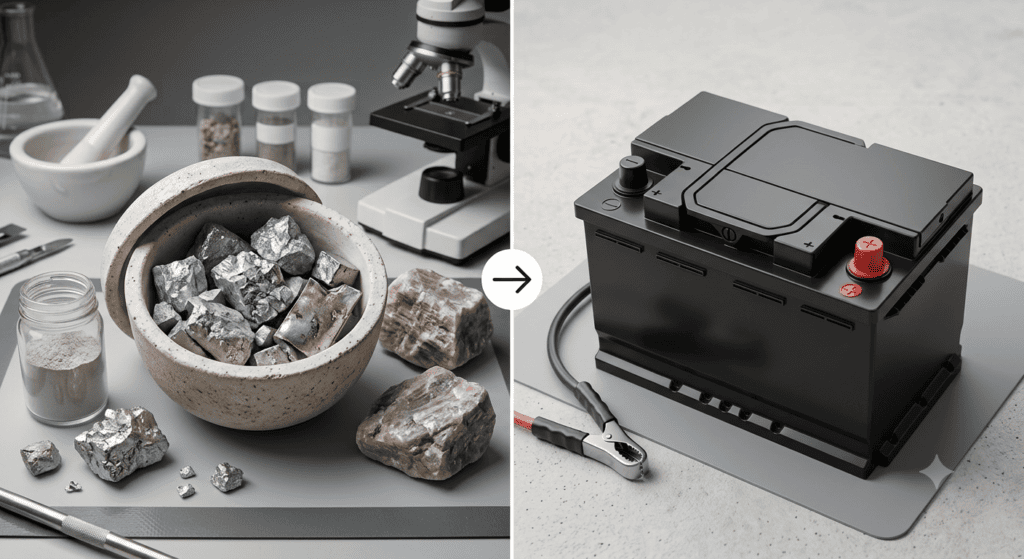
Furthermore, a fourfold expansion of recycled battery materials by 2035 serves as a crucial defense against extreme commodity price volatility.
During past market cycles, supply-demand imbalances in raw lithium and refined nickel triggered massive cost spikes that delayed battery pack cost-parity milestones for electric vehicles.
By establishing a robust domestic and regional secondary supply, energy storage original equipment manufacturers (OEMs) and automotive giants can insulate production schedules from trade disruptions and geopolitical chokepoints, stabilizing the unit economics of clean energy technologies.
Policy Catalysts and the Future Horizon of Battery Circularity
Achieving the 420 index target by 2035 will ultimately depend on synchronized regulatory evolution and technological innovation.
Advanced hydrometallurgical and direct recycling technologies are continuously improving recovery yields for critical elements, allowing recyclers to extract over 95% of lithium, nickel, and cobalt content at commercial scales.
As regulatory frameworks evolve globally, economic models will increasingly penalize linear virgin material consumption while rewarding circular battery supply chains.
For nascent markets like the Middle East & Africa, bridging the gap between potential and operational reality requires rapid infrastructure modernization.
Establishing public-private partnerships, formalizing scrap handling networks, and enacting statutory recycling targets will be essential to capture the rising volume of storage and mobility batteries.
As global energy systems deepen their reliance on electrochemical storage, power lithium battery recycling stands as a cornerstone of long-term energy security, industrial competitiveness, and environmental stewardship.
READ ALSO: Black Queens Intensify WAFCON Preparations With Draw Against Tanzania and Key Technical Appointment