

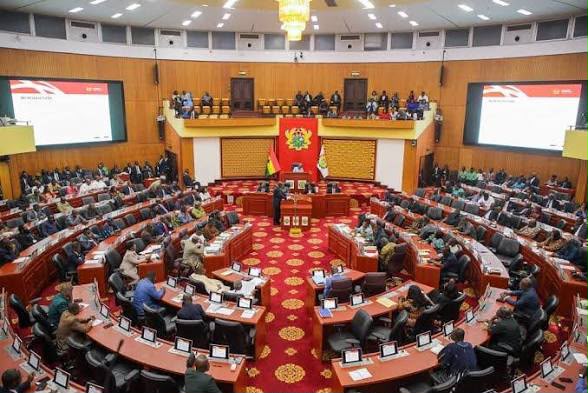
Parliament has approved significant amendments to Ghana’s energy levy regime, with government arguing that the changes are intended to plug revenue leakages, strengthen oversight of fuel oil imports and address abuses that have emerged within subsidy and exemption arrangements for industrial users.
The approved amendments revise key provisions of the Energy Sector Levies Act and introduce a new approach to how tax relief for industrial fuel oil is administered.
The measures are part of broader efforts to improve revenue collection within the downstream petroleum sector while protecting the integrity of programmes designed to support manufacturing and other productive activities.
At the centre of the changes is a sharp increase in the Energy Sector Shortfall and Debt Repayment Levy on fuel oil, which will rise from 24 pesewas to GH¢1.93 per litre.
The new rate aligns fuel oil with the levy already applied to diesel and marine gas oil.
Parliament also approved the extension of the Road Fund Levy to fuel oil, bringing the product further into the mainstream petroleum levy framework.
Government shifts from exemptions to refunds
Presenting the measures to Parliament, Finance Minister Dr. Cassiel Ato Forson said the objective was not to impose a new tax burden on motorists but to reform a system that had become vulnerable to abuse.

Under the previous arrangement, qualifying industrial users received exemptions before importing fuel oil.
Government says that structure created opportunities for misclassification, diversion and tax leakage.
The new framework requires importers to pay the applicable levies upfront and subsequently apply for refunds if they qualify for industrial relief.
Some individuals are taking advantage and smuggling, buying diesel and disguising it as fuel oil and collecting the taxes on it.
Finance Minister Dr. Cassiel Ato Forson
The Minister stressed that government intends to maintain support for genuine industrial users but wants to ensure that relief reaches only those who are entitled to it.
“There will not be a tax increase on petroleum products”, he said, arguing that fuel oil is primarily an industrial input rather than a product used by ordinary motorists.
Why fuel oil became a policy concern
Fuel oil occupies a different place in Ghana’s petroleum market from petrol and diesel.
It is commonly used by factories, heavy industries and certain large-scale commercial operations.

Because of its role in production, governments have often provided tax relief or preferential treatment to reduce operating costs for industry.
However, differential tax treatment can create incentives for abuse if oversight is weak.
Where fuel oil carries lower levies than diesel, there is a financial incentive to misdeclare products, divert subsidised fuel or exploit exemption arrangements for private gain.
Government argues that such practices have undermined both revenue mobilisation and the effectiveness of support programmes intended for productive sectors.
The approved amendments are therefore aimed less at raising fuel prices for consumers and more at tightening control over how industrial fuel relief is administered.
Faster refunds promised for industry
Recognising concerns from manufacturers and other industrial users, government says it will also amend the Revenue Administration Act to accelerate the refund process.
The proposed change would reduce the processing period for fuel oil tax refunds from 90 days to 14 days.
If implemented effectively, the shorter timeline could ease cash-flow pressures for legitimate industrial importers who would now be required to pay levies upfront before claiming refunds.
The success of the new system will depend heavily on administrative efficiency.
Delayed refunds could increase financing costs for industry and weaken the intended balance between stronger enforcement and continued industrial support.
A broader downstream governance issue
The parliamentary decision highlights a wider challenge within Ghana’s downstream petroleum sector: how to combine revenue mobilisation, subsidy control and industrial competitiveness within a deregulated fuel market.
Energy sector levies remain an important source of funding for addressing legacy debts and financial shortfalls within the power and petroleum sectors.
At the same time, industry has consistently argued that high energy costs reduce competitiveness and discourage investment.
The government’s approach appears to be an attempt to separate support for genuine industrial activity from loopholes that enable tax avoidance and smuggling.
That distinction is important, but it also requires strong monitoring, transparent refund procedures and effective coordination between customs, revenue authorities and petroleum regulators.
The real test is implementation
The amendments are defensible from a revenue and governance perspective.
An upfront-payment-and-refund model is generally easier to audit than a system that grants exemptions before importation.

It reduces opportunities for abuse and creates a clearer transaction trail for regulators.
The more difficult question is whether the refund mechanism can operate with the speed and transparency government has promised.
If refunds are delayed, legitimate manufacturers could face higher working-capital requirements and increased financing costs.
If refunds are processed efficiently, the reform could improve compliance without significantly undermining industrial activity.
The debate therefore shifts from the legislation itself to the capacity of the state to administer it effectively.
A signal of tougher petroleum oversight
Beyond the technical levy changes, the parliamentary approval sends a broader signal that government is moving toward tighter oversight of petroleum taxation and fuel classification.
With fuel prices already under pressure from global oil markets and exchange-rate movements, authorities appear increasingly focused on protecting revenue and reducing leakages within the downstream system.

For industry, the message is that relief remains available, but scrutiny will intensify.
For government, the challenge is to ensure that stronger enforcement does not become another source of administrative burden for productive sectors.
Ultimately, the amendments represent a shift from trust-based exemptions to verification-based refunds.
Whether that shift improves both revenue collection and industrial policy will depend not on the law alone, but on the credibility, speed and transparency of the system that now has to implement it.
READ MORE: GH¢5bn Bond Market Surge: Expert Sees Bond Rally Extending on Policy Signals and IMF Support