
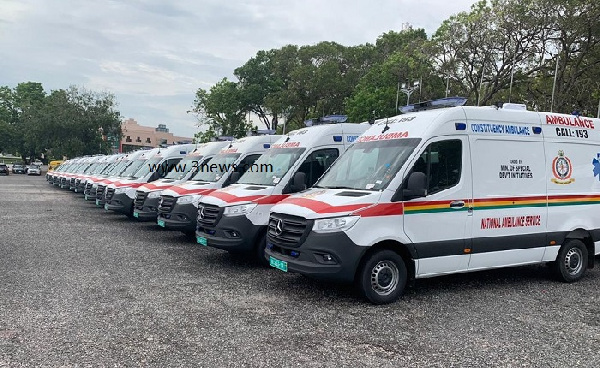
The Minister for Health, Hon. Kwabena Mintah Akandoh, has announced that government will procure 100 new ambulances for the National Ambulance Service (NAS) in 2027, as part of a broader push to strengthen Ghana’s pre-hospital emergency response system.
The announcement forms part of a wider set of measures unveiled by the Minister to address longstanding gaps in emergency medical logistics, ranging from fleet expansion and vehicle rehabilitation to funding for repairs and a stronger regulatory framework for the Service.
“We are committed to putting the National Ambulance Service in a position to reach every part of this country. The addition of 100 new ambulances in 2027 will significantly expand our operational capacity and bring emergency care closer to the people who need it most.”
Hon. Akandoh
Addressing matters affecting the National Ambulance Service, the Minister reaffirmed government’s commitment to enhancing emergency medical services, describing the planned acquisition of 100 ambulances as a move that will significantly boost the operational capacity of the NAS and improve access to emergency care nationwide.
The disclosure comes at a time when public attention on Ghana’s emergency healthcare infrastructure remains heightened, with the planned procurement positioned as a central component of the Ministry’s health sector agenda for the coming years.

Refurbished Burma Camp Ambulances to Rejoin Fleet
In addition to the planned procurement, the Minister disclosed that 30 ambulances recently retrieved from the Ghana Air Force Base at Burma Camp and handed over for refurbishment will also be integrated into the national ambulance fleet upon completion of the rehabilitation process.
Those vehicles had previously been withdrawn from active service, and their planned reintegration is expected to offer near-term relief to a fleet that has, in recent years, come under pressure from ageing stock and rising demand for emergency transport. The Minister did not specify a completion date for the refurbishment exercise but indicated that work was already ongoing.
“Once the refurbishment is done, these 30 vehicles will go straight back into service. It is not just about new ambulances coming in 2027; it is about making sure every vehicle we already have is roadworthy and available today.”
Hon. Akandoh
Additional Funding Earmarked for Repairs and Maintenance
The Minister further indicated that additional funding will be made available to support the repair and maintenance of existing ambulances, to ensure that more vehicles remain roadworthy and available for emergency response operations across the country.
The commitment speaks to a persistent concern within the health sector, where poorly maintained or grounded ambulances have, in the past, been linked to delays in emergency response, particularly in rural and hard-to-reach communities.
By directing fresh resources toward maintenance alongside new acquisitions, the Ministry appears to be pursuing a dual approach expanding the fleet while preserving what already exists so that gains from new procurement are not eroded by the deterioration of older vehicles.
Call for Expedited Action on Legal Instrument
Recognising the critical role of policy and regulation in strengthening emergency medical services, the Minister called on all relevant stakeholders to expedite action on the Legal Instrument (LI) for the National Ambulance Service, describing it as essential to the Service’s long-term development.
According to him, the LI will provide the necessary regulatory framework to support the Service’s operations, formalising standards and structures that have, until now, lacked comprehensive legal backing.
“We cannot talk about a modern ambulance service without the legal backbone to support it. I am calling on all stakeholders to move with urgency to get the LI finalised, because regulation is what will sustain the gains we are making.”
Hon. Akandoh
Broader Implications for Emergency Healthcare Delivery
Taken together, the announcements reflect a multi-pronged strategy by the Ministry of Health to overhaul emergency medical services in Ghana, combining new investment, the rehabilitation of existing assets, and stronger regulatory oversight.
Health sector observers have long argued that the country’s ambulance-to-population ratio remains below what is required to guarantee timely emergency response, particularly outside the major cities, a gap that makes the planned expansion a closely watched development.

For many Ghanaians, especially those in underserved districts, the real measure of these announcements will not be the number of vehicles procured but how quickly help arrives when it is needed most. The Ministry is yet to release a detailed rollout plan or budgetary breakdown for the 2027 procurement, though further details are expected as government finalises its broader health sector budget for the coming year.
READ MORE: Educatin Minister Appeals to GAUA to Call Off Ongoing Strike