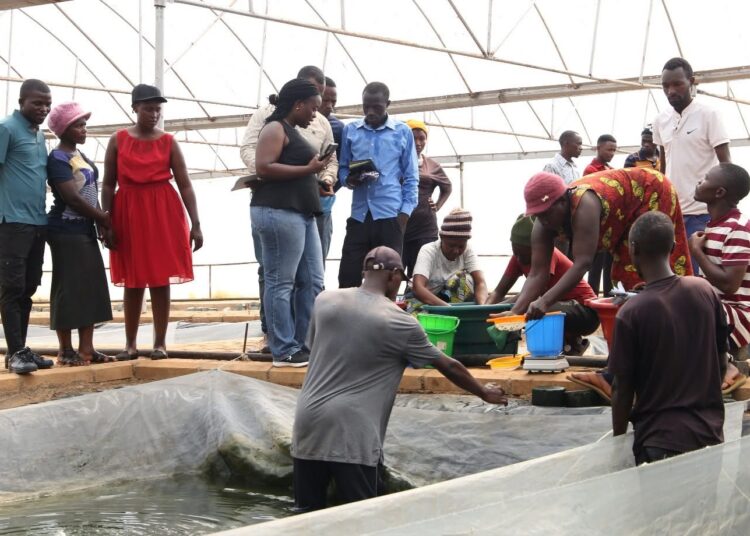
The Fisheries Commission, with support from the Technologies for African Agricultural Transformation (TAAT) Programme, has taken a significant step towards transforming aquaculture in the region with a three-day intensive step-down training on Phase II of the TAAT Programme.
The training, which happened in Ashaiman Aquaculture Demonstration Centre, assembled about 100 participants comprising existing and prospective fish farmers as well as government officials whose mandates are directly linked to aquaculture development in the Greater Accra Region.
The programme was spearheaded by the Regional Director for the Greater Accra Regional Commission, Ms. Matilda Ajakameh, and the TAAT Project Focal Person, Mr. Anthony Wassipi. They were supported by a team of seasoned facilitators including Mr. Gabriel Obeng-Manu, Madam Eleanor Naa Ayeley Aryee, and Mr. Lawrence Afagbegee, who took participants through both the science and business of modern aquaculture.
The training was structured to provide a balanced blend of theory and practical experience. The first day was dedicated to theoretical sessions where participants were introduced to the core principles and emerging technologies under the TAAT Phase II framework.
The second day moved to the ponds and hatchery for practical demonstrations, giving farmers hands-on experience, while the third day was reserved for plenary discussions that focused on effective tilapia production and farm management strategies.
At its core, the initiative is aligned with the United Nations Sustainable Development Goals, particularly Goals 1, 2, 3, 14 and 15 which focus on no poverty, zero hunger, good health and well-being, life below water and life on land.
According to the organizers, the training was deliberately designed to strengthen the technical capacity of players in the aquaculture value chain with the ultimate aim of improving the quantity, efficiency and sustainability of commercial tilapia production in the region and beyond.
TAAT Phase II Training Targets Gaps in Ghana’s Tilapia Production
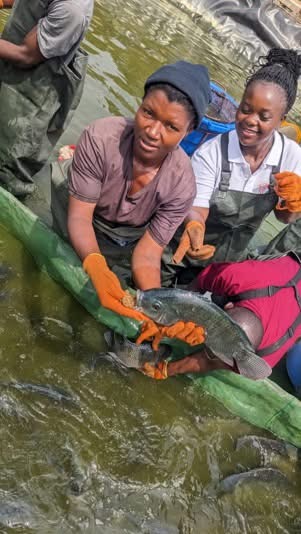
Tilapia remains one of the most consumed fish in Ghana, yet local production continues to face challenges ranging from poor fingerling quality to inefficient farm management practices. The TAAT Phase II training sought to directly address these gaps.
Participants were exposed to in-depth knowledge on how to identify and manage different production systems and holding facilities suitable for various scales of operation. They also learned about the critical process of brood stock selection, which is fundamental to ensuring high-quality feeds for production.
A major component of the training focused on water quality management, a factor that experts say determines the success or failure of any fish farm. Farmers were taught how to monitor and maintain optimal water conditions for tilapia growth and survival.
The sessions also delved into the technical aspects of sex ratio and stocking, ensuring that farmers understand the right balance needed to maximize productivity while minimizing losses.
Other crucial areas covered included spawning and egg collection techniques, as well as hormonal sex-reversal, a specialized process that allows for the production of all-male tilapia populations which are known to grow faster and yield higher commercial returns.
The facilitators emphasized the importance of quality feed and proper feeding regimes for fry and fingerlings, noting that nutrition at the early stages significantly influences the overall output of the farm.
The Training Highlights Business Potential in Fingerling Production
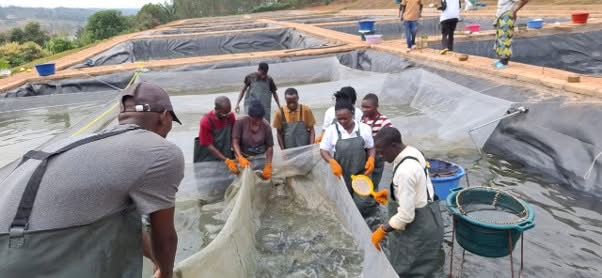
Beyond production, the training placed strong emphasis on the business side of aquaculture. Participants were taken through best practices in harvesting and marketing of fingerlings, a segment that holds huge economic potential for farmers who can produce quality seeds for other growers.
They were also trained on record keeping, which was described as an indispensable tool for tracking growth, managing costs, and making informed business decisions. Throughout the three days, the atmosphere at the Ashaiman Aquaculture Demonstration Centre was one of active engagement and collaboration.
Participants asked questions, shared experiences from their own farms, and practiced what they were taught under the guidance of the facilitators. For many prospective farmers present, the training served as an eye-opener to the viability of aquaculture as a profitable and sustainable livelihood, while existing farmers received updated techniques to scale up their operations.
Speaking at the close of the programme, Ms. Matilda Ajakameh and Mr. Anthony Wassipi expressed their appreciation to the facilitators for their dedication and to the participants for their commitment and active involvement.
They noted that the enthusiasm demonstrated over the three days was a clear indication that fish farmers in Greater Accra are ready to embrace improved technologies to increase production.
They also acknowledged the role of the Technologies for African Agricultural Transformation Programme in making the training possible, describing TAAT as a critical partner in Ghana’s efforts to achieve self-sufficiency in fish production.
The organizers are hopeful that beneficiaries of the training will become ambassadors within their communities, sharing the knowledge gained and encouraging more people, especially women and young people, to venture into aquaculture.
With strengthened capacity and renewed motivation, the Greater Accra Region is poised to become a hub for sustainable and commercially viable tilapia production in Ghana.
READ ALSO :Illegal Mining Thrives Where Authorities Turn Blind Eye, Coordinator Warns