Ghana has begun developing a new Petroleum Downstream Infrastructure Master Plan aimed at reshaping the infrastructure backbone of the country’s petroleum supply chain, with the government seeking to improve the use of existing assets, strengthen logistics and provide clearer signals for future private-sector investment.
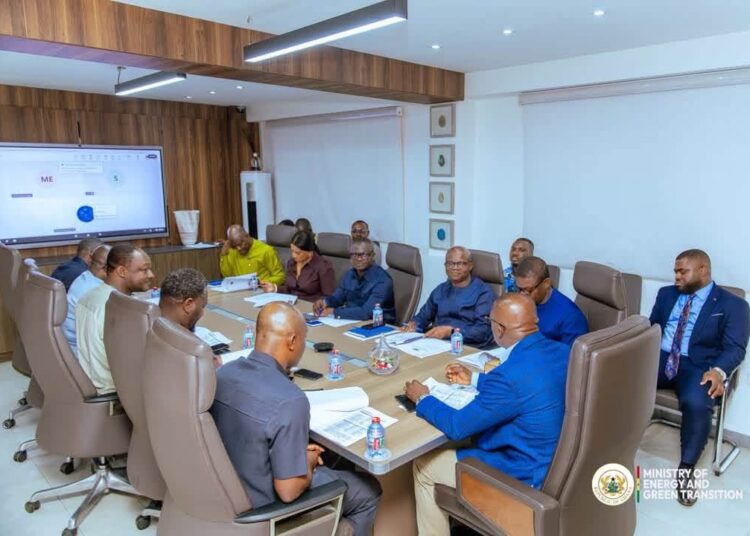
The Energy and Green Transition Ministry has inaugurated a Steering Committee to lead the preparation of the Downstream Infrastructure Master Plan, positioning the exercise as a strategic response to infrastructure constraints that have affected efficiency, utilisation and investment across the petroleum downstream value chain.
The initiative is significant because Ghana’s downstream system is no longer simply dealing with the question of how much petroleum products are available.
The more difficult challenge is how efficiently products can be imported, received, stored, transported and distributed through infrastructure that must support a growing economy while also adapting to changing fuel demand.
Energy and Green Transition Minister Dr John Abdulai Jinapor said the master plan would provide a framework for addressing those challenges and aligning infrastructure development with Ghana’s future energy requirements.
“The Master Plan is a critical step towards addressing infrastructure gaps, improving the efficiency and utilisation of existing assets, strengthening downstream petroleum logistics, and creating a more predictable environment for investment.”
Energy and Green Transition Minister Dr John Abdulai Jinapor
The government’s decision to revisit downstream infrastructure planning is not occurring in isolation.
Ghana has previously identified the need for a coordinated infrastructure framework for the petroleum downstream sector, with earlier national development plans also assigning responsibility for developing such a master plan to the energy ministry and identifying institutions including the National Petroleum Authority, BOST, Ghana National Gas Company and Tema Oil Refinery as key collaborators.
Existing Assets Face A New Test
A central question for the new master plan will be whether Ghana can extract more value from infrastructure already built before committing large amounts of capital to additional facilities.
The downstream petroleum chain includes refineries, bulk storage facilities, pipelines, depots, ports, truck-loading infrastructure and distribution networks.

Weak coordination between these components can create bottlenecks even where petroleum products are physically available.
That makes infrastructure utilisation almost as important as infrastructure expansion.
For example, additional storage capacity has limited value if product evacuation systems cannot move volumes efficiently.
Similarly, expanding import or refining capacity without adequate pipelines, terminals, depots and road logistics can simply shift congestion from one part of the value chain to another.
Dr Jinapor said the committee’s task was therefore expected to go beyond producing another policy document.
“Our objective is to develop a practical and implementable roadmap that responds to Ghana’s future energy needs while supporting economic growth and energy security.”
Energy and Green Transition Minister Dr John Abdulai Jinapor
That emphasis on implementation matters. Ghana has had various petroleum infrastructure strategies and plans over the years, but the persistent infrastructure gaps suggest that planning has not always translated into coordinated investment and execution.
The new exercise should therefore identify not only what infrastructure Ghana requires, but also which existing assets are underutilised, where bottlenecks occur, what investments are commercially viable and which projects should receive priority.
Logistics At Centre Of Petroleum Security
The downstream sector is particularly sensitive to logistics because Ghana remains dependent on imported petroleum products to meet a substantial portion of domestic demand.
The reliability of the fuel market consequently depends on a chain extending from international suppliers and marine terminals to storage facilities, bulk distribution points and retail outlets.
Any weakness along that chain can increase costs and create supply vulnerabilities.

A properly integrated master plan could help determine how import terminals, storage facilities, refineries, pipelines and inland distribution infrastructure should interact as Ghana’s petroleum market evolves.
That could also become increasingly relevant as domestic refining capacity changes.
The rehabilitation and renewed operations of the Tema Oil Refinery create the possibility of a larger domestic refining role, while other private-sector refining initiatives could alter the country’s future requirement for imported finished petroleum products.
The infrastructure question therefore cannot be approached from the perspective of imports alone.
Ghana needs a system capable of handling different combinations of imported products, locally refined fuels, domestic crude, strategic stocks and potentially greater regional petroleum trade.
Earlier government planning documents similarly identified the development of downstream infrastructure as a means of improving infrastructure, governance and investment conditions, while linking Ghana’s petroleum infrastructure ambitions to the broader objective of becoming a petroleum hub in West Africa.
Investment Certainty Becomes Critical
The master plan could also influence how private investors assess Ghana’s downstream petroleum market.
Infrastructure projects require substantial capital and long investment horizons. Investors are therefore more likely to commit funds where there is clarity about demand, regulations, tariffs, access arrangements, competing infrastructure and the government’s long-term policy direction.
A comprehensive plan could reduce some of that uncertainty by providing a common framework for infrastructure development rather than allowing individual projects to emerge without sufficient coordination.

Dr Jinapor said the final document should guide both government policy and investment decisions.
“I look forward to the Committee delivering a Plan that will guide policy, inform investment decisions and drive meaningful transformation in Ghana’s petroleum downstream sector.”
Energy and Green Transition Minister Dr John Abdulai Jinapor
That expectation puts pressure on the committee to produce something more useful than a catalogue of infrastructure requirements. The real value will lie in prioritisation.
Ghana cannot afford to treat every infrastructure proposal as equally urgent.
Scarce public and private capital must be directed towards facilities capable of removing the biggest constraints in the petroleum supply chain.
Refining Revival Changes The Equation
The resurgence of domestic refining makes the timing of the master plan particularly important.
If Tema Oil Refinery and other emerging refineries are able to process more crude consistently, Ghana’s infrastructure requirements will shift.
Refineries will need reliable crude supply, product storage, evacuation systems and access to markets.

That creates an opportunity to integrate upstream, midstream and downstream planning more closely.
Domestic crude availability, refinery capacity, gas infrastructure, petroleum storage and product distribution should not be planned as separate systems.
Each component affects the commercial viability of the others.
The master plan therefore offers an opportunity to address one of Ghana’s longstanding energy-sector problems: fragmented infrastructure planning.
A refinery without reliable feedstock cannot operate consistently.
Storage without efficient evacuation can become stranded capacity. Imported products without sufficient inland logistics can create congestion and additional costs.
The objective should be a petroleum system in which infrastructure works as a connected network rather than as isolated assets.
Energy Transition Adds Another Layer
The plan will also have to account for the changing structure of energy demand.
Ghana’s downstream petroleum system is being developed at a time when government is simultaneously promoting cleaner cooking, LPG expansion, electric mobility and broader energy-transition initiatives.
The Ministry’s current 2026–2029 sector plan, for instance, includes increasing access to LPG, expanding the National LPG Promotion Programme and finalising the National Strategic Fuel Reserve policy alongside development of a Downstream Infrastructure Master Plan.

That means the new infrastructure strategy should not simply assume that today’s fuel consumption patterns will remain unchanged.
LPG storage and distribution, strategic petroleum reserves and infrastructure capable of supporting future fuels could become increasingly important as Ghana’s energy mix changes.
The strongest master plan would therefore be one that protects petroleum supply security while avoiding infrastructure decisions that become economically inefficient as energy consumption patterns evolve.
The inauguration of the Steering Committee is consequently more than an administrative step.
It marks an attempt to give Ghana’s downstream petroleum infrastructure a coordinated long-term direction.
The test will be whether the resulting plan identifies the bottlenecks that genuinely constrain the sector, assigns clear priorities and creates an investment framework capable of attracting capital.
For Ghana, the opportunity is clear: better infrastructure can reduce logistics costs, improve fuel security, increase asset utilisation and strengthen the country’s position in the regional petroleum market.
But the plan will only matter if it moves from strategy to execution.
Ghana already has evidence that infrastructure planning without sustained implementation can leave the same constraints unresolved for years.
The new master plan must therefore be judged not by the quality of its document, but by the infrastructure it ultimately helps Ghana build, rehabilitate and use more efficiently.
READ ALSO: Xabi Alonso’s Chelsea Tenure Begins With a Win in Five-Goal Thriller