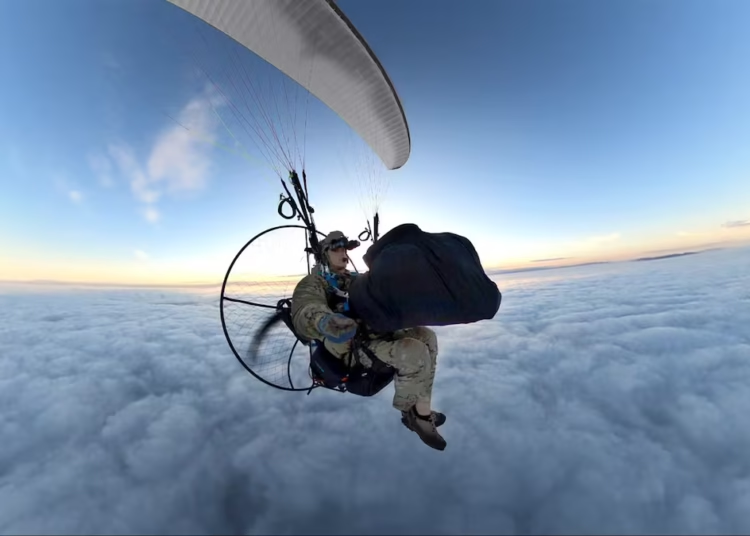
British soldiers could soon be equipped with rucksack-sized powered paragliders capable of carrying troops up to 200 miles behind enemy lines, as the United Kingdom moves to expand the use of innovative, homegrown technology for covert military operations.
The Ministry of Defence (MOD) is investing around £6 million in the system developed by Wiltshire-based start-up Blakcro, with trials involving the Royal Marines and Parachute Regiment expected to begin in the coming months.
The technology offers a new approach to military air mobility, allowing individual soldiers to launch from the ground and enter hostile territory without relying on aircraft, helicopters or traditional parachute drops.
The backpack-sized system is designed to be assembled in less than eight minutes, including in complete darkness, before being launched on foot. Rather than being deployed from an aircraft, the pilot runs to take off while the paraglider’s engine provides additional power during flight.
According to the manufacturer, the titanium-framed gliders can travel as far as 200 miles under their own power and carry equipment including body armour, night-vision technology and weapon mounts. Their relatively small size and design are intended to provide troops with an alternative means of reaching difficult or hostile areas while reducing their dependence on conventional aviation platforms.
Minister for Defence Readiness and Industry, Luke Pollard, stated that the initiative demonstrated the government’s intention to combine military capability with the development of Britain’s industrial base.
“With UK Defence Innovation supporting SMEs like Blakcro from the drawing board through to deployment, we are building a more resilient, homegrown defence supply chain and ensuring our armed forces receive the pioneering equipment that can give them the edge on the battlefield.”
Luke Pollard
The Minister added that the approach was designed not only to provide new military capabilities but also to generate employment and support economic activity in regions outside Britain’s traditional defence manufacturing centres.
The project comes as UK faces increasing pressure to strengthen its defence capabilities and clarify its long-term spending commitments amid a changing security environment.
The government’s defence investment plans have become a significant political issue, particularly over the country’s commitment to increasing defence spending as a proportion of national income.
Chancellor John Healey has faced pressure over the pace at which Britain intends to increase military expenditure, with questions surrounding when the country will reach its NATO-linked targets.
The government has said it intends to establish a pathway towards spending 3.5% of gross domestic product on defence by 2035, while setting a target date for reaching 3% as part of that broader trajectory.
A government spokesperson noted that, “the first duty of government is to keep its citizens safe. The Prime Minister and Chancellor are committed to fully funding the defence investment plan.”
“At the spending review we will set out a pathway to meet our NATO commitment of 3.5% of GDP on defence by 2035 and will set a target date to hit 3% on that path.”
Government Spokesperson
Smaller Defence Innovators Gain Momentum

The Blakcro project represents a departure from conventional methods of moving troops through the air, with its systems designed to give individual soldiers an alternative route into hostile environments.
The gliders fold into cases roughly the size of large rucksacks, allowing troops to transport the equipment before deploying it when required. The company says the system can be prepared in under eight minutes and operated without a runway or conventional aircraft.
Its titanium airframe is designed to keep the equipment lightweight while providing sufficient capacity for military personnel and their equipment.
Blakcro first engaged with UKDI through its Open Call for Innovation, an initiative intended to identify technologies with potential military applications. The company subsequently received support for two additional projects, including a Defence Innovation Loan aimed at helping it move from developing a single product towards full-scale production.
According to Sam Wedgwood, founder and Chief Executive Officer of Blakcro, the relationship with UKDI had been central to the company’s rapid expansion.
“From a UKDI success story perspective, we have very rapidly moved from base technology in 2024, through UKDI-supported rapid innovation, through to purchase, through to operational use by 2026.
“We could not have done that at this pace without the support we have received not just the funding, but the commercialisation support and the access to the right people. UKDI kept telling us we were special. I think it’s mutual.”
Sam Wedgwood
The next test for Britain’s armed forces will come during trials involving the Royal Marines and Parachute Regiment, which will assess the paragliders’ effectiveness and practical value in military operations.
READ ALSO: Xabi Alonso Hopeful of Having Caicedo Ready for Brighton Visit