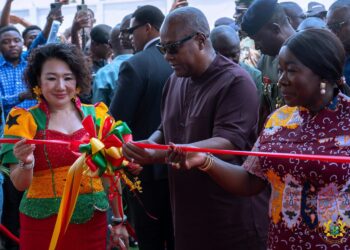
President John Dramani Mahama took the stage to commission the Northshore Apparel 24-Hour Economy Factory at Savelugu, he focused not just on jobs and exports, but on a deeply personal story of Northern girls who for decades have had to migrate south to carry loads on their heads to survive.
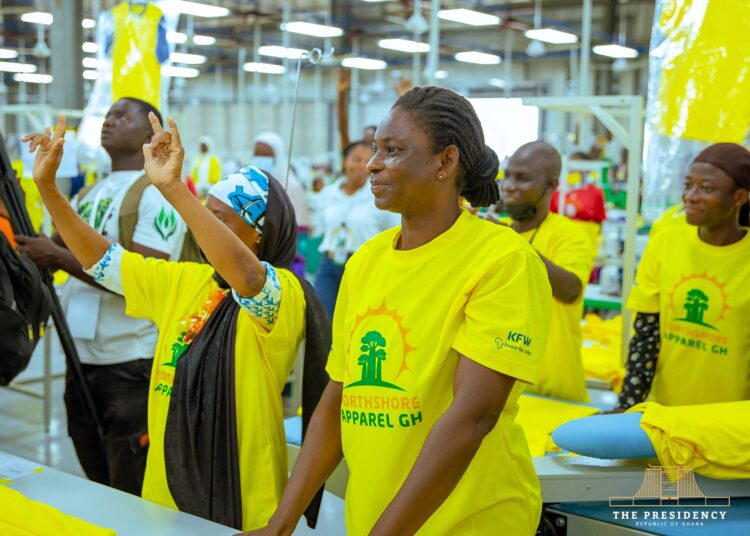
He revealed that 80 percent of the current 2,000 workers at Northshore are young girls who would otherwise have become Kayayei in Accra and Kumasi.
“80% of the employees here, are young girls and all of us know that in the past once they finished school and there were no opportunities for them, they headed down south and did the demeaning work of being human donkeys: head porters carrying heavy load.”
President Mahama
President Mahama said, many of them suffer spinal problems because of the menial work they do and they are paid a pittance. He added that Northshore will keep more of these girls here so that they don’t have to go down south looking for menial jobs.
That statement drew loud applause from traditional leaders and dignitaries present. Many of whom have daughters or relatives who have experienced Kayayei life.
President Mahama said the Northshore model proves that deliberate industrialization in the north is the most effective social intervention against Kayayei and youth unemployment, not just cash transfers.
This is why, he announced, Northshore is only the beginning. The government will develop the entire enclave into the Northshore Industrial Hub, a cluster of factories that will employ at least 30,000 young people at full strength.
“Like the coordinator of the 24-hour economy said, it’s just the beginning. Northshore is the anchor tenant. This is going to become an industrial hub and I know that Yaa-Na is going to give us much more land for all the other industries that are going to come here.”
President Mahama
The President said the hub is critical to correcting a historical development imbalance that was flagged by the African Peer Review Mechanism, APRM, during Ghana’s peer review.
“When we did the African peer review mechanism and Ghana was peer reviewed, one of the things for which we were indicted was the lack of opportunities in the northern part that was leading to an imbalance of our population. So the population was sparser in the north because when students finished school and they have no opportunity they just pick their bikes, board a vehicle and go to the south and so it puts pressure on social services in the south.”
President Mahama
He recounted on one of the recommendations of the peer review mechanism which was that Ghana should balance out development between the north and south to create more opportunity in the north so that people will remain here. And he believes that this is the beginning of that.
He explained that unchecked north-south migration does not only deprive the north of its youth, but also overstretches schools, hospitals, housing and sanitation systems in southern cities. Creating jobs where the youth live, he argued, is therefore a national cohesion strategy.
Government to Enforce Made-in-Ghana Procurement Act
Beyond the hub, President Mahama outlined two strong policy measures to ensure factories like Northshore do not collapse like past initiatives. First is a compulsory made-in-Ghana procurement policy.
He said government is amending the Procurement Act to include a schedule from the Ghana Standards Authority listing all licensed locally manufactured products. Once a product is on that list, all government agencies, schools, hospitals and security services must buy it locally at a published recommended price, without going through competitive tendering that is often used to justify imports.
He emphasized that this became necessary after the collapse of the revamped Kumasi Shoe Factory, which he said was producing quality army boots under a PPP in his first term, but was abandoned by state buyers who preferred imports from China.
“I took note of the Northshore CEO’s mention of local production of uniforms. I think that it is a thing whose time has come. We need to be firm and insist on it now. Under the next phase of the hub, all security uniforms and protective wear will be made in Ghana.”
President Mahama
‘Our commanders and all will wear made-in-Ghana military uniforms,” he declared.
The second measure is linking the factory to the 24-Hour Economy and Free Zones incentives to make it globally competitive. He stressed that Northshore is going to run several shifts and it means several more young people will get jobs to do. ‘And so the 24-hour economy is designed to achieve the creation of jobs and accelerated exports,” he said.
He confirmed that Northshore is registered under the Free Zones programme.
“And so Northshore is registered under the free zones and so it will benefit from all incentives that the free zones have to offer.”
As Part of his closing remarks, the President addressed accountability, saying he will continue to support lawful efforts to retrieve public funds taken by individuals who have not accounted for them.
The Northshore Apparel factory currently exports the bulk of its products, bringing in foreign exchange while retaining northern girls at home – a double win President Mahama says defines the true spirit of the 24-Hour Economy.
READ ALSO :Bright Simons Urges Data-Driven Exploration to Fix Africa’s Mineral Gap