A catastrophic glacial collapse in the Himalayan region has triggered deadly flash flooding in Nepal, leaving communities facing immense loss while highlighting the growing dangers posed by a warming climate to some of the world’s most fragile mountain environments.
The disaster, which sent torrents of water, ice, rocks and sediment downstream, has renewed concerns over the vulnerability of communities living in the Hindu Kush Himalayas, where scientists and local populations have for years warned that rising temperatures are destabilising glaciers and increasing the risks of floods, landslides and other interconnected natural hazards.
The scale of the devastation has prompted a strong response from the United Nations, with the UN Climate Chief, Simon Stiell, describing the loss of life as “absolutely heartbreaking” and warning that the disaster was a stark reminder of the vulnerability of mountain ecosystems to climate change.
“The catastrophic glacial collapse in the Himalayan region, with so many lives lost in an instant, is absolutely heartbreaking. My thoughts are with everyone affected, especially those who have lost loved ones.”
UN Climate Chief
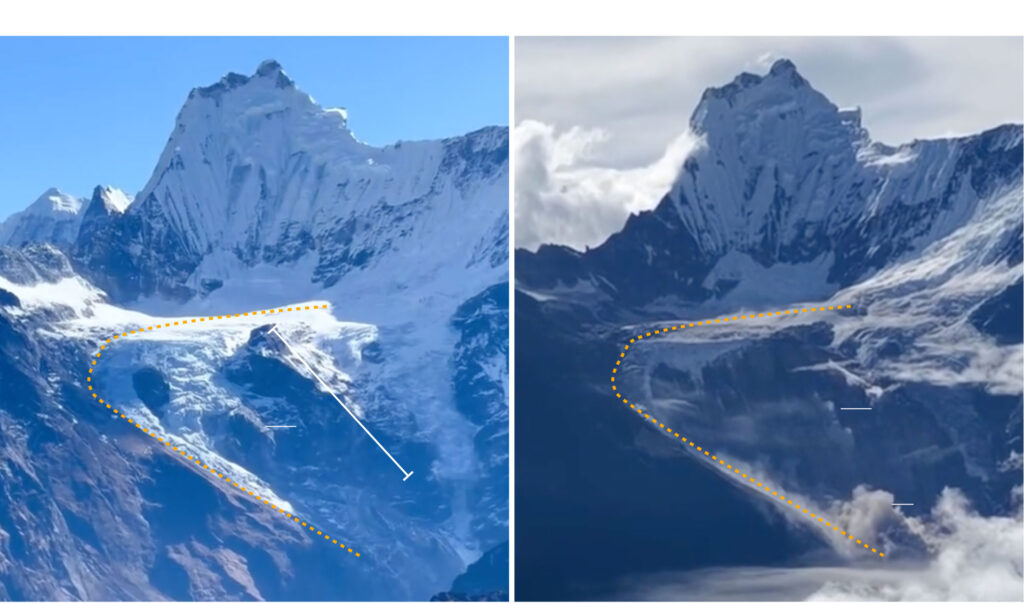
The statement came as Nepal reeled from deadly flash floods that scientists believe were triggered by the collapse of a glacier high in the river headwaters. While researchers are still working to establish the precise chain of events, satellite imagery has provided evidence of a glacial collapse in the upper reaches of the affected river system.
A seismic event was also recorded and has been attributed to the collapse of part of the glacier, according to Marin Clark, a University of Michigan geoscientist who studies erosion processes, landslides, and river floods and has conducted extensive research on hazards in Nepal.
Clark disclosed that scientists are still examining how the glacier collapse initiated the devastating flood. Several mechanisms could have contributed, including meltwater and icy sediment released by the collapse, or temporary blockages in the river that accumulated water before suddenly giving way.
“We’re still not sure of all the details, but we have seen evidence of a glacier collapse way up in the river headwaters. We see this on satellite images, and there was a seismic event recorded that has been attributed to the collapse of a piece of the glacier. But how exactly that collapse is related to the initiation of a flood is still under a lot of speculation.”
Marin Clark
What followed, she explained, was not simply a conventional flood but a powerful debris flood, in which enormous quantities of water become mixed with rocks and sediment. Such flows can acquire tremendous momentum as they move downstream, increasing their destructive power and extending their reach far beyond the location where the initial collapse occurred.
Climate Change Heightens Risk of Cascading Disasters
The disaster has therefore raised concerns extending beyond the immediate loss of life and destruction. Scientists warn that the hazard may not have ended with the floodwaters receding.
According to Clark, evidence of a new lake forming near the site of the initial glacial collapse could present another danger. Water is already accumulating in the area, raising the possibility that a sudden release could generate another flood and send yet more water and debris downstream.
The prospect illustrates what scientists describe as a “cascading natural hazard,” that is a situation in which one extreme event triggers a chain of additional hazards, creating risks that can persist for months or even years.
The phenomenon is particularly significant in the Himalayas because of the region’s complex interaction between glaciers, rivers, steep mountain slopes, rainfall and human settlements. A single disruption at high altitude can therefore produce consequences hundreds of kilometres downstream.
Clark indicated that the latest disaster demonstrates why disaster preparedness cannot focus only on the immediate event.
“So we know that the hazard in Nepal won’t be over once the flood recedes. There seems to be this new lake forming up in the area where the first glacial collapse happened. It’s ponding water, and if that water catastrophically gets released downstream, that can create a second flood.”
Marin Clark
The warning comes against a broader backdrop of accelerating climate concerns across the Himalayan region, where glaciers are under increasing pressure from rising temperatures.
According to the UN Climate Chief, the latest disaster was a reminder of how vulnerable the Hindu Kush Himalayas are to climate change, stressing that communities in exposed areas are frequently among those suffering the greatest consequences of climate-related disasters.
“We also know a warming climate, driven by humanity burning colossal amounts of coal, oil and gas, is making tragedies like this one, and so many others around the world, much more likely, frequent and severe, with vulnerable communities often hardest hit.”
UN Climate Chief
The UN Climate Chief argued that the response must therefore combine accelerated action to reduce global heating with stronger resilience measures.
READ ALSO: ‘Happy’ Bradley Barcola Seals Dream Liverpool Move