International tourism continued to expand during the first half of 2026, but growth has lost momentum amid rising geopolitical and climate risks, alongside higher travel costs and disruptions to air connectivity that are weighing on global demand.
According to the latest World Tourism Barometer from UN Tourism, an estimated 690 million tourists travelled internationally between January and June 2026, representing about 3 million more arrivals than during the same period in 2025.
The increase confirms that international travel has continued to grow despite a more uncertain global environment. However, the headline figure masks a notable weakening in momentum as the year progressed, with tourism activity moving from modest growth in the first quarter to contraction in the second.
International tourist arrivals increased by 2% in the first quarter of 2026 but declined by 1% in the second quarter.
The slowdown was particularly evident in April, when global arrivals fell by 3%, reflecting in part the calendar effect of Easter beginning in March and the wider consequences of the conflict in the Middle East.
By June, the decline had deepened, with international arrivals falling by 3% globally.
The latest figures therefore present a tourism sector that remains resilient but increasingly exposed to developments outside the industry itself. Conflict, airspace disruptions, extreme temperatures and rising costs are influencing where people travel, how frequently they travel and how much they are prepared to spend.
UN Tourism Secretary-General Shaikha Al Nuwais described the situation as evidence of a sector continuing to absorb significant pressure while warning that its expansion remains vulnerable.
“The latest data shows a sector absorbing real pressure and finding a way forward. Tourism has not stopped growing, but that growth is fragile. The Middle East situation has touched destinations far beyond the region itself and serves as a clear reminder that, in such a connected world, resilience needs to be built everywhere and not just when a crisis begins.”
UN Tourism Secretary-General
The Middle East conflict provides a clear example. Although the region experienced the most direct effects, disruptions to air routes through the region affected destinations much farther away. Changes in connectivity, higher operating costs, and uncertainty also influenced travel demand in other markets.
Africa Outpaces Global Tourism Growth Despite Rising Uncertainty
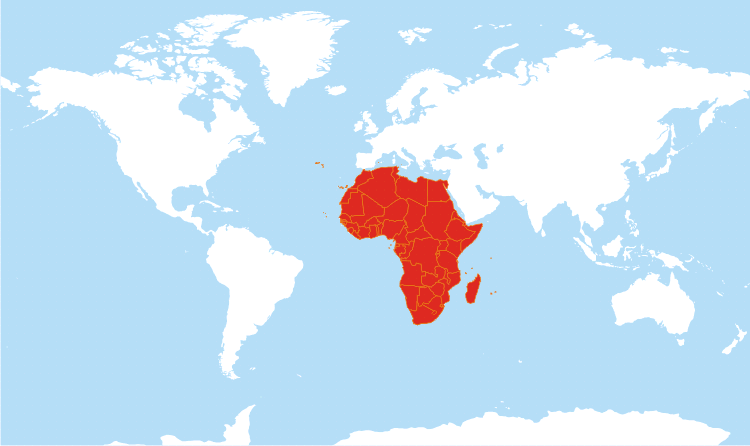
While the global tourism industry experienced a slowdown during the second quarter, Africa recorded one of the stronger performances among the major world regions during the first half of 2026.
UN Tourism data shows that international arrivals in Africa increased by 4% between January and June, exceeding the global growth rate over the same period.
Europe also recorded solid growth of 3%, while the Americas registered a 2% increase, although performance varied considerably between individual sub-regions.
Africa’s performance is significant within a global tourism market increasingly shaped by geopolitical uncertainty and changing consumer behaviour.
The continent’s tourism sector, like other regions, remains exposed to external shocks. However, the 4% growth recorded in the first half of the year indicates continued international demand for African destinations despite the wider pressures affecting global travel.
The regional picture also contrasts sharply with the Middle East, where arrivals declined by 22% during the six months as the conflict directly affected tourism activity.
Asia and the Pacific recorded a more modest 1% increase but remained 11% below their 2019 tourism levels. The region continued to face difficulties linked to air connectivity, higher fares and uncertainty affecting intra-regional travel.
Within the region, the results were uneven.
North-East Asia recorded 3% growth during the first half of the year, while South Asia experienced a 5% decline. South-East Asia also recorded a 1% decline compared with the same period in 2025.
The weakness in South-East Asia became particularly pronounced in June, when arrivals dropped by 5%.
UN Tourism attributed the decline to weaker demand from Asian markets, geopolitical tensions, disruptions to air travel through the Middle East and increased travel costs.
Europe experienced a similar deterioration in June, with arrivals falling by 6%. Part of the decline was associated with a heatwave affecting some destinations.
In Oceania, some destinations recorded a 6% decline in arrivals in June, with Typhoon Sinlaku in the second quarter contributing to the disruption.
These developments reveal a tourism industry operating under several overlapping pressures.
UN Tourism reported that disruptions to air traffic gradually eased in May and June following the announcement of a ceasefire. Some air routes subsequently reopened, contributing to an uneven recovery in consumer sentiment.
However, the rebound has not eliminated the uncertainty facing the sector. The tourism outlook for the remainder of 2026 has consequently been revised downward.
UN Tourism now expects international tourist arrivals to increase by between 1% and 2% globally during the year, compared with its January forecast of 3% to 4%.
READ ALSO: BoG Warns Digital Asset Firms Over Compliance Failures