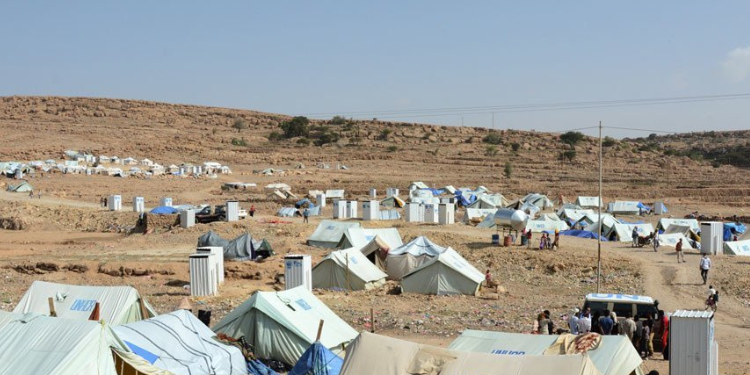
Yemen’s humanitarian crisis is worsening amid a sharp rise in displacement, with renewed tensions between Saudi-backed Yemeni Government forces and Iran-backed Houthi militia displacing more than 112,000 people in just two weeks and pushing the already overstretched humanitarian response closer to its limits.
The latest escalation has affected communities across Aden, Hudaydah, Abyan and Taiz, where civilians already facing years of conflict, economic hardship and environmental disasters are once again being forced from their homes in search of safety.
The scale and speed of the recent displacement have placed additional pressure on humanitarian agencies operating in a country where millions already depend on assistance to meet basic needs.
According to the International Organization for Migration (IOM), the latest emergency is unfolding against a severe shortage of resources needed to respond to the growing number of displaced people.
Abdusattor Esoev, Chief of Mission in Yemen for the IOM, noted, “our resources are very, very, very limited and our stocks will be depleted very soon”
Moreover, the United Nations refugee agency, UNHCR, has revealed that years of instability have already uprooted nearly 4.8 million Yemenis.
The humanitarian situation has also extended beyond Yemen’s borders, with more than 3,000 people crossing the Bab el-Mandeb Strait by boat to seek safety in Djibouti.
The journeys across the strategically important waterway are themselves dangerous, with people fleeing bombardment, shelling and gunfire in Yemen facing additional risks at sea.
UN agencies have consequently warned that immediate action is required to prevent the situation from deteriorating further.
According to Alessandra Vellucci, Director of the UN Information Service in Geneva, “Yemen civilians are already bearing the consequences of renewed full-scale hostilities.”
“We urge all parties and those with influence over them to act immediately to de-escalate, protect civilians, and facilitate humanitarian access. Preventing further loss of life must take precedence.”
Director of the UN Information Service
Speaking at a media briefing, Vellucci noted that the delivery of UN humanitarian assistance in Houthi-controlled areas had become “untenable” citing the detention of UN personnel and the occupation of UN premises by representatives of Yemeni opposition forces.
Displacement Pushes Yemen’s Humanitarian System Toward the Brink
The worsening security situation is being compounded by the detention of humanitarian personnel, raising concerns about whether aid organisations will be able to continue reaching civilians in areas controlled by the Houthis.
“As of today, 73 UN personnel remain arbitrarily detained by the Houthi de facto authorities, some of them since 2021. In addition, five former UN personnel and dozens of personnel from non-governmental organizations, civil society organizations, and diplomatic missions remain detained.”
Director of the UN Information Service
The continued detention of humanitarian workers creates a direct challenge to the delivery of assistance. Aid agencies require access, personnel and functioning facilities to reach displaced populations, but restrictions on their operations can leave vulnerable communities without essential services.
IOM’s Esoev has consequently called on the international community to increase support for Yemen, particularly for people uprooted by the latest violence.
Before the current escalation, nearly half of Yemen’s 41 million people were already in need of humanitarian assistance. In Government-controlled areas, one in two people was experiencing high levels of hunger, according to UN-backed food insecurity experts from the Integrated Food Security Phase Classification platform.
The renewed tensions therefore risk intensifying existing food insecurity rather than creating an entirely new humanitarian crisis.
The pressure is also evident in Yemen’s health sector. The World Health Organization has warned that the country is already confronting “multiple concurrent health risks”including cholera, measles, dengue, diphtheria, malnutrition and trauma injuries.
The latest escalation threatens to increase those pressures by generating additional trauma cases while making it harder for already weakened health facilities to operate.
Before the latest escalation, an assessment found that only 60 of more than 5,000 health service delivery units were fully functioning, according to WHO spokesperson Tarik Jasarevic.
Thousands of Yemenis have left the nation in search of safety. Since the most recent escalation, about 3,000 individuals have entered the Bab el-Mandeb Strait into Djibouti, with many arriving in Obock, Khor Angar, Moulhoule, and Godoria.
The voyage poses its own risks, especially for families fleeing violence with little preparation.
Sandrine Desamours, UNHCR Representative in Djibouti, explained that “at the reception centres, the new arrivals recount fleeing sudden bombardment, shelling, gunfire and having to fear for their lives; mothers quickly gathering their children and whatever they can.”
“We saw them arrive with very little, some arriving without their family members. And others are also arriving for the second time, having already fled Yemen during the 2015 crisis. Some arrivals were hoping to be able to go back to Yemen to retrieve them. Unfortunately, there is a shortage of fuel in Yemen, and they are not able to return.”
UNHCR Representative in Djibouti
In some cases, Djibouti’s Coast Guard has provided fuel to boats stranded at sea and assisted others in reaching safety.
The Djiboutian authorities and UN agencies are now discussing ways to support arrivals as they reach shore and provide them with protection, shelter and other forms of assistance.
IOM Chief of Mission in Djibouti Alexandre Coissac explained that the arrival of more than 3,000 refugees represented a significant challenge for “a generous country that is already hosting a large number of refugees.”
READ ALSO: Dr Likee Named New Brand Ambassador for KIVO Products