
Public Health Practitioner and Health Systems Researcher, Augustine Kumah, has warned that a significant proportion of Ghana’s community-based health compounds, the frontline of the country’s Free Primary Healthcare (FPHC) system, are operating without the basic infrastructure, equipment or staffing required to deliver effective care, despite the underlying model being widely regarded as one of the best in Africa.
Sharing his assessment of the country’s primary healthcare architecture on an exclusive interview with the Vaultz News, Kumah, a Healthcare Quality Improvement and Patient Safety Professional, explained that Ghana’s system is built around community-based health compounds and health centres situated directly within communities.
The designed to serve as the first point of contact for preventive care, early diagnosis, treatment and health education. He noted that while the underlying Community-Based Health Planning and Services (CHPS) concept has been cited internationally and studied by other countries, its practical operation on the ground tells a very different story.
According to Kumah, the CHPS concept remains one of Ghana’s strongest health policies in principle but is simultaneously one of the most fragile in terms of actual implementation.
He explained that many community health compounds exist only on paper, lacking the infrastructure, personnel or resources necessary to function as intended, despite being officially recorded as operational within the health system.
“There are so many CHPS’ compounds and community healthcare facilities that, in quotes, exist only on paper, without any proper infrastructure or resources to run them.”
Mr. Kumah

Model Undermined by Its Own Operation
Kumah presented figures underscoring the scale of the staffing crisis facing these facilities, noting that a national workforce analysis shows approximately 74 percent of community health compounds fail to meet minimum staffing requirements.
He explained that a fully functioning compound would typically be expected to have at least one midwife on staff, yet many facilities operate instead with only community health nurses, without any midwife present at all.
Beyond staffing, Kumah said around 44 percent of these facilities also lack basic infrastructure and equipment requirements, including essential first aid supplies, functioning diagnostic tools and reliable physical infrastructure needed to deliver even minimal standards of care.
A recurring challenge Kumah highlighted was the absence of reliable referral infrastructure connecting community-level facilities to higher levels of care.
He explained that many community health compounds have no ambulance access, meaning that when a patient requires urgent referral to a district hospital, staff are often left with no immediate means of transporting them, sometimes resulting in life-threatening delays.
Financial And Information Barriers Compound the Problem
He also pointed to significant infrastructure gaps affecting service delivery more broadly, citing the absence of electricity at many facilities as a critical barrier to providing immunisation services, since vaccines require consistent cold storage that cannot be maintained without a reliable power supply.
Kumah further identified financial barriers as a persistent obstacle to effective healthcare access at the community level, noting that while the National Health Insurance Scheme (NHIS) provides coverage for many services, certain preventive services either remain uncovered or are simply unavailable at the community facility level, leaving individuals to bear costs directly.

He also pointed to information and health literacy gaps within communities as a significant barrier, explaining that many caregivers lack the knowledge needed to recognise warning signs in their children and seek timely medical attention, often resorting to home remedies rather than promptly visiting a health facility.
Staff Motivation and Quality of Care Concerns
Kumah raised additional concerns about staff attitudes and working conditions at some facilities, describing instances of long waiting times and inconsistent availability of care, despite the community healthcare model being designed to offer round-the-clock service.
He attributed part of this challenge to a lack of adequate motivation and incentive structures for health workers posted to remote or underserved areas, suggesting that clearer incentive policies, such as allowances or accelerated promotion pathways, could help attract and retain staff willing to serve in these locations.
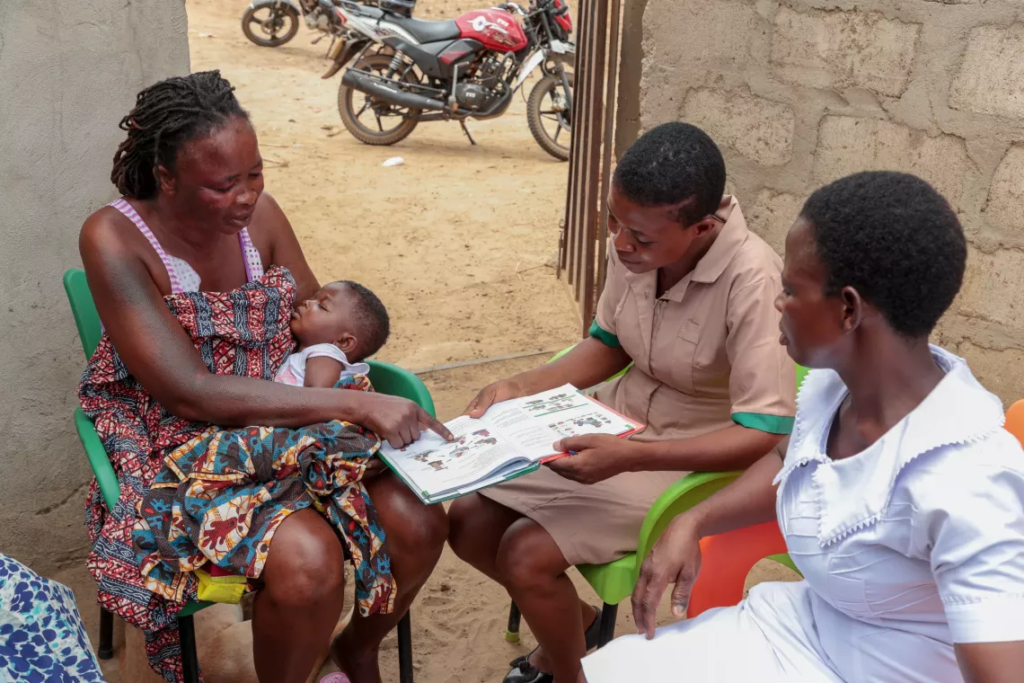
To address these challenges, Kumah called for a renewed focus on fully staffing and equipping community health facilities in line with established national standards, alongside sustained investment in infrastructure such as reliable electricity and diagnostic equipment.
He stressed that fixing the human resource gap, alongside protecting and safeguarding sustainable financing for the sector, remains central to ensuring that Ghana’s community healthcare model can function as intended and meaningfully advance the country’s progress toward universal health coverage.
READ MORE: New Environment Minister Vows Decisive Action on Illegal Mining and Pollution