
New York City public schools will temporarily prohibit elementary and middle school students from using student-facing generative artificial intelligence tools during the upcoming school year, as the city undertakes a broader review of how children interact with AI in education.
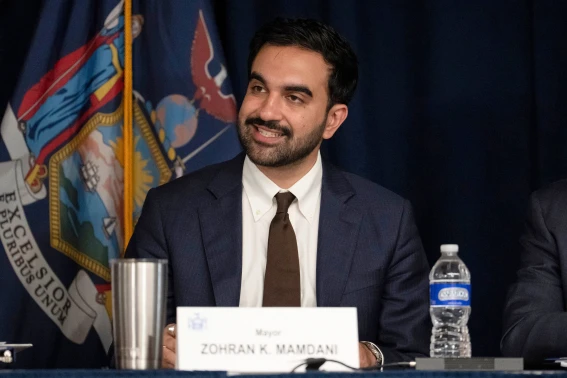
Mayor Zohran Mamdani announced the one-year moratorium, describing it as part of an effort to ensure that students learn to think critically rather than become overly dependent on artificial intelligence. The policy will apply to students through eighth grade and cover “all software that uses student-facing generative AI,” according to the Mayor’s office.
City officials described the measure as the most expansive prohibition of its kind in the United States. The ban comes as schools across the country struggle with how to incorporate rapidly developing AI technology into education while addressing concerns about cheating, overreliance on automated tools and the potential effects of excessive technology use on students’ learning.
“Each day when our children come to school we teach them to ask questions, to challenge assumptions, to interrogate the premise, to ask why. When it comes to AI in our schools, we hold an obligation to do the same.”
Zohran Mamdani
While younger students will face the temporary prohibition, New York City is taking a different approach with high school students. The city plans to introduce AI literacy classes twice a year for all public high school students, while also establishing pilot programmes that will allow selected students to work with a limited number of AI platforms under the supervision of educators.
Companion chatbots will be prohibited across all grade levels, officials said. The contrasting approach is intended to restrict unsupervised use of generative AI among younger children while giving older students an opportunity to learn how to use the technology responsibly.
City officials are also planning a comprehensive review of technology tools currently used throughout the public school system. Some products could be removed if education officials determine that they are not essential to student learning.
The review reflects growing scrutiny of the role technology plays in classrooms, particularly as schools acquire increasingly sophisticated digital tools. Officials have indicated that the assessment will examine whether existing products contribute meaningfully to education and whether adequate safeguards are in place.
Screen Time Limits Recommended
Screen time will also be addressed under the new approach. The city plans to recommend a limit of 30 minutes a day for students in grades three through five and 45 minutes for students in grades six through eight.
The proposed limits are intended to encourage schools and families to balance digital learning with other forms of classroom instruction and student activity. Teachers, however, will still be permitted to use AI for instructional planning and operational tasks. The policy therefore distinguishes between educators’ use of the technology and direct, student-facing applications.
Michael Mulgrew, President of the United Federation of Teachers in New York, welcomed the proposed screen-time limits but said the city’s AI policy leaves important questions unresolved. He said that the education department should take greater responsibility for ensuring that technology products purchased by the school system include appropriate AI safeguards. “If we are going to be serious, let’s start at the source, rather than expect school communities or individual educators to figure out after the fact if what their school uses fits the new policy,” Mulgrew said.
The debate reflects a broader national effort to establish rules governing artificial intelligence in schools. At least 37 states have developed official AI guidance that schools can use when considering how the technology should be introduced into education.
However, there is no single national definition of AI literacy or agreement on how it should be taught. Schools and education authorities have consequently adopted different approaches, ranging from restrictions on student use to programmes designed to teach responsible AI use.
New York City is seeking to combine both strategies. Younger students will face tighter restrictions on direct interaction with generative AI, while high school students will receive structured instruction intended to help them understand and use the technology. The city’s policy also comes after New York state approved a ban on students’ use of cellphones in schools last year, reflecting a wider effort to reduce distractions and reassess the role of personal technology in the classroom.
The challenge facing educators is complicated by the rapid development of AI tools. Generative AI systems can produce text, answer questions, summarise information and assist with a range of academic tasks, making them increasingly accessible to students.
The city’s public school students are scheduled to return to classrooms next week, meaning the new measures will soon begin affecting one of the largest public school systems in the United States.
READ ALSO: Xi Calls for New Middle East Security Order