Ghana reduced the value of public-sector financial irregularities across five audit streams by 62.9% in 2025, but the headline improvement conceals sharp deterioration in the institutions closest to central administration and local service delivery.
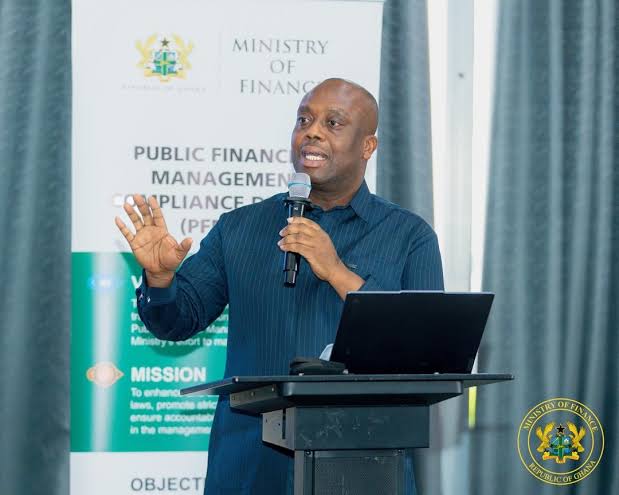
Figures presented by Deputy Finance Minister Thomas Nyarko Ampem at the 2025 Auditor-General’s Reports Engagement show that irregularities fell from about GH¢20.72 billion in 2024 to GH¢7.69 billion in 2025, exceeding the government’s 50% reduction target. Over the same period, irregularities in Ministries, Departments and Agencies rose 156.3%, while those in Metropolitan, Municipal and District Assemblies increased 125.6%.
Aggregate Improvement Came from Uneven Sources
The overall decline was driven by large reductions elsewhere in the public sector. Public Boards, Corporations and other Statutory Institutions recorded an 87.8% fall, Public Universities and Colleges of Education reduced irregularities by 51.5%, and the District Assemblies Common Fund recorded a 39.6% decline. Within tertiary education, recoverable irregularities fell 35.2% in public universities and 95.8% in colleges of education.
These movements show why an aggregate total cannot serve as a complete measure of public financial management. A very large reduction in one audit stream can outweigh worsening controls in several others. Differences in the institutions audited, the transactions examined and the composition of irregularities also matter when annual totals are compared.
An irregular audit must not automatically be described as stolen money or a realised fiscal loss. The category includes unsupported or improperly applied expenditure, unpaid taxes, outstanding receivables, unretired imprests, payroll anomalies and breaches of procurement or financial procedures. Some amounts are recoverable, while others primarily indicate control failures that increase the probability of future loss.
Central and Local Controls Weakened
The Auditor-General’s MDA report placed 2025 irregularities at approximately GH¢5.27 billion, up from about GH¢2.06 billion in 2024. Tax-related irregularities of roughly GH¢4.8 billion accounted for more than 91% of the total, followed by cash irregularities of about GH¢410.7 million. This composition makes the MDA increase the revenue-administration problem as much as an expenditure-control problem.
At the assembly level, the 2025 report recorded about GH¢42.61 million in irregularities, compared with approximately GH¢18.88 million a year earlier. The percentage increase is large partly because the starting value was much smaller than the MDA total, but the direction remains troubling. Assemblies manage transactions that affect roads, sanitation, markets, permits and other local services, so weak controls can translate quickly into poorer delivery.
The timing also raises the stakes. Government has committed to transferring 80% of the District Assemblies Common Fund directly to MMDAs to reduce release delays and accelerate local projects. Greater fiscal decentralisation can improve responsiveness, but larger and faster transfers require stronger procurement, cash management, internal audit and project verification at the receiving institutions.
Irregularities Carry Wider Fiscal Costs
Even when an amount is legally recoverable, delayed recovery has an economic cost. Government loses the immediate use of the cash, may borrow or postpone spending to close the gap, and bears administrative and legal costs in pursuing repayment. Inflation and the time value of money also mean that a cedi recovered several years later is not equivalent to a cedi protected at the point of transaction.
Repeated tax irregularities weaken the link between revenue mobilisation and public spending. GRA may intensify collection from private taxpayers while public entities fail to deduct or remit statutory taxes on time. That asymmetry undermines confidence in the fairness of the tax system and shifts financing pressure towards compliant firms, households or additional borrowing.
Control failures also reduce expenditure efficiency. A budget can satisfy its aggregate ceiling and still deliver poor value if contracts are unsupported, projects are delayed, payrolls contain anomalies or receivables remain uncollected. For citizens, the relevant outcome is not only how much government spends, but how much functioning public service is delivered for each cedi spent.
Recovery Must Become a Measurable Outcome
The Ministry of Finance says heads of covered entities must move from findings to action plans and actual recovery, rather than treating audit reports as annual administrative records. That approach requires more than demand letters. Each recoverable item needs an accountable officer, a deadline, an ageing schedule and a publicly reported status showing amounts recovered, under litigation, disputed or written off under lawful authority.
Prevention should be tracked with the same discipline. Parliament, audit committees and the Ministry should identify repeat findings by institution and disclose whether recommended controls were implemented. An entity that records a lower total only because one large receivable was settled may not have improved its underlying systems, while an institution with better controls may still report a legacy item from an earlier period.
Ghana’s 62.9% aggregate decline is therefore a qualified gain, not a reason for complacency. The next test is whether recoveries enter the public accounts, repeat breaches fall, and MDAs and assemblies reverse their worsening trend. Until that happens, the audit system will remain better at identifying exposed public funds than ensuring that every cedi produces its intended public value.
READ MORE: MDAs Financial Infractions Hit GH¢5.26bn in 2025, Tax Irregularities Account for 91.2%