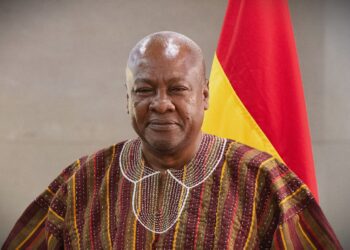
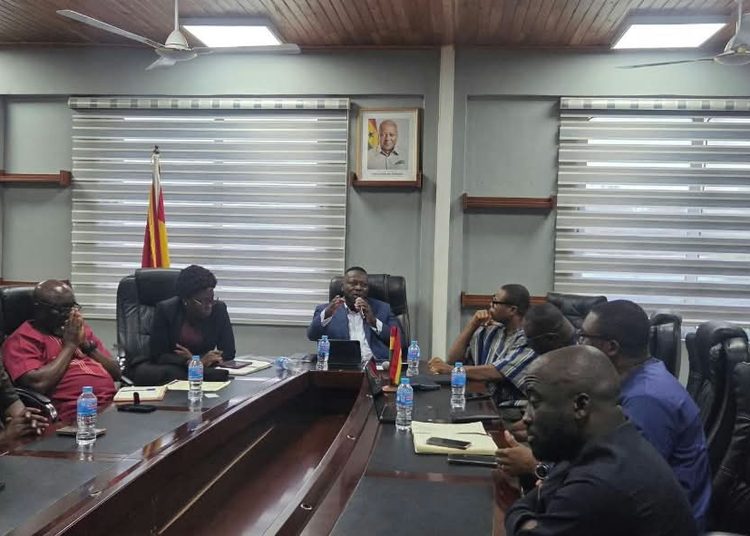
The IMANI Center for Policy and Education pressed the Ministry of Youth Development and Empowerment over severe fiscal constraints limiting its flagship programmes, during a strategic dialogue held at the Ministry’s premises in Accra on Wednesday, September 2, 2026.
The IMANI delegation, led by Founding President and Chief Executive Officer Franklin Cudjoe alongside Vice-President Selorm Branttie, Research Assistant Ransford Brobbey, Writer and Associate Kay Codjoe, and Technology Associate John Sitsofe Mensah, used the session to scrutinise the gap between the Ministry’s policy aspirations and the resources actually available to deliver them.
IMANI analysts underscored the necessity of stringent commitment control, drawing parallels with historical challenges faced by statutory vehicles like GETFund, where unbacked project allocations have repeatedly resulted in delayed execution and accumulated arrears.
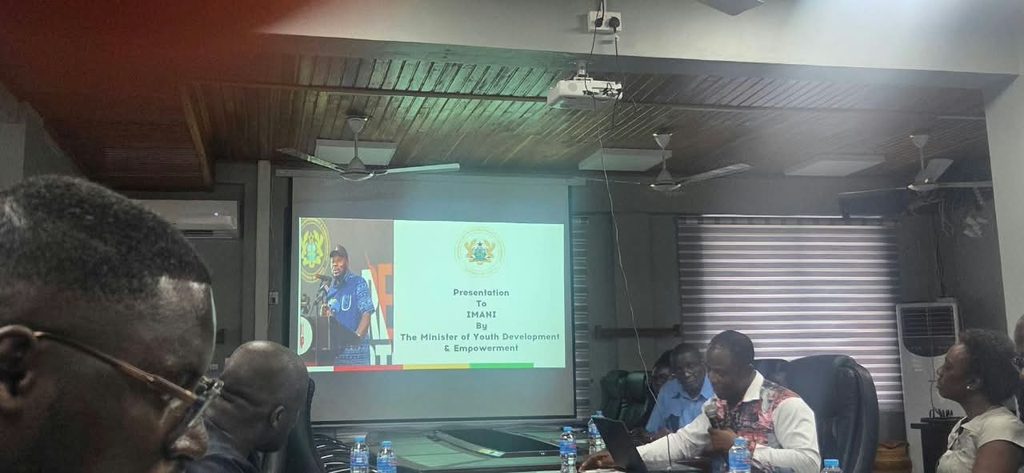
Ministerial leadership responded by clarifying just how tightly statutory obligations constrain the Ministry’s nominal 2026 budget of GH¢1.6 billion. Approximately GH¢1.1 billion is ring-fenced for economic transition programmes, and of that sum, nearly GH¢1.0 billion is absorbed entirely by National Service Authority personnel allowances.
That leaves discretionary capital for enterprise-focused modules severely limited, a structural reality that shapes how much genuinely new programming the Ministry can fund in any given year regardless of its stated priorities.
Turning to the Private Sector
To address that shortfall, IMANI proposed aggressive corporate co-financing strategies, urging the Ministry to leverage the corporate social investment portfolios of multinational manufacturing and beverage firms to multiply programmatic impact without over-relying on the central treasury.
Both parties acknowledged growing consensus among development partners around establishing a dedicated statutory youth funding mechanism, a longer-term structural fix that would reduce the Ministry’s dependence on annual budget allocations vulnerable to competing fiscal priorities elsewhere in government.
The conversation moved from financing structure to programme scale, with the Ministry’s flagship Adwumawura Programme drawing particular attention.
IMANI analysts noted that its current reach of 54,000 individuals amounts to just over 200 beneficiaries per district across Ghana’s 261 Metropolitan, Municipal and District Assemblies, a figure the delegation described as insufficient given the country’s structural unemployment levels.
That arithmetic exposed a tension between headline enrolment numbers and the actual density of support reaching any single community.
Spread across 261 districts, even a programme serving tens of thousands nationally translates into a modest presence at the local level, raising questions about whether Adwumawura’s current design can meaningfully shift youth employment outcomes at scale.
From Isolated Equipment to Cooperative Hubs
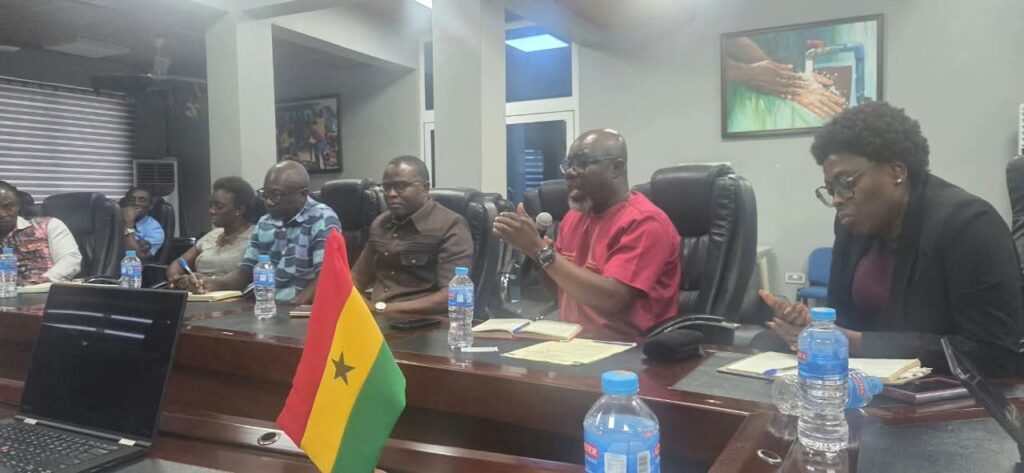
IMANI critiqued the traditional political practice of distributing isolated artisan equipment to individual beneficiaries, arguing this approach spreads resources thin without building lasting productive capacity.
The delegation advocated instead for a transition to cooperative enterprise models, in which beneficiaries are aggregated into shared mini-manufacturing hubs with access to pooled machinery, reliable utilities and unified procurement opportunities.
Aligning with that recommendation, MYDE confirmed ongoing efforts to convert ten existing National Youth Authority resource centres into light-industrial parks, two of which are already complete.
That conversion represents a concrete, already-underway response to the aggregation model IMANI proposed, suggesting some alignment between the think tank’s recommendation and the Ministry’s own direction of travel.
Untapped Value in Indigenous Crafts
IMANI researchers further highlighted the underdeveloped potential of indigenous crafts, including beadmaking, weaving and basketry, as drivers of non-traditional exports and circular economy jobs.
The delegation urged the Ministry to establish direct aggregation hubs for these crafts within the planned industrial parks, specifically to protect rural artisans from middleman exploitation that currently erodes their earnings and bargaining power.

That recommendation ties the broader cooperative enterprise model to a specific, currently underexploited segment of the informal economy, one where Ghana holds genuine comparative advantage but where individual artisans typically lack the scale or market access to capture full value from their work.
A Structural Conversation, Not a One-Off Critique
The fiscal and scale discussion reflected a consistent thread running through the dialogue: that good intentions and reported outputs are not sufficient on their own, and that programme design must account honestly for both the money actually available and the density of support reaching individual beneficiaries.
IMANI’s recommendations, corporate co-financing, cooperative aggregation and craft-sector hubs, were each pitched as ways to extract more impact from a fiscal envelope the Ministry itself acknowledged is tightly constrained by pre-existing statutory commitments.
Whether these recommendations translate into concrete policy shifts will depend partly on the pace at which the remaining eight National Youth Authority resource centres are converted into industrial parks, and on whether the Ministry succeeds in attracting the corporate co-financing partnerships IMANI proposed as an alternative to further treasury dependence.
READ ALSO: UK Pledges £100m Winter Defence Package to Strengthen Ukraine’s Defence