United Kingdom is set to introduce new restrictions on trade with Israeli settlements in the occupied West Bank.
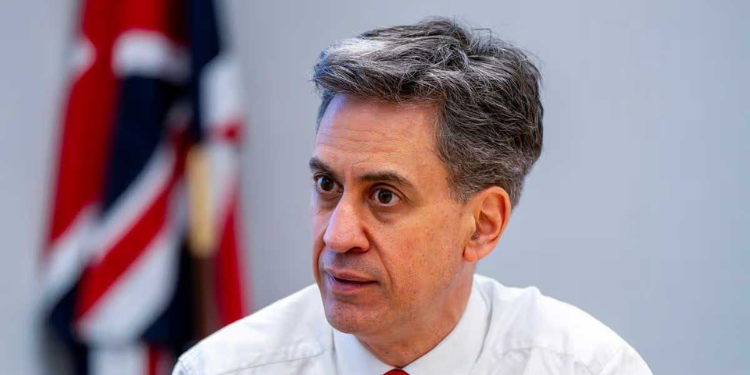
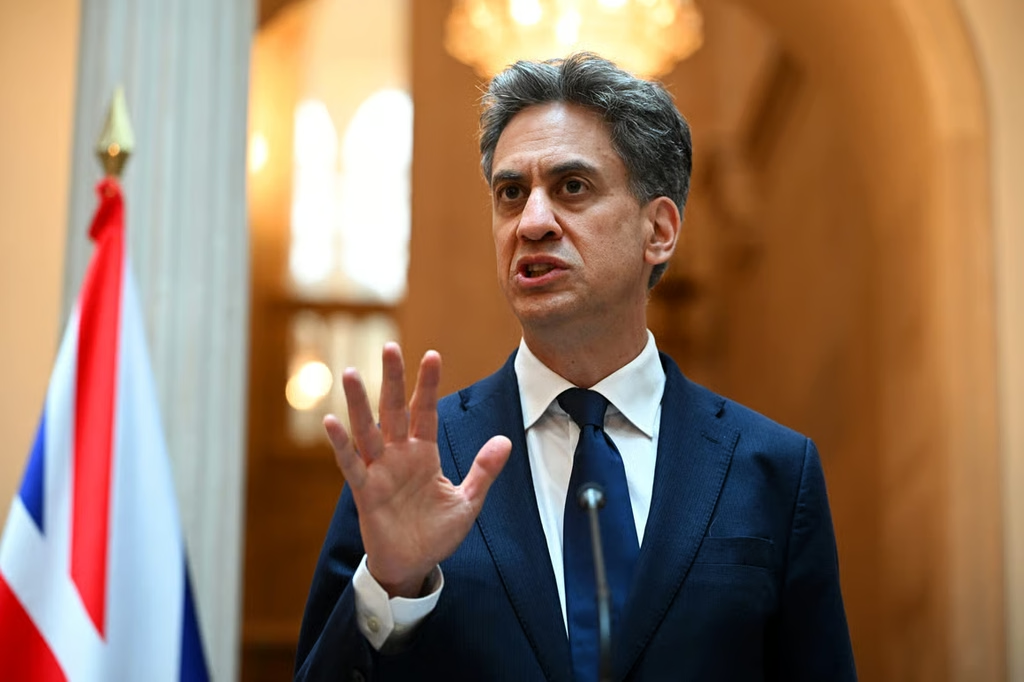
Foreign Secretary Ed Miliband is expected to outline the measures in the House of Commons as part of a reset of Britain’s relations with Israel.
The move represents a significant escalation in Britain’s response to Israel’s continued settlement expansion and rising violence against Palestinians in the West Bank.
Although the precise details of the package have not been made public, Labour MPs briefed on the plans believe the proposed measures could target trade involving illegal settlements, including both goods and services.
The British government has repeatedly stated that Israeli settlements in the occupied West Bank are illegal under international law and constitute a major obstacle to a two-state solution.
Foreign Secretary, Ed Miliband is expected to frame the measures as part of a broader policy shift rather than an isolated trade restriction.

“The statement will be a complete reset of the nature of our Israel-Palestine relationship. It will all feel very different. It is not just about sanctions. We hope that this will finally achieve what those of us who have been working towards for two years over the Middle East have been working on.”
Ed Miliband
The intervention follows Miliband’s announcement last week that the government would introduce a “comprehensive reset” of Britain’s policy towards Israel.
The Foreign Secretary has increasingly focused on the threat posed by settlement expansion, particularly following Israel’s decision to advance plans for new homes in the strategically significant E1 area east of Jerusalem.
The Israeli government recently opened tenders for around 1,200 settlement homes in the area, prompting widespread international condemnation.
Miliband described the E1 development as the crossing of a “red line,” arguing that its location could undermine the territorial continuity required for a future Palestinian state.
“This Israeli Government’s publication of a tender for the E1 settlement project is an unacceptable and destructive act,” Miliband stated previously, warning that E1 would cut across the heart of Palestine and risk separating the West Bank from East Jerusalem.

The British government has stated that it will not accept measures that could make the establishment of a Palestinian state increasingly difficult.
Prime Minister Andy Burnham has similarly warned that Israel’s E1 plans could “imperil or end” the two-state solution.
UK had already strengthened its guidance to British businesses earlier this year, advising them against economic and financial activities in illegal Israeli settlements. Settlement goods also do not receive preferential treatment under the UK-Israel Trade and Partnership Agreement.
However, the government now appears prepared to consider more concrete restrictions.
UK Seeks Broader Response as Settlement Expansion Accelerates
It is anticipated that the planned measures will address issues that have already been the focus of British sanctions, such as individual settlers and settler violence.
Stephen Doughty, who previously served as Europe Minister before becoming Middle East Minister, has argued that existing powers do not go far enough.
“At the moment, we can sanction where there is evidence of it being linked to settler violence, but not, for example, in relation to a contractor working on the settlements. We need to expand our sanctions powers.”
Stephen Doughty

The government’s perspective reflects a growing worry that the broader economic infrastructure that supports settlement development cannot be sufficiently addressed by penalties that solely target violent people.
The government is expected to use the announcement to demonstrate that Britain’s opposition to settlement expansion is moving from diplomatic statements towards concrete policy.
Israel has built roughly 160 settlements housing about 700,000 Jewish settlers in the West Bank and East Jerusalem since occupying the territories during the 1967 Middle East war. Around 3.3 million Palestinians live alongside them.
The expansion of settlements has intensified since the outbreak of the Gaza war, which began after the Hamas-led attack on Israel on 7 October 2023.
The West Bank has subsequently witnessed increased attacks by Israeli settlers against Palestinians and their property, further deepening international concern over the future of the territory.
Britain’s proposed measures are therefore being positioned within a wider effort to preserve the possibility of a negotiated settlement.

The two-state solution, which envisages an independent Palestinian state in the West Bank and Gaza, with East Jerusalem as its capital, existing alongside Israel, has received broad international backing for decades.
But the expansion of settlements has increasingly complicated that prospect by creating new physical and political realities on the ground.
Miliband has therefore linked the government’s planned response directly to the preservation of the two-state framework.
At the same time, the government is likely to face resistance from Israel and potentially from the United States.
Israel has previously warned that it would retaliate if Britain introduced punitive measures against the country.
Israeli Foreign Minister Gideon Sa’ar has stated that if Britain acts against Israel, Israel would respond, warning that it has the tools to do so.
United States is also expected to oppose a British trade ban, particularly given Washington’s close relationship with Israel.
READ ALSO: World Bank Partnership To Prioritise Ghana’s Power Sector Reforms