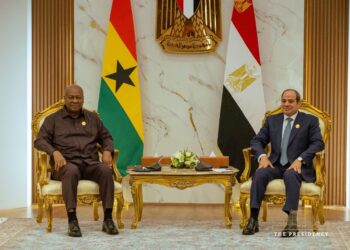
President John Dramani Mahama singled out the Ghana Gold Board’s 2025 financial performance for commendation, but his own caution against reading too much into a single profitable year has shifted attention from the headline number to the durability of GoldBod’s operating model.
Speaking at the SIGA Governing Boards and CEOs’ Conference, President Mahama cited profit of approximately GH¢896.5 million, compared with GH¢178.5 million in 2024. “These results deserve commendation.”
The figure needs careful reading. The 2025 State Ownership Report classifies GoldBod’s GH¢896.52 million as operating profit before interest and tax, while GoldBod’s audited financial statements report a GH¢909.71 million operational surplus.
The audited accounts also show a much larger GH¢5.44 billion overall surplus, but that total includes GH¢4.55 billion in government seed capital that remained unutilised at year-end. These measures describe different parts of the accounts and should not be presented as interchangeable profit figures.
That distinction makes President Mahama’s sustainability warning economically important. Ghana is not deciding whether GoldBod had a strong 2025; the available accounts show a clear improvement in underlying revenue and expenditure.

The harder question is how much of that performance can persist when gold prices, exchange-rate conditions, financing costs and trading volumes change.
Underlying Operations Improved Sharply
GoldBod’s audited 2025 financial statements show non-tax revenue of GH¢970.76 million, up from GH¢307.7 million in 2024, while expenditure fell to GH¢109.58 million from GH¢129.7 million.
That materially higher internally generated revenue alongside lower expenditure provides a stronger measure of operating improvement than the overall surplus alone. GoldBod’s balance sheet also expanded rapidly. Total assets reached GH¢9.55 billion and cash and cash equivalents stood at GH¢8.77 billion at the end of 2025.
But part of that balance-sheet expansion reflects the GH¢4.55 billion government capital provided for gold purchasing and trading, which means asset growth should not be confused with value created by operations.
The comparison with 2024 also spans an institutional transition from the former Precious Minerals Marketing Company framework to GoldBod’s broader statutory mandate. That does not invalidate the improvement, but it means year-on-year comparisons should be read alongside changes in functions, revenue streams, and capital structure.
One Profit Number Cannot Tell the Whole Story
The difference between GH¢896.52 million, GH¢909.71 million and GH¢5.44 billion is not evidence that one set of accounts must be wrong.

The figures answer different accounting questions. SIGA’s measure focuses on operating profit before interest and tax; GoldBod reports an operational surplus from core non-tax activities; the overall surplus incorporates the treatment of the government subvention.
The distinction matters because the most useful test of a commercial state enterprise is whether its recurring operations generate enough income to cover costs, finance necessary investment and eventually provide an appropriate return to the state without repeated fiscal support.
The issue has already surfaced in debate over GoldBod’s GH¢4.55 billion government subvention. The cleaner way to assess performance is therefore to separate the capital provided by the shareholder from the income generated by the institution’s ongoing operations.
Favourable Conditions May Have Helped
President Mahama placed GoldBod’s performance inside a wider improvement across Ghana’s state-owned enterprises. SOE revenue rose 28.1% to GH¢176.43 billion in 2025, while the portfolio moved from a GH¢2.25 billion net loss to GH¢19.8 billion in net profit.
But the President noted that roughly GH¢11.72 billion in foreign-exchange gains and a 42.5% fall in aggregate finance costs contributed materially to the turnaround.
That is why his warning matters beyond GoldBod. “A one-year turnaround is encouraging, but sustained performance is the real test.” A stronger cedi, favourable gold prices or cheaper financing can improve reported results without necessarily proving that productivity has permanently increased.

GoldBod’s growing role in foreign-exchange mobilisation adds another layer. Its August FX allocation to commercial banks and the Bank of Ghana shows that the institution’s performance has implications beyond its own income statement.
The durability of those flows will depend on gold volumes, financing arrangements, margins and global prices.
Public Value Requires More Than a Profitable Year
The broader SIGA conference message was that commercial state enterprises should be judged by efficiency, competitiveness and financial sustainability rather than by their ability to survive on the public balance sheet.
President Mahama summarised that standard more briefly: “Public ownership must produce public value.” For GoldBod, that means future reporting should make it easy to track recurring operating income, trading costs, capital employed, cash returns to the state and the foreign-exchange generated from its gold model.
Those measures will reveal whether 2025 was the start of a durable operating improvement or an exceptional year assisted by unusually favourable conditions. The current evidence supports a positive but narrower conclusion: GoldBod’s underlying operations improved substantially in 2025.
What the accounts cannot yet establish is whether that performance is repeatable. The next set of audited results will therefore matter more than another headline surplus, because sustainability (not the largest single-year number) is the better measure of economic value.
READ ALSO: GoldBod’s US$1.315bn FX Split Channels Dollars to Market, Reserves