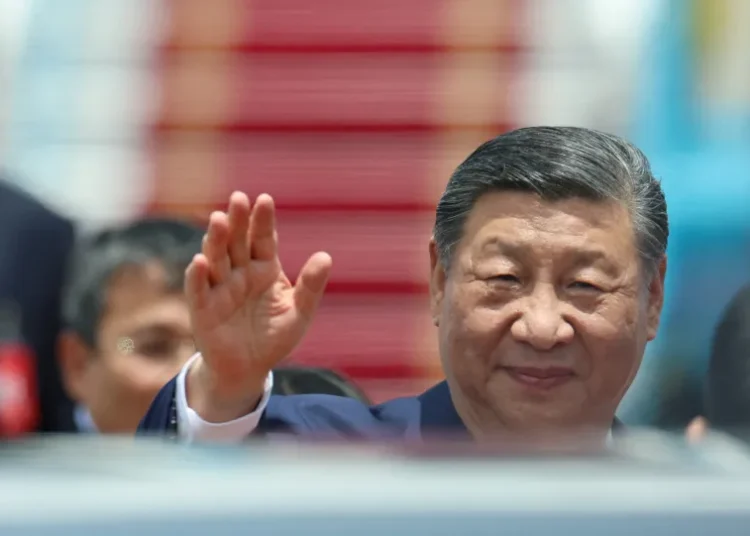
Chinese President Xi Jinping has arrived in New Delhi for the 18th BRICS summit, his first visit to India since 2019, as Beijing and New Delhi seek to consolidate a cautious diplomatic thaw while the expanded grouping faces mounting geopolitical and economic challenges.
Xi departed for India at the invitation of Indian Prime Minister Narendra Modi, according to China’s state-run Xinhua news agency. He was accompanied by Chinese Foreign Minister Wang Yi and senior Chinese Communist Party official Cai Qi.
The visit is being closely watched as the most significant step yet in efforts by the two nuclear-armed neighbours to improve relations following years of tensions, particularly after a deadly military confrontation along their disputed Himalayan border in 2020.
Relations between China and India have gradually improved in recent months, with both sides restoring flights, easing visa restrictions and increasing high-level diplomatic contacts. However, the underlying territorial dispute remains unresolved, and China and India continue to maintain substantial military deployments along their approximately 3,500-kilometre (2,175-mile) high-altitude border.
Beijing signalled its willingness to continue improving relations ahead of Xi’s visit, with Chinese authorities saying on Friday that the country was “ready to work with India … by strengthening communication, enhancing cooperation, and properly handling differences.”
Xi and Modi are expected to meet later today on the sidelines of the BRICS summit, with their discussions likely to provide another indication of whether the recent diplomatic improvement can develop into a more stable relationship.
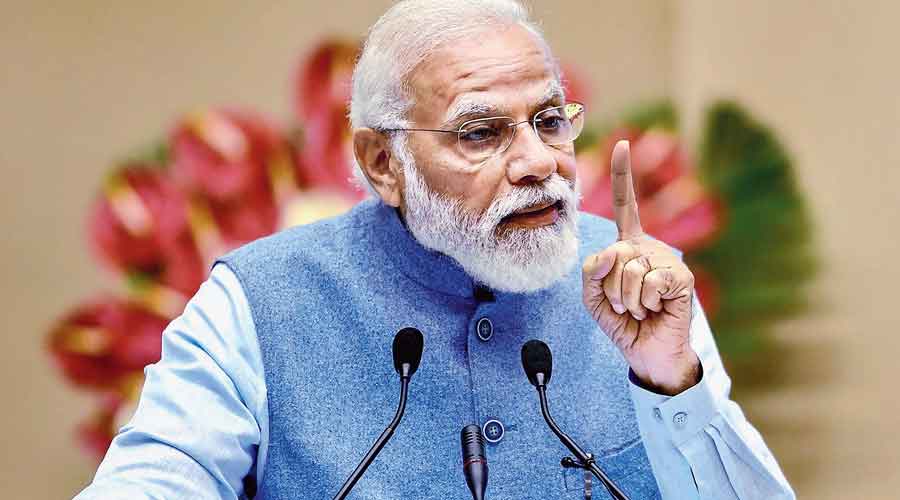
Xi’s presence at the summit provides an opportunity for India to engage directly with China while reinforcing New Delhi’s position as an important diplomatic actor among emerging and developing economies.
The BRICS gathering brings together Modi, Russian President Vladimir Putin, Iranian President Masoud Pezeshkian and leaders from the other members of the bloc.
Thousands of police and paramilitary personnel have been deployed around the summit venue and other parts of New Delhi, with traffic restrictions and diversions introduced as leaders gather for the high-level meeting.
The two-day summit is taking place against a backdrop of wars in Ukraine and the Middle East, rising tensions between the United States and China, global trade disruptions and concerns over energy security.
Leaders are expected to discuss economic cooperation, investment, energy and food security, technology, supply chains and reforms to international institutions. Greater use of national currencies in trade and payments and reducing dependence on the US dollar are also expected to feature prominently.
China and Russia have increasingly viewed BRICS as a vehicle for strengthening cooperation among emerging and developing economies and reducing Western influence over the global economic and political system. Beijing is also seeking to deepen its influence within the expanded grouping and position BRICS as an alternative centre of global power.
Chinese Foreign Ministry Spokesperson Mao Ning said that Xi was expected to discuss major international issues and ways to deepen cooperation among BRICS members.
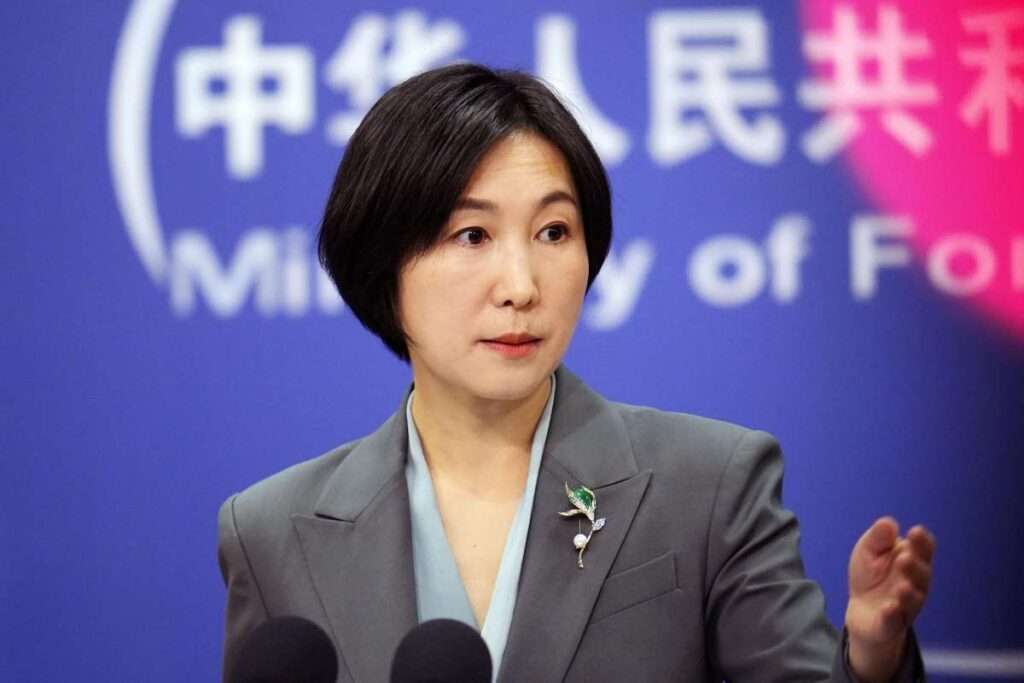
For New Delhi, however, the summit carries an additional significance because of its potential to help ease tensions with Beijing. Modi’s expected meeting with Xi could consolidate the diplomatic thaw that has emerged since the deterioration of bilateral relations following the 2020 border clashes.
BRICS Unity Faces Test As Wars and Trade Divide Members
While Xi’s arrival has placed China-India relations in the spotlight, the wider summit is also expected to test whether BRICS can maintain unity despite increasingly divergent positions among its members.
The grouping is meeting at a time when conflicts in Ukraine and the Middle East, trade tensions and energy insecurity are placing pressure on countries with different geopolitical priorities and relationships with major global powers.
One immediate test for India, which is chairing the summit, will be whether leaders can agree on a joint statement. Divisions within the grouping were already apparent in May, when BRICS Foreign Ministers failed to reach agreement on a joint statement over the Iran war, prompting India to issue a chair’s summary instead.
The issue is particularly sensitive as concerns grow that the Iran war, triggered by US-Israeli strikes on February 28, could widen amid escalating tensions involving Saudi Arabia and Yemen’s Houthi rebels.
The conflict has significant implications for energy security, trade routes and the broader global economy, making it difficult for BRICS members to separate economic cooperation from their differing geopolitical positions.
India is therefore seeking to use its chairmanship to promote cooperation while navigating competing interests among members that include China, Russia and Iran, alongside other emerging economies.
The outcome of the Modi-Xi meeting and the summit’s ability to produce a unified position on major global issues will therefore be closely watched as BRICS seeks to expand its influence in an increasingly divided international system.
READ ALSO: Modi, Putin Discuss Cooperation Ahead of BRICS Summit