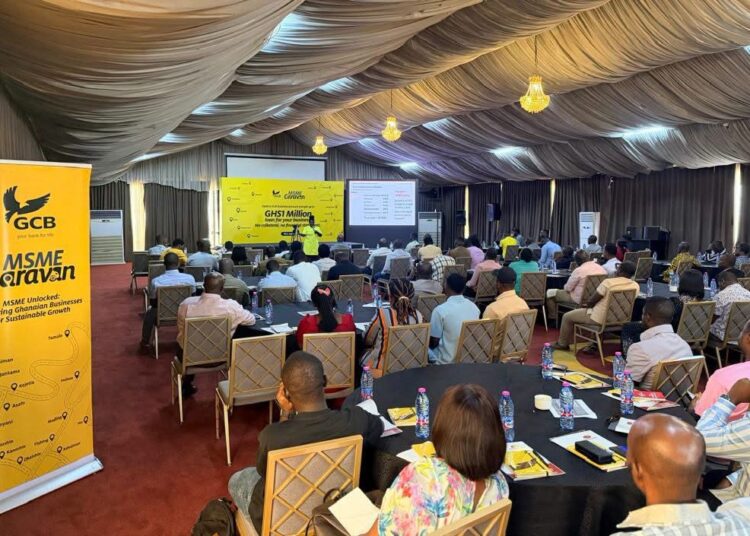
The GCB MSME Caravan Clinic is ongoing in Kumasi this week, engaging MSMEs and entrepreneurs in practical conversations on financing, sustainable business growth, branding, reputation management and tailored solutions designed to help their businesses thrive.
It is all about listening, learning, connecting and providing the right support to move Ghanaian businesses forward and for GCB Bank PLC, Ghana’s largest indigenous bank, it is part of a nationwide push to reposition itself from a lender to a business partner.
Hundreds of business owners, traders, artisans, start-ups and women led enterprises have gathered at the Kumasi edition for one-on-one advisory sessions, masterclasses and networking clinics with GCB’s SME banking, retail, digital banking and insurance teams.
Speaking at the clinic, GCB officials say the caravan was designed to understand customer needs better and co-create solutions. The biggest challenge facing SMEs, they note, remains access to finance, particularly the demand for collateral.
To address that, the bank is showcasing its collateral-free SME Business Loan of up to GH¢1 million for eligible businesses, its Value Added Package (VAP) insurance initiative which provides insurance cover for qualifying MSME customers at no premium cost, and its expanded digital services that enable businesses to receive payments, make transactions, issue invoices and improve operational efficiency.
“At GCB, our solutions are targeted at addressing the fundamental challenges of the MSME sector and to help grow businesses in Ghana,” the bank’s management has emphasized at recent clinics.
Participants in Kumasi are also receiving practical toolkits how to structure business finances, build bankable records and how to access GCB’s short term facilities and the bank’s competitive 3.5% MSE loan module that traders in Kumasi have previously described as the best on the market.
This initiative helps with branding, customer trust and reputation management in a competitive market Continuity planning and risk protection through insurance
A National Caravan Clinic Agenda for Customers
The Kumasi clinic follows successful editions in Accra and Tamale, reinforcing GCB’s strategy to decentralize SME support beyond the capital. In Accra, the bank hosted a large MSME clinic as part of its broader financial inclusion agenda.
The Accra edition, like Kumasi, focused on bridging the knowledge gap for small businesses. Over 80 businesses in Accra’s markets and industrial enclaves participated, raising familiar concerns: high interest rates elsewhere, lack of proper bookkeeping, and difficulty formalizing businesses to attract investment.
GCB responded by walking entrepreneurs through business formalization processes, financial management, credit readiness and the use of its digital platforms for merchant payments. The bank also used the Accra clinic to officially launch its VAP insurance initiative, telling customers that it had paid premiums for qualifying customers to support their businesses in times of emergency.
In Tamale just last month, GCB organized another clinic under its GCB MSME Caravan initiative under the theme “MSME Unlocked: Powering Ghanaian Businesses for Sustainable Growth.” That event, held in partnership with local business groups, brought together entrepreneurs, business owners and industry stakeholders in the Northern Region.
Speaking at the Tamale event, Executive Head of Commercial and Business Banking at GCB Bank, Alhassan Idrisu Danaa, said the initiative is designed to understand better customers’ needs and co-create solutions.
The Tamale event became successful CEO one that is now replicating in Kumasi, using financing plus advisory to help businesses move from micro to medium.
Why this Initiative Matters?
MSMEs employ nearly four-fifths of Ghana’s workforce and generate about 60% of national output, according to Ministry of Finance figures. Yet, according to the Ghana Statistical Service, only 18% of SMEs maintain formal accounting records, and access to patient capital remains limited.
The government has recently directed state-owned enterprises to channel more business through domestic banks like GCB to position state banks to better support small businesses. At the same time, it is working with development finance institutions on guarantee schemes to lower borrowing costs and reduce collateral demands.
GCB says its caravan model is its answer to the last-mile challenge. Rather than waiting for entrepreneurs to come to the banking hall, the bank is going to markets, bringing its relationship managers, credit officers and capacity-building partners to the entrepreneurs.
The Kumasi edition is expected to run with pitch sessions, business health checks and on-the-spot account opening and advisory. The bank says more clinics will follow in other regional capitals in the coming months, with the ultimate goal of building a pipeline of bankable, resilient and digitally enabled Ghanaian MSMEs that can take advantage of the African Continental Free Trade Area.
For entrepreneurs in Kumasi today, the message is simple: bring your business challenge, and find a practical, Ghanaian solution.