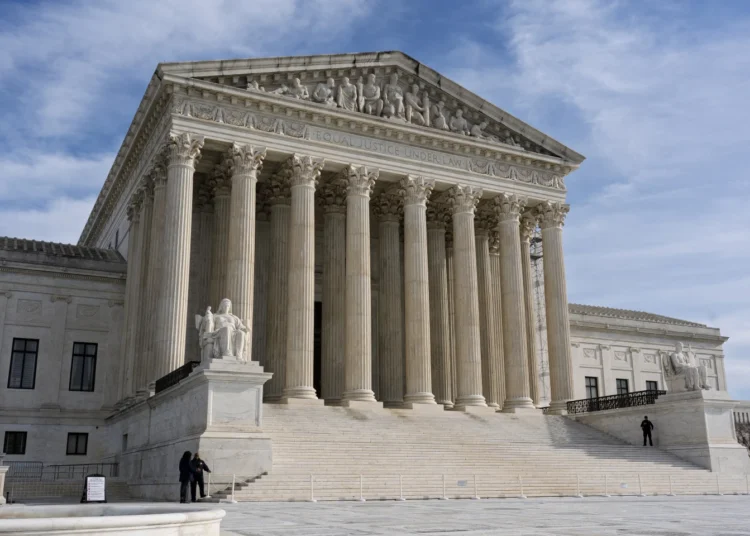
The U.S. Supreme Court has rejected President Donald Trump’s bid to impose new restrictions on mail-in ballots ahead of the November midterm elections, dealing a significant setback to his efforts to tighten voting-by-mail rules.
The conservative-majority court refused to lift an order by U.S. District Judge Indira Talwani that had blocked a Trump administration measure allowing the U.S. Postal Service to enforce new requirements targeting mail-in ballots.
The decision means states can continue sending and processing mail ballots under the procedures they have used in previous elections, preserving a voting method that has accounted for nearly one-third of ballots cast in recent elections.

The dispute began after Trump signed an executive order in March seeking to tighten rules governing mail-in voting. Under the proposed system, states would have been required to provide the Postal Service with lists of ballot recipients and use ballot-mail envelopes previously approved by the agency.
The Postal Service would then have been permitted to reject ballots that did not comply with the new standards or could not be linked to registered voters on the relevant lists.
Democratic state officials and voting rights organisations challenged the policy in court, arguing that the president lacked the constitutional authority to establish election rules of this nature. They warned that implementing the restrictions shortly before a major election could “virtually eliminate mail voting on the eve of a major election.”
Judge Talwani subsequently issued an injunction blocking the measure, finding that it was likely unconstitutional and could be difficult, if not impossible, for election officials to implement so close to the midterm elections.
The Trump administration then asked the Supreme Court to intervene, urging the justices to allow the policy to take effect. The administration described the measure as “an important federal policy to protect the mails from being used to commit voter fraud.”
The Supreme Court had temporarily allowed Trump to proceed with the executive order in late August on procedural grounds, but that decision did not resolve whether the restrictions themselves were legally valid.
In its latest ruling, however, the court concluded that the administration was “unlikely to succeed on the merits” of its challenge, leaving Talwani’s injunction in place. Justices Samuel Alito and Clarence Thomas dissented from the decision.
Alito argued in his dissent that the Postal Service “has broad authority to regulate the mail” and likely possesses the power to enforce the restrictions proposed by the Trump administration.
Justice Brett Kavanaugh, who was appointed to the Supreme Court by Trump, joined the majority in preventing the restrictions from taking effect for the midterms. However, he indicated that he could potentially support the administration’s position if the issue returned to the court at a later stage.
The ruling comes as election officials prepare for the midterm elections, with some states already beginning the process of sending mail ballots to voters. Alabama, North Carolina and Wisconsin have already started sending ballots, while other states are moving ahead with preparations under their existing election procedures.
Election officials had warned that implementing a completely new mail-ballot system so close to the election could disrupt the delivery and processing of thousands of ballots and potentially disenfranchise voters who rely heavily on voting by mail. The concern is particularly significant in states where mail voting is widely used, including several Democratic-leaning states.
Trump has long criticised voting by mail and has repeatedly linked the practice to his unsubstantiated claims of widespread fraud in the 2020 presidential election, which he lost to Democrat Joe Biden. Trump has nevertheless used mail voting himself, including this year.
The Supreme Court’s decision therefore represents a major setback for one of the President’s longstanding election priorities, while allowing election officials to proceed with established voting procedures for the midterms.
Officials Hail Supreme Court Decision
The Supreme Court’s ruling was welcomed.
Utah Lt. Gov. Deidre Henderson, a Republican who serves as the state’s chief election officer, said that the decision should reassure voters that the election process would proceed normally. “Utahns can have confidence that the 2026 election will proceed as normal,” Henderson said in a social media post.
Washington Secretary of State Steve Hobbs, a Democrat, similarly welcomed the ruling, saying election officials could continue their preparations without being forced to introduce what he described as unrealistic requirements for ballot mail.
Hobbs noted that the decision means work “to carry out a safe, secure, and accurate election” can continue “without having to upend our election processes to meet unrealistic ballot mail requirements.”
In Arizona, another state where voting by mail is widely used, Democratic Secretary of State Adrian Fontes also praised the ruling. Fontes said “it is crucial for us to continue rejecting the notion that access and security are mutually exclusive when it comes to running strong elections.”
The Supreme Court’s decision leaves the Trump administration unable to enforce the proposed mail-ballot restrictions for the upcoming midterms, at least under the current legal challenge.
The case could still return to the courts in the future, particularly given Kavanaugh’s indication that the legal questions surrounding the Postal Service’s authority could receive a different consideration outside the immediate pressure of the midterm election.