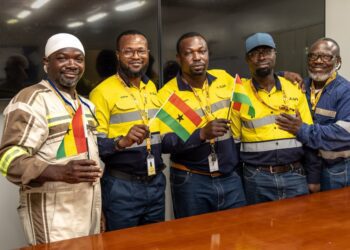
The Minerals Commission is establishing baseline minimum wage thresholds and standard tender benchmarks for local contract mining firms to safeguard workers’ remuneration and prevent destructive undercutting across the extractive sector.
The regulatory intervention seeks to strengthen domestic participation, elevate operational safety, and foster a sustainable local sub-contracting ecosystem while supporting overall industrial competitiveness.
“The regulator does not want people to be worse off under contract mining,” Ben Birch-Mensah, director of local content at the Minerals Commission, stated regarding the benchmark policy.
This policy shift comes as part of Ghana’s broader effort to deepen local ownership and extract long-term, tangible economic value from its natural resource endowment.
By establishing standard pricing structures and strict labor baselines, the regulator aims to resolve a persistent dilemma facing resource-rich African nations: balancing stringent local content mandates with corporate efficiency and technical productivity.
“If people keep undercutting themselves, they may not have the resources to undertake the work, they won’t pay workers properly, they won’t train people, and safety is compromised,”
Chamber of Mines CEO Ken Ashigbey

Curbing Unfair Bidding to Safeguard Workforce Welfare
The drive to reform tender benchmarks stems directly from systemic under-pricing within Ghana’s sub-contracting landscape.
In a bid to secure competitive contracts with major foreign mining conglomerates, local service providers have repeatedly engaged in aggressive rate cutting.
While lower bids initially appear cost-effective for primary operators, they severely degrade the internal capacity of local service firms.
This destructive bidding dynamic directly undermines worker compensation, suppresses wages, and forces sub-contractors to operate on paper-thin profit margins that leave no room for long-term growth.
When sub-contractors compete solely on price rather than quality and operational integrity, employee welfare is the first area to suffer.
Aligning Local Content Policies with Global Industrial Standards
Enforcing minimum tender standards represents a pivotal step in evolving local content policy from simple quota compliance into a robust model for local capacity building.
Historically, local content regulations risk becoming hollow mandates if indigenous firms lack the financial reserves to invest in modern machinery, workforce development, or specialized technology transfers.
Setting a mandatory wage and tender floor protects local contractors from financial distress, enabling them to build institutional capital, upgrade equipment, and retain skilled labor necessary to meet stringent international standards.

This intervention aligns Ghana with a growing regional trend across Africa’s mining jurisdictions, where regulators are reshaping extractive frameworks to foster sustainable, indigenous industrial capacity.
By ensuring that local contract miners receive viable commercial rates for their services, the Minerals Commission creates a predictable business environment.
This baseline framework enables domestic companies to compete fairly, scale operations effectively, and contribute meaningfully to the country’s economic development without compromising site safety or operational excellence.
Balancing Cost Efficiency and Sustainable Partner Ecosystems
For primary mining operators, establishing regulated tender baselines creates a more resilient, highly skilled, and dependable local supply chain.
Unregulated market forces often create contractor volatility, high turnover rates, and frequent safety incidents, which ultimately result in cost overruns and operational delays for primary mineral right holders.

Establishing fair, predictable bidding terms ensures that contract firms maintain the financial stability needed to execute technical projects safely, efficiently, and on schedule.
Ultimately, balancing operational efficiency with local content objectives requires viewing local suppliers as long-term strategic partners rather than short-term cost centers.
Through clear baseline regulations, the Minerals Commission ensures that local participation translates into measurable, lasting value for Ghanaian workers, contract enterprises, and the wider national economy.
READ ALSO: Yemen’s Humanitarian Crisis Worsens Amid Rising Displacement