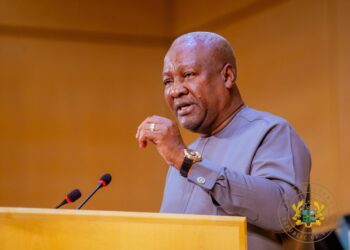


The Minority Ranking Member on Parliament’s Defence and Interior Committee, Honourable John Ntim Fordjour, has questioned the decision by the government to deploy its communications machinery in response to an earlier warning he raised about suspicious aircraft allegedly linked to drug trafficking and money laundering.
Honourable Fordjour, who is also the Member of Parliament for Assin South, argued that the drug cases involve transnational crime and therefore require the security agencies mandated to investigate narcotics and national security issues to lead the government’s response.

The Ranking Member explained that his initial warning did not accuse specific individuals of wrongdoing but sought investigations into the aircraft, their activities in Ghana and the persons behind them. He indicated that the relevant authorities should have examined what the aircraft brought into the country, what they took out and whether their activities have any connection to narcotics trafficking or money laundering.
Against this, Honourable Fordjour questioned why the government’s spokesperson and presidential spokesperson, Felix Kwakye Ofosu, was tasked with leading the communication surrounding the matter. He argued that the responsibility should have rested with institutions such as national security agencies and the Narcotics Control Commission.
Furthermore, the Assin South MP drew comparisons with international cases involving major narcotics seizures. He referenced investigations in Australia and France where, according to him, security and law enforcement authorities took responsibility for communicating the cases without political figures becoming the primary public voices.
“These are purely security matters, transnational crimes; there are agencies mandated to deal with it. Those agencies spearhead the communication. When $280 million was busted in Australia from Ghana, it took the authorities in Australia to make this public. They took it to a TV station, published the suspects they were trying in court, and gave a full profile with their images and everything. No public official, no government official came into it.”
Honourable John Ntim Fordjour
The Ranking Member therefore argued that the approach adopted by the government created questions about the interests being protected. He contended that the agencies responsible for investigating transnational crimes should have been allowed to establish the facts and communicate their findings.
Honourable Fordjour also linked his concerns to the broader series of major drug seizures involving consignments allegedly connected to Ghana. Recent reporting has documented his calls for investigations following the seizure of nearly 3.9 tonnes of cocaine in France from a container that arrived from Ghana.
Additionally, he questioned why major drug cases have not, in his assessment, produced corresponding high-profile prosecutions. He argued that the focus should be on identifying the networks responsible for financing, facilitating and moving large consignments instead of limiting enforcement efforts to individual seizures.

Honourable Fordjour consequently called for the security architecture to take such warnings seriously and pursue the evidence presented to it. He stressed that the objective of his original intervention was to trigger investigation and accountability before the alleged activities developed into a larger national security challenge.
Fordjour Questions Security Response And Intelligence Co-operation
The Member of Parliament for Assin South and Ranking Member on the Defence and Interior Committee recalled that he invited security officials to Parliament to examine the information available to him. He explained that the invitation was intended to facilitate a formal exchange of information rather than create confrontation between Parliament and the security agencies.
Honourable Fordjour, however, alleged that the authorities declined the invitation before armed personnel later went to his residence seeking further particulars. He questioned why such an approach would be necessary when he indicated his willingness to provide information through Parliament.
The Ranking Member argued that the episode created the impression that individuals raising questions about narcotics trafficking could face intimidation instead of being engaged through established parliamentary and security channels. He insisted that his original intervention was directed at uncovering information and identifying those responsible for any criminal activity.

“The Interior Minister, who has additional responsibility for National Security, Interior, NACOB and all those agencies under him, had reason to publicly disclose that our external partners, the intelligence agencies in other countries who had held long-standing joint intelligence-sharing cooperation with us, most of them are now fatigued. They have lost confidence and trust in us and have now discontinued sharing information.”
Honourable John Ntim Fordjour
Honourable Fordjour argued that the reported development should trigger serious institutional reflection because international intelligence sharing forms an important part of efforts against transnational organised crime. He stressed that the issue should not be reduced to partisan exchanges when the underlying matter involves Ghana’s security and international reputation.
The Ranking Member further used the scale of the recent seizures to illustrate why stronger security coordination remains necessary. He pointed to the reported 3.9-tonne cocaine seizure in France and argued that consignments of that magnitude could not reasonably be treated as isolated incidents.
READ ALSO: Parliament Assesses TOR Revival As Ghana Seeks Fuel Security