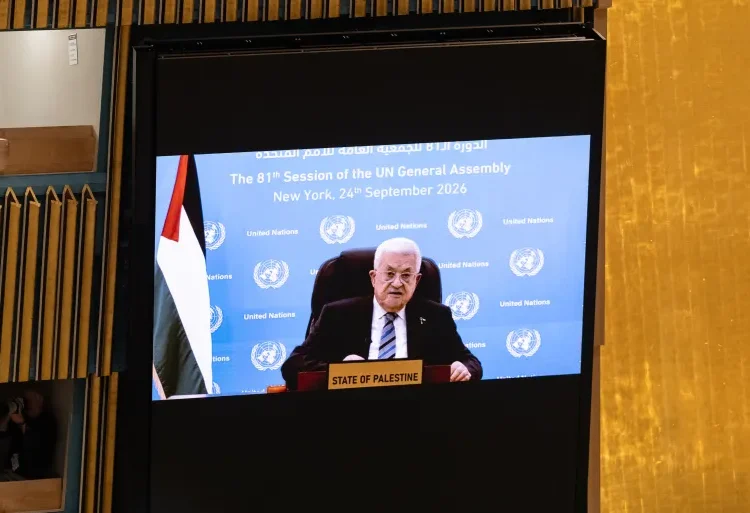
Palestinian President, Mahmoud Abbas has condemned the United States’ decision to deny visas to Palestinian Authority officials for the second consecutive year, arguing that the restrictions violate Washington’s obligations as host country of the United Nations.
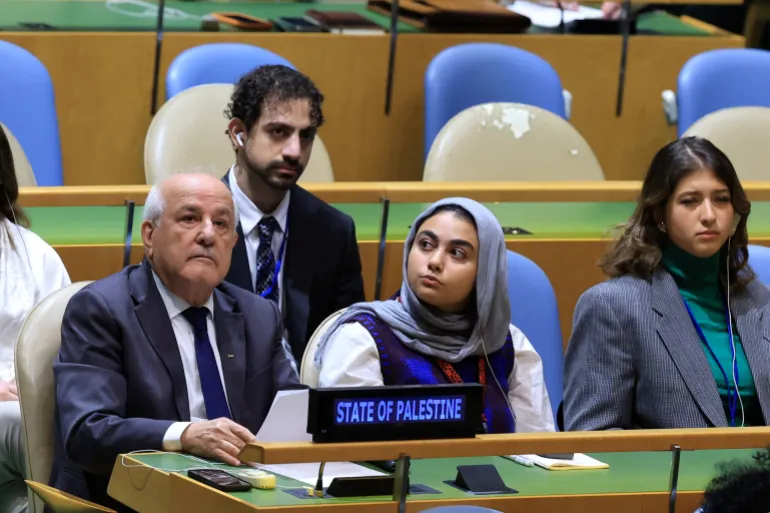
Speaking in a pre-recorded address to the UN General Assembly, Abbas rejected the US decision and the justifications given for the restrictions, which prevented members of the Palestinian delegation from travelling to New York for the annual high-level gathering. “We reject these unlawful, punitive measures and we reject the accusations and justifications on which they were based,” Abbas said.
He argued that denying the Palestinian delegation access to the UN headquarters constituted a violation of the United States’ responsibilities as the host country.
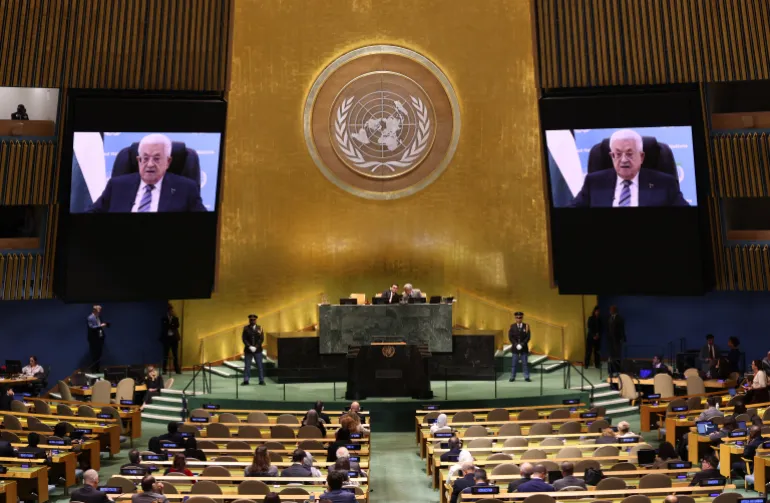
“We call upon the American administration to lift these sanctions and restrictions, return to dialogue and mutual respect, and work with us and with the international community in order to implement the two-state solution on the basis of international legitimacy and to establish peace rather than punishing the side that has chosen the path of international law, and political and diplomatic action, in order to guarantee its rights.”
Mahmoud Abbas
Abbas said that the Palestinian people and their leadership should not be punished for seeking an end to the Israeli occupation or for turning to international institutions including the United Nations, the International Court of Justice and the International Criminal Court. “Our choice to invoke international law is a peaceful and civilised choice,” he said.
The Palestinian President also used his address to criticise Israeli policies in the West Bank, including occupied East Jerusalem, where he said settlement expansion was accelerating.
He accused Israeli settlers of escalating violence “under the protection of the occupying forces” and condemned what he described as land confiscation and demolitions carried out through a system of measures he said was based on racial discrimination, ethnic cleansing and state terrorism.
Abbas warned that these policies threatened not only the prospects for a two-state solution but also “the very existence of the Palestinian people.”
Turning to Gaza, Abbas described the situation as an “unprecedented humanitarian catastrophe,” accusing Israeli forces of killing, destruction, starvation and attempts to displace Palestinians. “In the Gaza Strip, our people are being subjected at the hands of the Israeli occupation forces to killing, destruction, starvation, and attempts at displacement,” he said, describing the Israeli assault as a “genocidal war.”
Abbas questioned how long the international community would remain silent over the situation in Gaza and the West Bank and criticised countries that continue to supply Israel with weapons. “How much longer will some states continue to remain silent on Israel or supply it with the weapons that it uses against our people?” he asked.
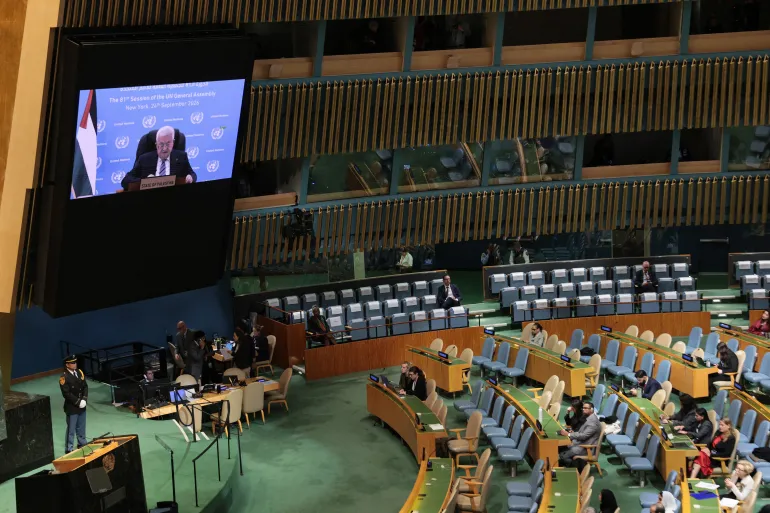
He called on the international community to protect Palestinians, ensure their continued presence on their land, end the Israeli occupation and pursue a two-state solution based on international legitimacy.
Abbas also raised concerns over the impact of Israeli actions on the United Nations Relief and Works Agency for Palestine Refugees (UNRWA), saying attacks on UN facilities and institutions in Jerusalem and the West Bank were undermining its ability to operate.
“We call upon all states and international and regional organisations to continue supporting the work of UNRWA, for which there is no substitute so long as the issue of refugees remains unresolved.”
Mahmoud Abbas
Abbas Calls For Second Phase of Gaza Peace Deal
Abbas also called for an acceleration of the second phase of the Gaza peace deal between Israel and Hamas, warning against allowing the transitional period to become indefinite.
He noted that the Gaza Board of Peace was established nearly a year ago and said only one year remained in the designated transitional period. “Therefore, we call for accelerating the implementation of the second phase [of the Gaza peace deal between Israel and Hamas] rather than wasting any more time,” Abbas said.
He also called on US President Donald Trump to fulfil commitments he said Trump had made to Arab and Islamic leaders in September to prevent the annexation of Palestinian territory and reject displacement.
Abbas said that the eventual objective should be a democratic Palestinian state that respects the rule of law and human rights. “We seek a democratic Palestinian state that respects the rule law and human rights,” he said, emphasising that it should be “a non-militarised state” living peacefully alongside Israel.
He also warned against an open-ended transitional arrangement that fails to establish a clear political path towards a final settlement.
The transitional period, Abbas said, should ultimately lead to the reunification of Gaza and the West Bank, including East Jerusalem, under the authority of the Palestinian state.
He called for a political process that would end the occupation and guarantee Palestinian freedom and self-determination while also providing security and peace for Israel and other countries in the region.
“We do not want a new process for managing the conflict, while the face of the land changes every day. We want a process that puts an end to occupation and guarantees freedom and self-determination for Palestinians, a process that guarantees also security and peace for Israelis and the countries of the region.”
Mahmoud Abbas
Addressing Palestinians in the territory and the diaspora, Abbas said that they would not accept displacement or allow others to determine their future.
“We will not leave our homeland. We will not accept displacement. And we will not allow anyone to decide our future on our behalf. We decide for ourselves.”
Mahmoud Abbas
Abbas concluded by reiterating his support for a peace process based on international legitimacy, Palestinian independence and regional security.
He said that his vision involved a Palestinian state alongside Israel that could provide the foundation for wider regional integration, cooperation, prosperity and security.
READ ALSO: Trump Claims US Has Weakened Iran’s Power In Middle East